Last updated 2026-07-25
TL;DR
Starting a medical transportation business means forming a legal entity, getting the right commercial auto and general liability insurance, buying or converting a compliant wheelchair van, enrolling as a Medicaid transportation provider in your state, and credentialing with brokers like Modivcare or MTM. There's no federal license; each state Medicaid agency sets its own NEMT enrollment rules.
How do you start a medical transportation business, step by step
Starting a non-emergency medical transportation (NEMT) business is mostly a paperwork and compliance project before it's ever a driving job. The core sequence is the same in nearly every state, even though the specific forms and fees differ. First, you form a legal business entity (LLC or corporation) with your Secretary of State, get an EIN from the IRS, and open a business bank account. Second, you get commercial auto insurance and general liability coverage, because personal auto policies almost never cover paid passenger transport. Third, you buy or convert a vehicle that meets ADA and state accessibility standards if you're doing wheelchair transport. Fourth, you register with your state Medicaid agency as an NEMT provider, which usually means an application, background checks, vehicle inspection, and sometimes a surety bond. Fifth, you credential with the broker(s) that manage NEMT trips in your region, such as Modivcare, MTM, Access2Care, or SafeRide. Most states also require driver background checks (often including a check against state abuse/neglect registries), a specific number of hours of driver training, and proof of a vehicle maintenance and inspection schedule. Confirm the exact list with your broker and state Medicaid agency, because requirements change and vary by county-level broker contract in some states. One honest note: there's no such thing as a single "NEMT license" issued nationally. You're really assembling several separate approvals (business registration, insurance, vehicle permit, Medicaid enrollment, broker credentialing) that together let you legally bill for rides. Skipping any one of them is the most common reason new operators get stuck for months. For a state-by-state breakdown of enrollment portals and contacts, see medical transportation and the general nemt overview.
What is NEMT and how is it different from an ambulance ride
NEMT stands for non-emergency medical transportation: rides to and from medical appointments for people who don't need emergency care but can't drive themselves or use regular transit, often because of a wheelchair, a disability, or a temporary mobility limit after surgery. It's a Medicaid benefit in every state, not an optional add-on. Federal Medicaid regulation requires states to "ensure necessary transportation for beneficiaries to and from providers" and to describe in their state plan how they meet that requirement, per 42 CFR 431.53 [1]. States can run this benefit directly, contract with regional transportation brokers, or use a mix of both, which is why the broker landscape (Modivcare, MTM, Access2Care, SafeRide, and various regional companies) looks different from state to state. Ambulance transport is a different benefit category entirely. Ambulances are for emergencies or situations requiring medical monitoring during the ride; NEMT is for stable patients who just need a ride, often in a wheelchair van, ambulette, or sedan. A dialysis patient going three times a week, a senior going to a cardiology follow-up, or a person in a wheelchair going to physical therapy are classic NEMT trips. None of them need an ambulance. See non emergency medical transportation and what nemt transportation covers for more on trip types and eligibility.
Does Medicaid cover ambulance rides
Yes. Medicaid covers ambulance transportation when it's medically necessary, meaning the patient's condition requires the medical monitoring or equipment an ambulance provides during transit. This is billed and regulated separately from NEMT. Coverage rules and reimbursement rates for ambulance transport are set at the state level within federal guidelines, and states vary in prior authorization requirements and what counts as "medically necessary" for ground versus air ambulance. CMS's Medicaid benefits page confirms that transportation, including emergency ambulance service, is part of the required and optional benefit structure states must address in their state plans [2]. If you're building a business around emergency transport (as opposed to NEMT wheelchair van work), you're looking at a different licensing track entirely, usually through your state's EMS office rather than the Medicaid transportation unit. That path involves EMT/paramedic staffing, ambulance vehicle certification, and separate Medicaid or Medicare ambulance provider enrollment. For background on that side of the business, see emergency medical transport.
Does Medicare cover medical transportation
Medicare's coverage of transportation is narrower than Medicaid's. Original Medicare Part B covers ambulance services when other transportation "could endanger your health" and the trip is to the nearest appropriate facility, per Medicare.gov's ambulance services page [3]. Medicare generally does not cover routine non-emergency rides to a doctor's office the way Medicaid does. Some Medicare Advantage plans do offer supplemental NEMT-type benefits (a set number of rides per year to medical appointments), but that's a plan-level extra benefit, not a standard Original Medicare entitlement. If you plan to contract with Medicare Advantage plans for these supplemental rides, you'll be dealing with each plan's own transportation vendor or broker network, which is a separate contracting process from state Medicaid NEMT enrollment. For a new owner-operator, the realistic near-term revenue path is Medicaid NEMT broker contracts, not Medicare. Medicare ambulance billing requires ambulance-level licensure and clinical staff; it's not a wheelchair van business model.
What legal and business structure do you need before you enroll
Before any Medicaid agency or broker will look at your application, you need the basic business skeleton in place: a registered LLC or corporation, an EIN, a business bank account, and usually a state or local business license depending on your city and county rules. Most states also require a specific NEMT or "medical transportation provider" business classification separate from a general passenger transport permit, especially if you're transporting wheelchair users under Medicaid. Some states (Texas and Florida among them) fold NEMT registration into a broader Transportation Network Company or for-hire vehicle permit process at the state Department of Transportation level, in addition to Medicaid enrollment. Confirm which agencies apply to you with your state Medicaid agency, because the answer depends on whether you're doing ambulatory sedan service, wheelchair van service, or stretcher van service. Don't skip workers' compensation insurance if you'll have any employees, and don't assume a sole proprietorship is fine, most brokers and state Medicaid programs won't credential a sole proprietor for anything beyond the smallest local contracts. Forming an LLC costs somewhere between $50 and $500 depending on the state, according to typical Secretary of State fee schedules; check your specific state's fee page before budgeting.
What vehicle and equipment requirements apply to wheelchair vans
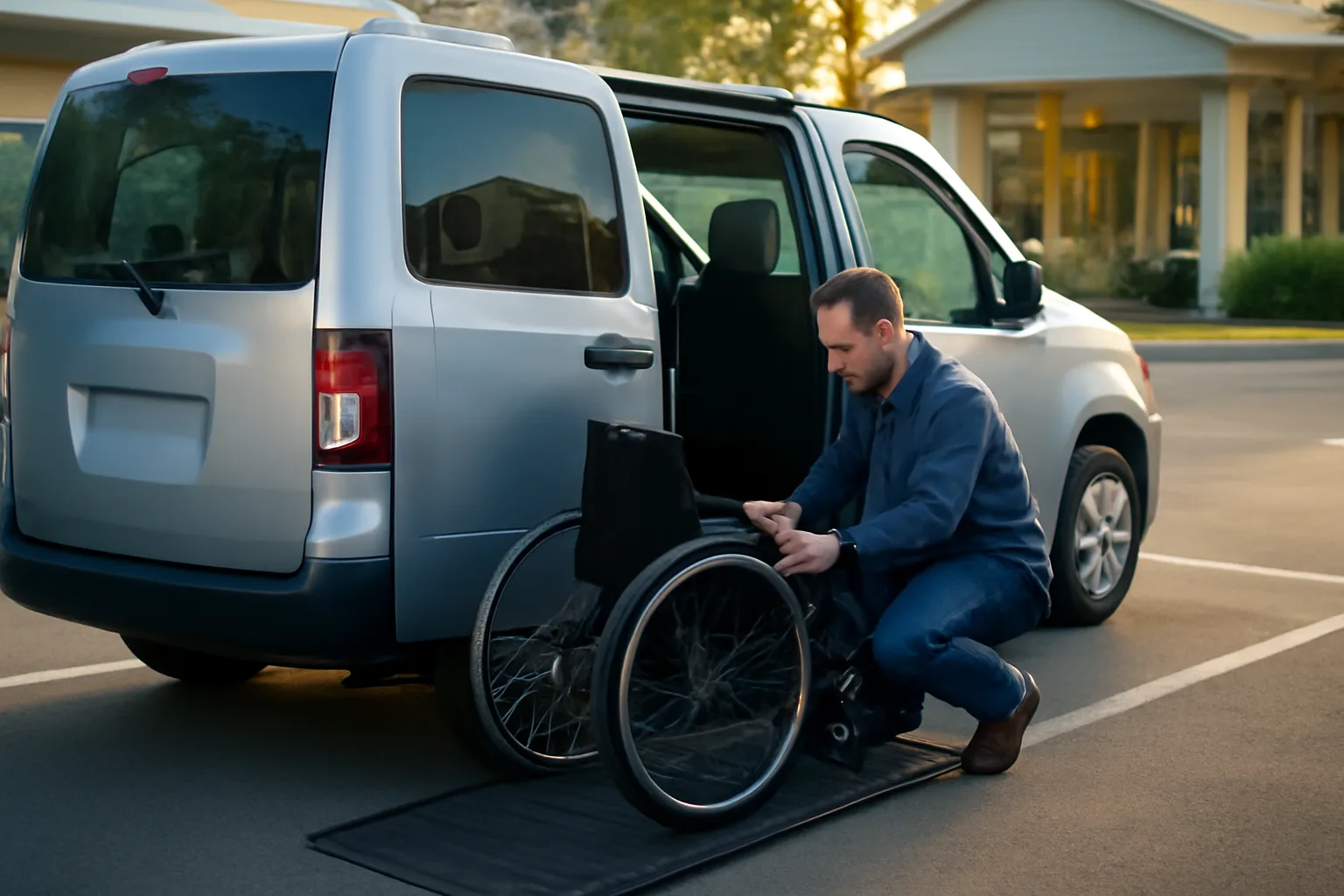
If you're running wheelchair van service, your vehicle needs to meet accessibility and safety standards, more than pass a regular state vehicle inspection. This typically means a wheelchair lift or ramp, floor-mounted wheelchair securement systems (tie-downs), an occupant restraint system for the wheelchair user, and interior clearance that meets ADA-related dimensions. Many states require an annual (or more frequent) NEMT-specific vehicle inspection separate from standard DMV registration, sometimes performed by the state Medicaid agency's transportation unit or by the broker itself before you can accept trips. Ambulette and wheelchair van conversions typically run from roughly $30,000 to $60,000+ depending on whether you're buying new or converting a used minivan or full-size van, though exact costs depend heavily on your vehicle choice and local conversion shop. Brokers often require documentation showing the wheelchair securement system meets industry standards (commonly referenced against SAE or WC19 standards for wheelchair tie-down and occupant restraint systems) before they'll approve a vehicle for their network. Keep every inspection and maintenance record; brokers audit vehicle files regularly and a missing inspection sheet is a common reason for a suspended contract. For buyers deciding between a used retrofit and a new accessible van, non emergency medical transportation services covers service-model tradeoffs that affect which vehicle type makes sense.
How do you enroll as a Medicaid NEMT provider in your state
Every state Medicaid agency runs its own provider enrollment process, and most publish it through a dedicated transportation or NEMT unit page. The general pattern: submit a provider enrollment application (often through the same portal used for other Medicaid providers), pass a background check for the business owner and drivers, submit proof of insurance and vehicle inspection, and in some states post a surety bond. CMS requires state Medicaid programs to screen and enroll providers under a risk-based system described in 42 CFR Part 455, Subpart E, which sorts provider types into limited, moderate, or high screening risk categories [4]. Transportation providers are commonly placed in the moderate or high category in many states because of historical fraud concerns in NEMT billing, which can mean fingerprint-based background checks and site visits as part of enrollment. Confirm your state's specific screening level and required documents directly with your state Medicaid agency, since this detail is state-specific and changes periodically. Processing time varies widely: some states process complete NEMT provider applications in a matter of weeks, others take a few months, especially if a site visit or fingerprint background check is required. Build a real cushion into your launch timeline rather than assuming a fast turnaround. Once you're Medicaid-enrolled, you generally still need to separately credential with whichever broker manages trip dispatch in your area, because Medicaid enrollment alone usually doesn't put you into a broker's active driver network.
What is broker credentialing and why is it a separate step from Medicaid enrollment
Most states don't have Medicaid case managers dispatching rides directly; they contract with a regional transportation broker like Modivcare, MTM, Access2Care, or SafeRide to manage trip scheduling, driver assignment, and payment. Being an enrolled Medicaid provider gets you eligible to bill Medicaid; being credentialed with the broker is what actually gets you trips. Broker credentialing typically requires its own application, its own copy of your insurance certificates naming the broker as an additional interested party, its own vehicle inspection or photo documentation, and its own driver roster with background check results. Some brokers also require a orientation session or a compliance test before activating your account. Requirements and portals differ by broker and by state contract, so confirm current specifics with the broker's provider services line and your state Medicaid transportation unit rather than relying on generic guidance. A practical reality: many new operators pass Medicaid enrollment fine and then get stuck for weeks in broker credentialing because a document was formatted wrong or an insurance certificate didn't list the broker correctly. Keep a single folder with every current document (COI, vehicle inspection, driver files, W-9, business license) so you're not scrambling every time a broker asks for a resubmission. This two-layer system (state Medicaid enrollment plus separate broker credentialing) is the single most misunderstood part of starting an NEMT business, and it's exactly what a ridecredential.com State + Broker NEMT Launch Kit is built to walk you through in one place, with state-specific checklists and broker document templates, for a $199 one-time cost rather than piecing it together from scattered PDFs. Find it at /launch-kit-builder.
How to start a medical transportation business with one van
You can absolutely start with a single wheelchair van; plenty of owner-operators do. The requirements don't shrink much just because your fleet is one vehicle, but the process is manageable if you sequence it right. Start with the entity and insurance first, since you can't get a vehicle inspection or broker application approved without proof of commercial auto and general liability coverage in place. Buy or convert your van to meet accessibility standards before you schedule any state inspection, because a failed inspection just costs you time. Apply for Medicaid enrollment and broker credentialing in parallel where your state allows it, since both processes can take weeks and there's no reason to run them sequentially if the applications don't depend on each other. Be realistic about driver capacity: with one van and one driver, you can't cover the trip volume a broker might expect from an "active" provider in some contracts, so ask the broker directly what minimum availability or trip-acceptance rate they expect before you commit. Some brokers are fine with small, part-time providers in less-served rural areas; others prioritize providers who can guarantee broader coverage. Don't let the one-van scale fool you into skipping paperwork, brokers and state auditors hold a one-van operator to the same documentation standard as a twenty-van company.
How much does it cost to get all this in place
| LLC formation | $50-$500 | State Secretary of State filing fee, varies by state | |
|---|---|---|---|
| Commercial auto + general liability insurance | Varies widely by state, driver history, and coverage limits | Confirm with a commercial NEMT-experienced broker | |
| Wheelchair van (new or converted) | ~$30,000-$60,000+ | Depends on new vs. used base vehicle and lift/ramp type | |
| State Medicaid provider enrollment | Often no fee, some states require a surety bond | Confirm current fee and bond requirement with your state Medicaid agency | |
| Broker credentialing | Typically no direct fee, but requires documentation prep time | Confirm with each broker's provider services team | The biggest line item by far is the vehicle. The paperwork side (entity formation, enrollment, credentialing) costs comparatively little in direct fees but eats real time, often the equivalent of several weeks of a person's part-time attention chasing documents and follow-up calls. |
Costs vary a lot by state and vehicle choice, but here's a rough shape of where the money goes. | Cost category | Typical range | Notes |
How long does the whole process take from zero to your first trip
For a well-prepared applicant, a realistic range is 6 to 12 weeks from having your entity and insurance in place to your first dispatched trip, though this varies a lot by state and by how quickly your broker processes credentialing. Add extra time if you're also sourcing and converting a vehicle, since that alone can take 4 to 8 weeks depending on availability. The slowest parts are usually background check turnaround (can take a few weeks depending on the state's fingerprint processing backlog) and any required site visit or vehicle inspection scheduling. Build in buffer time rather than assuming best-case timelines, and confirm current processing times directly with your state Medicaid agency's transportation unit, since these numbers shift with staffing and application volume. A common mistake: buying the van before confirming the exact accessibility specs your state and broker require. Converting a van that doesn't meet the securement standard your broker expects means paying for rework, which costs more than getting the spec right up front.
What ongoing compliance requirements keep the business running
What ongoing compliance requirements keep the business running
Enrollment and credentialing aren't one-time events. Most states require annual or biennial Medicaid provider revalidation, and brokers typically require annual insurance certificate renewals, periodic vehicle re-inspections, and updated driver background checks on a rolling basis. Driver training requirements often include things like defensive driving, passenger assistance and wheelchair securement technique, and sometimes CPR/first aid, with specific hour requirements varying by state. Keep training certificates current and on file, because a broker audit that finds an expired certificate can pull a driver (or the whole vehicle) out of rotation until it's fixed. Maintain a clean maintenance log for every vehicle. Brokers and state auditors both look for documented, regular maintenance, more than registration and insurance. A missed oil change record sounds trivial until it's the reason an audit flags your file. Finally, watch for state Medicaid program integrity and fraud-prevention updates. CMS and state Medicaid agencies have paid close attention to NEMT billing fraud over the years, and staying current on documentation and billing practices protects your enrollment status. See nemt transportation for more on operational best practices once you're up and running.
Frequently asked questions
How do you start a NEMT business from scratch?
Form an LLC, get commercial auto and general liability insurance, buy or convert a wheelchair-accessible van, enroll as a provider with your state Medicaid agency, then separately credential with the broker (Modivcare, MTM, Access2Care, SafeRide, or others) that manages trips in your area. Confirm the exact sequence and required documents with your state Medicaid agency, since steps and timing vary by state.
What is NEMT?
NEMT (non-emergency medical transportation) is rides to and from medical appointments for Medicaid beneficiaries who don't need emergency care but can't drive themselves or use regular transit. Federal Medicaid rules require states to ensure this transportation is available under 42 CFR 431.53, though states differ in how they administer it, often through regional brokers.
Does Medicaid cover ambulance rides?
Yes, Medicaid covers medically necessary ambulance transport, separate from routine NEMT rides. Coverage details, prior authorization rules, and reimbursement rates are set at the state level within federal Medicaid guidelines, so specifics vary by state; confirm current rules with your state Medicaid agency.
Does Medicare cover medical transportation?
Original Medicare Part B covers ambulance service when other transportation could endanger your health, per Medicare.gov, but it generally doesn't cover routine non-emergency rides to a doctor's office. Some Medicare Advantage plans offer limited supplemental NEMT rides as an extra benefit, contracted separately from state Medicaid NEMT programs.
What is non-emergency medical transportation exactly, in plain terms?
It's a ride to a medical appointment for someone who's stable but can't get there on their own, often because of a wheelchair, disability, or recovery from surgery. It covers wheelchair van, ambulatory sedan, and stretcher van trips, and it's a required Medicaid benefit in every state, though not an ambulance-level service.
Can you start a medical transportation business with just one van?
Yes, many owner-operators start with a single wheelchair van. The entity, insurance, vehicle, Medicaid enrollment, and broker credentialing requirements don't shrink much for one vehicle, but ask your broker directly about minimum trip-acceptance or availability expectations before committing, since some brokers prioritize providers who can cover more volume.
How much does it cost to start a wheelchair van NEMT business?
LLC formation typically runs $50 to $500 depending on the state. A new or converted wheelchair van commonly costs $30,000 to $60,000 or more. Medicaid enrollment fees vary (some states require a surety bond), and broker credentialing typically has no direct fee but requires real time to prepare documentation.
How long does it take to get Medicaid NEMT enrollment and broker credentialing approved?
A realistic range is 6 to 12 weeks for a well-prepared applicant, though this depends heavily on your state's background check processing time, whether a site visit or vehicle inspection is required, and how quickly the broker processes your file. Confirm current timelines with your state Medicaid agency and broker.
Do you need a separate business license from your state, or does Medicaid enrollment cover that?
You need both. Medicaid provider enrollment doesn't replace your state or local business license, LLC registration, or (in some states) a for-hire vehicle or transportation network permit through the Department of Transportation. Confirm which additional licenses apply in your city and county.
What insurance does a NEMT wheelchair van business need?
At minimum, commercial auto insurance (not a personal auto policy) and general liability coverage, with limits that meet your state Medicaid and broker requirements. Brokers typically require you to name them as an additional interested party on your certificate of insurance. Confirm required coverage limits with your state Medicaid agency and each broker you plan to work with.
What's the difference between Medicaid enrollment and broker credentialing?
Medicaid enrollment makes you an approved provider eligible to bill Medicaid for transportation services. Broker credentialing is a separate process with companies like Modivcare or MTM that actually assigns you trips in a region. You typically need both, and they have separate applications, document requirements, and renewal cycles.
Does every state use a transportation broker for Medicaid NEMT?
Most states use a broker model for at least part of their NEMT program, but the structure varies: some states run NEMT directly through managed care plans, some use a single statewide broker, and some use different regional brokers by county. Confirm your state's specific model with its Medicaid transportation unit.
What vehicle standards does a wheelchair van need to meet for Medicaid trips?
Typically a wheelchair lift or ramp, floor-mounted securement (tie-down) systems, and occupant restraints meeting recognized standards, plus passing a state or broker vehicle inspection, often on an annual basis. Exact accessibility and inspection requirements vary by state, so confirm specifics before buying or converting a vehicle.
Sources
- eCFR, 42 CFR 431.53 (Assurance of transportation): States must ensure necessary transportation for Medicaid beneficiaries to and from providers
- Medicaid.gov, Medicaid benefits: Transportation, including ambulance service, is part of the Medicaid benefit structure states must address
- Medicare.gov, Ambulance services: Medicare Part B covers ambulance service when other transportation could endanger the patient's health
- eCFR, 42 CFR Part 455 Subpart E (Provider screening and enrollment): CMS requires state Medicaid programs to screen and enroll providers under a risk-based categorization system
- Medicaid.gov: Non-Emergency Medical Transportation (NEMT) is a required Medicaid benefit that helps beneficiaries get to medical appointments when they have no other means of transportation.
- Electronic Code of Federal Regulations (eCFR): Interstate commercial motor vehicle operations, including passenger transport, are subject to federal safety regulations administered by the FMCSA.
- Electronic Code of Federal Regulations (eCFR): Vehicles used for passenger transport, including wheelchair vans, must meet federal parts and accessories safety requirements.
- U.S. Small Business Administration: Before enrolling in Medicaid as an NEMT provider, a business must first register its legal business structure such as an LLC or corporation.
- Internal Revenue Service (IRS): A new medical transportation business must obtain an Employer Identification Number (EIN) as part of its legal setup before enrolling with payers.