Last updated 2026-07-25
TL;DR
Starting a medical transportation business means picking a lane (usually NEMT, not ambulance), forming an entity, getting the right vehicle and driver credentials, enrolling as a state Medicaid transportation provider, and then credentialing with the broker that manages rides in your area (Modivcare, MTM, or a state-specific broker). Most owner-operators start with one wheelchair van and add vehicles later.
How do you start a medical transportation business?
You start by deciding what kind of medical transportation you're actually running, because that decision drives every license and contract that comes after it. Ambulance service (emergency or emergency-capable) requires EMS licensure through your state's EMS office, paramedic or EMT staffing, and a much heavier regulatory load. Non-emergency medical transportation, or NEMT, moves people who don't need clinical care in transit: dialysis patients, wheelchair users going to appointments, people without a car who qualify for Medicaid-covered rides. Most new owner-operators buying a wheelchair van are building an NEMT business, not an ambulance company, and this article is written for that path. The rough sequence looks like this: form a legal entity, get commercial auto and general liability insurance, buy or lease a compliant wheelchair-accessible vehicle, get the required driver background checks and training, register with your state Medicaid agency as an NEMT provider (or apply through your state's managed transportation broker), and then credential with whichever broker actually dispatches rides in your service area. Some states run NEMT through a single statewide broker; others let counties or managed care plans each pick their own. You have to check both. Don't skip the business fundamentals because the transportation part feels more urgent. You need a business entity (LLC is standard for liability separation), an EIN from the IRS, and in most states a for-hire or livery permit from your state Department of Transportation or Department of Motor Vehicles before Medicaid will even look at your application. Medicaid provider enrollment applications commonly ask for your entity's tax ID, NPI number, and proof of vehicle and liability insurance up front, so get those in order before you start the paperwork chain.
What is NEMT?
NEMT stands for non-emergency medical transportation. It's Medicaid-funded (and sometimes Medicare Advantage or private-pay) transportation for people who need to get to medical appointments, dialysis, therapy, or pharmacy visits but don't need an ambulance or EMT-level care during the ride. Federal Medicaid rules actually require states to provide this. Federal regulation at 42 CFR 431.53 requires state Medicaid plans to "ensure necessary transportation for beneficiaries to and from providers" and to describe the methods they'll use to do it [1]. That's the legal backbone that created the entire NEMT industry: states have to get Medicaid enrollees to their care, and most states hire brokers to run that logistics instead of doing it in-house. NEMT rides range from ambulatory sedan trips (a beneficiary who can walk to the car) up to wheelchair van trips and stretcher van trips for people who can't sit upright or transfer easily. Each mode has different vehicle and equipment requirements, and brokers usually credential each mode separately, so a wheelchair-van-only fleet won't automatically be approved to run ambulatory sedan trips or vice versa. If you're deciding what to buy first, read up on non emergency medical transportation and NEMT transportation basics before you commit to a vehicle type.
How to start a NEMT business (the licensing and entity steps)
Start with the boring stuff, because Medicaid and brokers will ask for it before they ask about your van. Form an LLC or corporation in your state (filing fees typically run $50 to $500 depending on the state), get an EIN from the IRS at no cost, and open a dedicated business bank account. Get a National Provider Identifier (NPI) through the National Plan and Provider Enumeration System; it's free and most state Medicaid systems require it for enrollment. Next, check whether your state requires a separate for-hire vehicle permit or livery license from the DMV or Department of Transportation, independent of Medicaid enrollment. Many states do. This is a state-by-state variable with no single national answer, so confirm the exact permit name and fee with your state Medicaid transportation unit and your state DOT before you assume you're covered. Then line up insurance. You'll need commercial auto liability that specifically covers passenger-for-hire or NEMT use (a personal auto policy or standard commercial policy often excludes this), and most brokers require general liability limits in the range of $1,000,000 per occurrence, though exact minimums vary by broker and by state contract. Get quotes early; NEMT-specific commercial auto coverage is a narrower market than regular commercial auto, and bind time can take longer than you'd expect. Finally, get your driver-side paperwork moving in parallel: state and possibly FBI background checks, a driving record pull, drug testing enrollment if required, and any state-mandated passenger assistance or wheelchair securement training. Background check turnaround alone can add two to four weeks depending on your state's process, so start it the same week you file your LLC, not after.
How to start a medical transportation business with one van
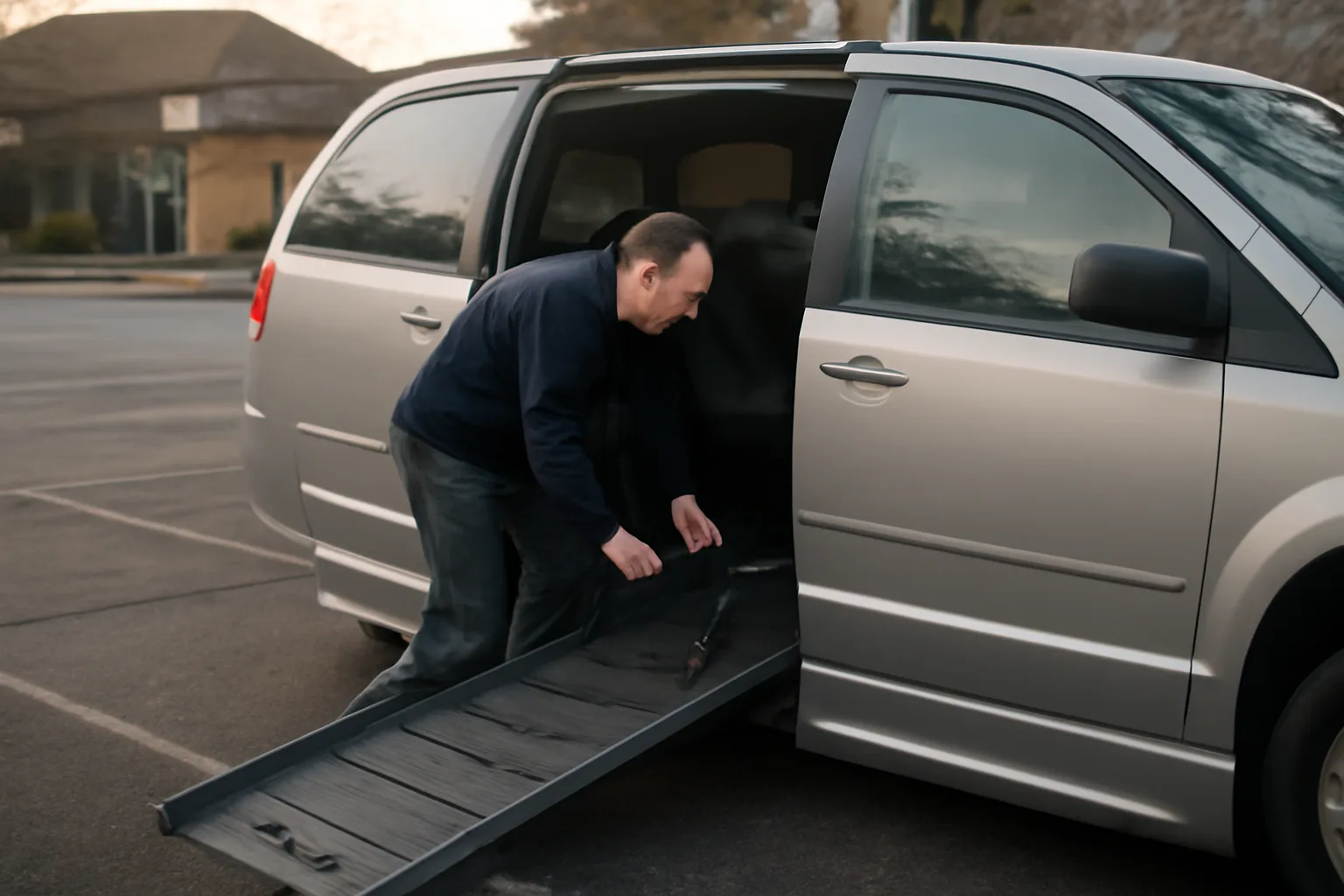
One van is a completely normal, sane way to start. You don't need a fleet to get Medicaid-enrolled or broker-credentialed; you need one compliant vehicle, one qualified driver (which can be you), and clean paperwork. Buy or convert a wheelchair-accessible van that meets ADA-style securement standards: a working ramp or lift, four-point wheelchair tie-downs, and a shoulder/lap belt system for the wheelchair occupant. Many owner-operators buy a used, already-converted van from a mobility dealer rather than paying for new conversion, since a quality used conversion (Braun, BraunAbility, VMI, or similar) often runs meaningfully less than a new build while still passing broker vehicle inspections. Whatever you buy, the vehicle will need to pass a physical inspection by the broker or state before you're approved to run trips, so don't buy something you haven't confirmed against your broker's written vehicle standards. With one van, you'll typically enroll as a solo owner-operator provider rather than an agency with dispatch staff. That's fine for state Medicaid enrollment; the state doesn't care how many vehicles you run, only that the one you have is compliant and insured. Brokers sometimes have minimum fleet expectations in certain markets, so ask directly whether solo, one-van providers are being onboarded in your service area right now, because some regions pause new provider enrollment when they have enough capacity. One real constraint: with a single van you can't take a trip while that van is in the shop, and brokers track no-show and late rates closely. Build slack into your own schedule assumptions, and have a plan (a backup rental agreement, a second driver) for the days your only vehicle is down.
How do you enroll as a Medicaid NEMT provider in your state?
Every state Medicaid agency runs its own enrollment process, and there is no single national NEMT provider application. Medicaid.gov confirms that non-emergency medical transportation is generally a required Medicaid benefit but that "states have flexibility in how they provide NEMT services," including running it directly, through a broker, or through managed care plans [2]. That flexibility is exactly why you can't shortcut this by reading one federal page; you have to go to your specific state Medicaid transportation unit's page and pull the current provider enrollment packet. Generally you'll submit: your entity and EIN documentation, NPI, proof of vehicle insurance and inspection, driver background check results, and sometimes a site visit or vehicle inspection scheduled by the state or its contracted broker. Processing time varies widely by state and by how backlogged the enrollment unit is; some states publish target turnaround times of a few weeks, others take considerably longer, so confirm current timelines directly with your state Medicaid transportation unit rather than assuming a number. A meaningful share of states have moved Medicaid NEMT management to regional or statewide brokers (Modivcare and MTM are the two largest nationally, with some states running Access2Care, SafeRide, or a state-built system instead). In broker states, you often can't get Medicaid reimbursement for NEMT trips at all unless you're also credentialed with the broker, because the broker is the entity actually authorizing and paying for rides, not the state directly. That's why this business has two separate enrollment tracks that both have to be done, not one.
How does broker credentialing work with Modivcare, MTM, and similar companies?
Broker credentialing is the second, separate approval process you need after (or sometimes alongside) state Medicaid enrollment, and it's run by the private broker that holds the state's transportation management contract, not by the state itself. Each broker (Modivcare, MTM, Access2Care, SafeRide, or a regional broker) has its own vendor application, its own vehicle inspection checklist, its own insurance minimums, and its own driver requirements layered on top of whatever the state requires. You'll typically submit a vendor packet with your business license, insurance certificates naming the broker as an additional insured or certificate holder, vehicle photos or an in-person inspection, and driver credentials including background checks and sometimes defensive driving certification. Brokers also run their own onboarding cadence, and it isn't instant. Expect a credentialing review period measured in weeks, plus a vehicle inspection appointment, plus setup in their dispatch and payment systems before you're actually eligible to receive trip assignments. Ask your broker contact directly for current processing timelines and document requirements, since these change without much public notice and vary by state contract cycle. One detail new owner-operators miss: broker credentialing status can lapse. Insurance certificates expire, background checks need renewal on a schedule (often annually), and vehicle re-inspections are typically required on a set interval. Missing a renewal deadline can get you paused from receiving trips even after you were fully approved, so track your renewal dates like you'd track a DOT medical card. Comparing what different brokers actually require side by side before you commit paperwork time is worth doing; a state + broker document checklist (like the one in RideCredential's Launch Kit Builder) can save you from filling out the wrong version of a form twice.
Does Medicaid cover ambulance rides?
Yes, Medicaid covers ambulance transportation, but it's a distinct benefit from NEMT and has its own medical necessity standard. Ambulance transportation under Medicaid generally requires that the beneficiary's condition make other means of transportation contraindicated, meaning an ambulance is needed because of the medical situation, more than convenience [2]. Ambulance coverage typically requires the transport to go to the nearest appropriate facility able to treat the condition, and it's billed and licensed entirely differently from NEMT: ambulance services need state EMS licensure, EMT or paramedic staffing, and equipment far beyond a wheelchair van (oxygen, monitoring equipment, stretchers built for clinical transport). If you're building a wheelchair-van NEMT business, ambulance-level Medicaid coverage rules aren't the ones that apply to your trips; you're operating under the separate NEMT benefit described in the sections above. Don't confuse the two when you're pricing your business plan. An ambulance company and an NEMT company file under different provider types with Medicaid, carry different insurance, and answer to different state oversight bodies (EMS office versus Medicaid transportation unit).
Does Medicare cover medical transportation?
Medicare's coverage of transportation is narrower than Medicaid's and works differently. Original Medicare Part B covers ambulance transportation when other transportation could endanger your health, and covers it to the nearest appropriate facility, per Medicare.gov's ambulance services coverage page [3]. Medicare does not have a broad standing non-emergency medical transportation benefit the way Medicaid does; routine rides to a doctor's appointment for someone who can travel safely by car generally aren't a covered Original Medicare benefit. Where this changes is Medicare Advantage. Many Medicare Advantage plans (the private plans that replace Original Medicare) now offer supplemental non-emergency transportation benefits as a plan extra, and these vary enormously by plan and by year, so there is no single national answer to what a Medicare Advantage plan will cover. If your business model depends partly on Medicare Advantage transportation trips, you'll be contracting with each plan or its transportation vendor separately, not with Medicare itself, and you should confirm current benefit design directly with the specific plan or its broker. For a wheelchair-van startup, this means your realistic near-term revenue base is Medicaid NEMT and broker-managed trips, with Medicare Advantage supplemental transportation as a smaller, plan-specific addition you'd pursue later, not the thing you build the business around on day one.
What insurance and vehicle requirements should you expect?
| Business entity filing | State Secretary of State | $50 to $500 filing fee, varies by state | |
|---|---|---|---|
| EIN | IRS | Free, immediate online | |
| NPI | CMS/NPPES | Free | |
| Commercial auto liability | Insurer, broker contract | Often $1M CSL minimum expected by brokers | |
| General liability | Insurer, broker contract | Often $1M per occurrence expected by brokers | |
| Vehicle inspection | State or broker | Recurring, often annual | |
| Driver background check | State, broker | 2-4 weeks typical turnaround, varies | |
| Medicaid provider enrollment | State Medicaid agency | Timeline varies by state; confirm directly | |
| Broker vendor credentialing | Broker (Modivcare, MTM, etc.) | Separate from state enrollment, weeks-long review | None of these numbers are universal law; they're the pattern reported across states and broker contracts, and your specific state Medicaid transportation unit and broker are the only sources with the current, binding figures for your market. |
Expect at least three insurance policies before anyone lets you carry a passenger: commercial auto liability written for passenger-for-hire or NEMT use specifically, general liability, and in many states either workers' compensation (if you have any employees) or an equivalent coverage if you're a true sole proprietor. Broker contracts commonly require $1,000,000 combined single limit auto liability and $1,000,000 general liability as a floor, though exact numbers are set by each broker's contract and can differ by state, so treat any number you read online (including this one) as a starting estimate to confirm, not a guarantee. Vehicle requirements center on the wheelchair lift or ramp, four-point tie-down securement systems, and passenger restraint systems that meet the broker's or state's written vehicle standard. Vehicles typically need a documented inspection, sometimes annual, sometimes tied to mileage, and you'll want your maintenance records organized from day one because inspection failures over simple things (worn tie-down webbing, a lift that's slow to deploy) are a common, avoidable cause of delayed approval. Here's a rough side-by-side of what most owner-operators are juggling at the same time in year one: | Requirement | Who sets it | Typical range/detail |
How to start a non-emergency medical transportation business step by step
If you want the condensed checklist version, here's the order that avoids the most rework: 1. Decide your service type and vehicle mode (ambulatory, wheelchair van, stretcher) and confirm demand exists for that mode with your target broker before buying anything. 2. Form your LLC, get your EIN, and open a business bank account. 3. Get your NPI through NPPES. 4. Shop and bind NEMT-appropriate commercial auto and general liability insurance. 5. Buy or inspect your vehicle against your state's and target broker's written vehicle standard, not a generic ADA checklist alone. 6. Start driver background checks, drug testing enrollment, and any required passenger assistance training immediately, in parallel with steps above. 7. Submit your state Medicaid NEMT provider enrollment application. 8. Submit broker vendor credentialing applications to every broker operating in your service counties (some states have more than one). 9. Schedule and pass your vehicle inspection. 10. Track every renewal date (insurance, background checks, vehicle re-inspection) on a calendar from day one, because these approvals lapse and reapproval isn't automatic. Because state and broker rules genuinely differ, treat any generic checklist, including this one, as a skeleton to confirm against your specific state Medicaid transportation unit and your specific broker's current vendor packet. If you want a structured version of this checklist built for your exact state and broker combination, that's the whole point behind RideCredential's $199 State + Broker NEMT Launch Kit: it maps out the paperwork order so you're not filling in a form twice because you did steps 7 and 8 in the wrong sequence. For deeper background on the vehicle and equipment side before you buy, see medical transportation and NEMT overviews, and if stretcher or higher-acuity transport is part of your plan, compare that against emergency medical transport licensing, which is a materially heavier lift than NEMT.
Frequently asked questions
How much does it cost to start a medical transportation business?
Costs vary enormously by state and vehicle choice, so there's no single honest number to quote. Expect entity filing fees ($50 to $500), insurance premiums that are notably higher for passenger-for-hire coverage than personal auto, a used wheelchair-accessible van (conversion vehicles have a wide used price range), and background check and training fees. Confirm current insurance quotes and vehicle pricing locally before budgeting, since both vary by region and market.
Do I need a special license to drive a wheelchair van for Medicaid trips?
Requirements vary by state; some states require only a standard driver's license plus background check and training, others require a for-hire or livery endorsement, and some require passenger assistance or wheelchair securement certification. A commercial driver's license (CDL) usually isn't required for standard wheelchair vans under a certain passenger capacity. Confirm the exact requirement with your state DMV and your target broker.
What is NEMT and how is it different from an ambulance?
NEMT is non-emergency medical transportation for Medicaid (and some Medicare Advantage) beneficiaries who need a ride to medical care but don't need clinical care during transit. Ambulance service is for situations where a beneficiary's condition requires EMT or paramedic care en route, and it needs separate EMS licensure, staffing, and equipment. NEMT wheelchair vans don't provide medical care; they provide safe transportation and securement.
Does Medicaid cover ambulance rides?
Yes. Medicaid covers ambulance transportation when a beneficiary's medical condition makes other transportation contraindicated, meaning an ambulance is medically necessary rather than just more convenient, generally to the nearest appropriate facility. This is a separate benefit category from NEMT with its own licensing and billing rules, so it doesn't apply to standard wheelchair van NEMT trips.
Does Medicare cover medical transportation to doctor appointments?
Original Medicare Part B covers ambulance transportation when other travel would endanger your health, but it doesn't have a broad routine non-emergency transportation benefit for doctor visits. Some Medicare Advantage plans offer supplemental non-emergency transportation as an extra benefit, but this varies by plan and year, so you'd confirm coverage with the specific Medicare Advantage plan or its transportation vendor.
Can I start a NEMT business with just one van?
Yes. State Medicaid enrollment and most broker credentialing processes don't require a minimum fleet size; they require that your one vehicle and driver meet the written requirements. Some brokers occasionally pause new provider onboarding in markets with enough existing capacity, so confirm directly whether solo, one-van providers are currently being accepted in your service area.
Do I need to enroll with Medicaid and the broker separately?
In most states that use a managed transportation broker (Modivcare, MTM, Access2Care, SafeRide, or a state-specific broker), yes. State Medicaid enrollment establishes you as a recognized provider type, but the broker is usually the entity that actually authorizes, dispatches, and pays for individual trips, so broker vendor credentialing is a separate application layered on top.
How long does it take to get Medicaid NEMT provider approval?
Timelines vary widely by state and by how backlogged the enrollment unit is; some states publish target windows of a few weeks, others take considerably longer. There's no single national timeline. Confirm current processing times directly with your state Medicaid transportation unit, and expect broker credentialing on top of that to add additional weeks.
What insurance does a wheelchair van NEMT business need?
Expect to need commercial auto liability specifically written for passenger-for-hire or NEMT use (standard personal or commercial auto policies often exclude this), general liability, and possibly workers' compensation if you have employees. Brokers commonly expect liability limits around $1,000,000 per occurrence, though exact minimums are set by each broker's contract and can vary, so confirm current limits with your broker.
What vehicle requirements does a wheelchair van need to pass inspection?
Typical requirements include a functioning wheelchair lift or ramp, four-point wheelchair securement tie-downs, occupant restraint (lap/shoulder belt) systems for wheelchair users, and general vehicle safety and cleanliness standards. Brokers and states usually require a physical inspection before approval and recurring inspections afterward, often annually. Always confirm the exact written vehicle standard from your specific broker before purchasing a van.
What is the difference between NEMT and non-emergency medical transportation services more broadly?
NEMT and non-emergency medical transportation services describe the same category of trips: rides for Medicaid or Medicare Advantage beneficiaries who need transportation to care but not in-transit medical treatment. "NEMT" is the industry shorthand used in Medicaid regulations and broker contracts, while "non-emergency medical transportation services" is the fuller descriptive term used in program documents and provider directories.
Do I need a CDL to operate a NEMT wheelchair van?
Usually not for standard wheelchair vans, since most seat under the passenger threshold that triggers CDL requirements under federal and state commercial driver rules. If you're operating a larger multi-passenger vehicle or a bus-style NEMT vehicle, CDL requirements may apply. Confirm the exact passenger capacity threshold and licensing requirement with your state DMV.
Which broker should I credential with first, Modivcare or MTM?
It depends entirely on which broker holds the Medicaid transportation contract in your state and county, not personal preference. Some states use Modivcare, others use MTM, Access2Care, SafeRide, or a state-run system, and some states split contracts by region or managed care plan. Check your state Medicaid transportation unit's page to find your assigned broker before applying anywhere.
Sources
- eCFR, 42 CFR 431.53 (Assurance of transportation): Federal Medicaid regulation requires states to ensure necessary transportation for beneficiaries to and from providers
- Medicaid.gov, Non-Emergency Medical Transportation: States have flexibility in how they provide NEMT services, including direct provision, brokers, or managed care
- Medicare.gov, Ambulance Services coverage: Medicare Part B covers ambulance transportation when other transportation could endanger health, to the nearest appropriate facility
- U.S. Small Business Administration: Entrepreneurs must choose a business entity structure (LLC, corporation, etc.) as one of the legal steps to start a NEMT business
- U.S. Small Business Administration: Registering the business name and entity with state authorities is a required step when starting a medical transportation business
- Internal Revenue Service: New medical transportation businesses need to obtain an Employer Identification Number (EIN) from the IRS
- eCFR (Code of Federal Regulations): Medicare coverage of ambulance services is governed by specific federal regulations outlining conditions of coverage
- Medicaid.gov: States manage their own Medicaid provider enrollment systems, which NEMT providers must use to enroll as Medicaid transportation providers