Last updated 2026-07-26
TL;DR
A usable NEMT business plan covers your vehicle and insurance setup, driver qualifications, state Medicaid enrollment status, and broker credentialing plan (Modivcare, MTM, etc.). There's no single official template. Lenders and brokers care most about compliance readiness and cash runway, not growth forecasts. Build it around the actual paperwork you'll need to submit anyway.
What is non emergency medical transportation, exactly?
Non emergency medical transportation, usually shortened to NEMT, is transportation for people who need to get to medical appointments but don't need an ambulance or emergency care. Think dialysis three times a week, a wheelchair user going to physical therapy, or someone recovering from surgery who can't drive themselves to a follow-up visit. It covers everything from a sedan trip to a stretcher van to a wheelchair-accessible van ride. Federal Medicaid rules require states to make sure eligible people can get to and from providers, and NEMT is how most states fulfill that. The Centers for Medicare & Medicaid Services describes this as an assurance states must have in their Medicaid state plan, so that "eligible individuals have transportation to and from providers" [1]. States meet that assurance in different ways: some run it in-house, some contract with a single statewide broker, some split it by region. This is the whole reason the business exists. If you're writing a plan, this is the paragraph that goes at the top, because everything else (vehicles, drivers, insurance, broker contracts) flows from this one federal requirement and how your specific state chose to implement it. For background on how the service fits into the broader system, see medical transportation and nemt. One clarifying point trips up new owner-operators constantly. NEMT is not ambulance service, and it is not emergency transport. If your plan mixes those up, brokers and state reviewers notice immediately.
How do you start a medical transportation business?
You start by figuring out which of three doors you're walking through: state Medicaid provider enrollment, broker network credentialing, or both. Most new owner-operators need both, because in broker states you generally can't get Medicaid trip referrals without being in the broker's network, and the broker usually requires you to have (or be actively getting) state Medicaid enrollment first. The rough sequence looks like this in most states: form your business entity, get commercial auto or livery insurance on your vehicle, get your driver background checks and any required certifications done, apply for state Medicaid transportation provider enrollment, then apply for broker network credentialing with whichever company runs NEMT in your service area (Modivcare, MTM, Access2Care, SafeRide, or a state-run alternative). Some states run their own portal instead of a private broker, so confirm with your state Medicaid agency which model applies to you before assuming it's a broker state. A lot of new operators try to do broker credentialing first, thinking it's faster. It rarely is. Brokers almost always ask for proof of active state Medicaid enrollment as part of their packet, so doing state enrollment first usually saves you a resubmission cycle. Realistically, budget more time than you think. Some state Medicaid provider enrollment cycles are quoted in weeks, but backlogs, incomplete applications, and required site inspections push many operators past 60 or 90 days. Nobody has solid national data on average turnaround because every state Medicaid agency runs its own process and none publish average processing times publicly in a comparable way. Ask your state Medicaid transportation unit directly for their current timeline when you apply.
What goes in a non emergency medical transportation business plan sample?
A useful NEMT plan is not a generic small business template with the words "medical transportation" swapped in. It needs sections that map directly to what a state Medicaid agency and a broker will ask you to prove. Here's the structure that actually holds up: 1. Company overview and service area (county or region, vehicle types, ambulatory vs. wheelchair vs. stretcher capability) 2. Ownership and management (who's the responsible party for Medicaid enrollment, who holds the DOT/state PUC authority if required) 3. Vehicle and equipment plan (make, model, wheelchair lift specs, ADA compliance details, maintenance schedule) 4. Insurance plan (commercial auto liability limits, and confirm your state's minimum with your state Medicaid agency, since required limits vary widely by state and vehicle class) 5. Driver qualifications and training plan (CPR/First Aid, defensive driving, background check policy, passenger assistance training) 6. Compliance and licensing plan (state Medicaid provider enrollment status, broker credentialing status, any required state transportation network company or livery permits) 7. Operations plan (dispatch method, scheduling software or manual process, trip documentation and billing workflow) 8. Financial plan (startup costs, working capital runway, insurance and fuel cost estimates) 9. Growth plan (adding vehicles, adding broker contracts, expanding service area) Notice what's missing from that list: growth forecasts and trip-volume guesses presented as fact. You can include a cost budget (insurance, fuel, maintenance, driver pay) because those are knowable numbers. But estimating how many Medicaid trips you'll get paid for is guesswork until you have an actual broker contract with actual trip volume commitments, and even then brokers rarely guarantee volume. If a lender or SBA loan officer wants a growth estimate, be honest that it's built on assumptions, not broker-confirmed numbers.
How to start a NEMT business with one van
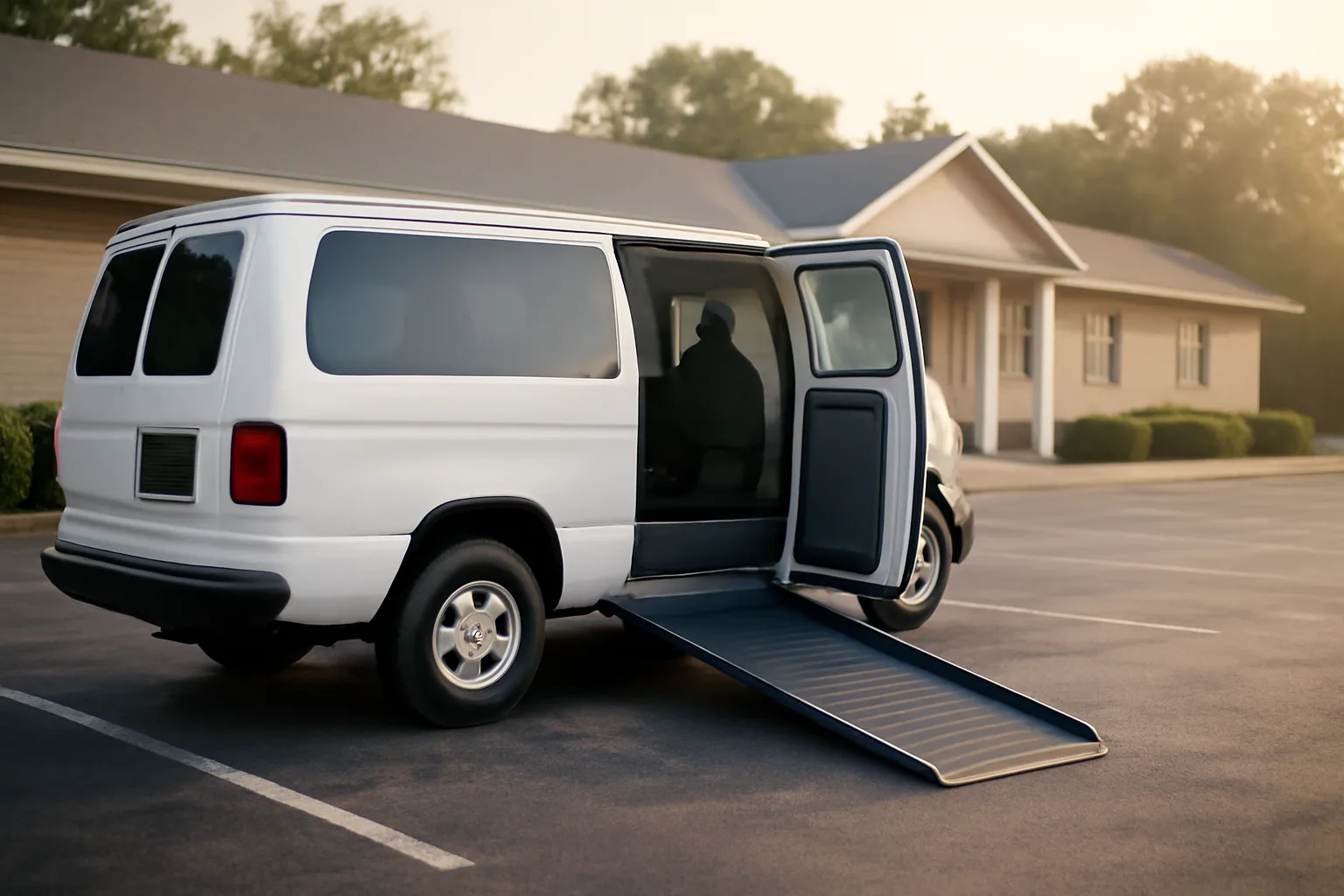
Starting with a single wheelchair van is normal and, in many states, the on-ramp. You don't need a fleet to enroll as a Medicaid NEMT provider or to get credentialed with a broker. What you do need is documentation that proves that one vehicle and its driver (often you, at first) meet every requirement a fleet would have to meet. That means: proof of ownership or lease, current registration, a wheelchair lift or ramp that meets ADA specifications, an annual vehicle inspection where your state requires one, commercial insurance naming the vehicle for hire, and a driver file with background check, driving record, and any required training certificates. The advantage of one van is that your business plan gets shorter and more concrete. Instead of describing a hypothetical fleet, you describe exactly what you own, exactly what it costs to run, and exactly how you'll cover trips if the vehicle is down for maintenance (this is a real question brokers ask, so have an answer, even if it's a backup rental arrangement or a partner owner-operator you'll subcontract to). One honest limitation: some broker contracts set minimum vehicle counts or service-area coverage expectations that a one-van operation can't meet. Confirm with your broker whether solo owner-operators are credentialed directly or whether you'd need to contract as a subcontractor under a larger transportation company in your area. This varies broker to broker and state to state, so don't assume either answer.
How to start a NEMT business (broker credentialing steps)
Broker credentialing is the process a company like Modivcare, MTM, Access2Care, or SafeRide runs to decide whether you get into their network of contracted transportation providers. Getting into the network is what actually generates Medicaid trip referrals in most brokered states. The general packet these brokers request includes: proof of business entity registration, active state Medicaid NEMT provider enrollment (or proof you've applied), commercial auto insurance certificates meeting their minimum limits, vehicle inspection records, driver background check results (often through a specific vendor the broker names), driver training certificates, and a completed provider application specific to that broker. Every broker's exact checklist differs, and brokers update their requirements periodically, so confirm the current list directly with the broker operating in your state rather than relying on a general list. Some brokers also require a facility or dispatch capability review, especially for larger fleets. One thing worth planning for: broker contracts are not guaranteed once submitted. Brokers evaluate network capacity in each region and may have closed enrollment or a waitlist if they already have enough providers covering your area. Ask upfront whether the broker is actively recruiting new providers in your specific county or zip code before you sink money into credentialing paperwork. For a deeper look at how brokers structure their networks, see nemt transportation and non emergency medical transportation services.
Does Medicaid cover ambulance rides?
Yes. Medicaid covers ambulance transportation when it's medically necessary, but that's a separate benefit category from NEMT. Ambulance service is for emergency transport or medically necessary transport where the person's condition requires medical monitoring or equipment during the ride. NEMT is for people who need a ride to a covered service but don't need ambulance-level care during transport. CMS guidance groups these under different program rules: emergency ambulance transportation is generally covered as a Medicaid benefit tied to medical necessity documented by a provider, while non-emergency transportation (including NEMT) is covered under the states' obligation to "ensure necessary transportation" for beneficiaries to get to covered Medicaid services [1]. If you're building a plan for a wheelchair-van NEMT operation, don't blur these two categories together. Ambulance providers need EMT/paramedic staffing, different vehicle certification, and typically a different state licensing track (often through the state EMS office, not the state Medicaid transportation unit). If a reader of your plan (a lender, a partner, a broker reviewer) sees ambulance and NEMT conflated, it signals you don't yet understand the regulatory lines, which hurts credibility fast.
Does Medicare cover medical transportation?
Medicare's coverage of medical transportation is narrower than Medicaid's, and this matters if any of your future passengers are dual-eligible (covered by both programs). Original Medicare Part B covers ambulance transportation when other transportation could endanger the person's health, subject to Medicare's medical necessity and payment rules [2]. Medicare does not generally cover routine non-emergency transportation the way state Medicaid NEMT programs do. Some Medicare Advantage plans offer supplemental non-emergency transportation benefits as an extra plan feature, but that's plan-specific and not a standard Original Medicare benefit. If you plan to contract with Medicare Advantage plans directly (separate from state Medicaid broker work), you'll need to check each plan's transportation benefit and provider network rules individually, since there's no single federal enrollment path for that the way there is for Medicaid. For a business plan, keep this section short and factual: state which payer sources you intend to serve at launch (state Medicaid via broker, private pay, Medicare Advantage supplemental transportation, or a combination) and don't assume Medicare referrals will function like Medicaid broker referrals, because the enrollment and credentialing paths are different.
What licenses and permits does a NEMT plan need to document?
| Business entity registration | State Secretary of State | LLC or corporation, confirm requirement with your state | |
|---|---|---|---|
| State Medicaid NEMT provider enrollment | State Medicaid agency | Often through the state's Medicaid Management Information System (MMIS) provider portal | |
| Broker network credentialing | Modivcare, MTM, Access2Care, SafeRide, or state alternative | Separate from state enrollment, confirm which broker(s) operate your service area | |
| Commercial auto/livery insurance | State DMV or insurance regulator, and broker | Minimum limits vary by state and vehicle class | |
| Vehicle inspection/ADA lift certification | State DOT or state Medicaid transportation unit | Annual inspection common, confirm frequency | |
| Driver background check | State-required vendor or broker-required vendor | May include fingerprinting depending on state | |
| Driver training (CPR/First Aid, passenger assistance) | Broker or state requirement | Certification validity period varies | |
| State transportation network or livery permit | State PUC or transportation regulator | Some states exempt Medicaid NEMT from separate for-hire permitting, others don't | Confirm every row of this table with your specific state Medicaid transportation unit and your target broker before finalizing your plan, since requirements change and vary by state. |
Your plan should list every license, registration, and certification your state and broker will ask to verify, more than describe them in general terms. Requirements vary significantly by state, so treat the following as a checklist to confirm, not a fixed national list. | Requirement | Who verifies it | Notes |
How do you build the financial section without inventing revenue numbers?
The honest way to handle finances in a NEMT plan is to be precise about costs, which you can actually know, and cautious about revenue, which you can't know until you have a signed broker contract. Cost items you can nail down: vehicle purchase or lease payment, commercial insurance premium, fuel, routine maintenance, driver wages or your own owner-operator draw, background check and training fees, and any state or broker application fees. For the revenue side, resist the urge to estimate a number of trips per week or a per-trip reimbursement rate as if it's guaranteed. Broker reimbursement rates and trip volume depend on your specific broker contract, your service area's demand, and factors outside your control (like how many other providers the broker already has under contract in your zip code). If a lender requires a revenue estimate, label it clearly as an assumption, show your math, and note the sources you used (state Medicaid fee schedule, if published, or direct quotes from the broker) rather than presenting a number as fact. A more useful financial exercise for a new owner-operator: calculate your monthly break-even cost (insurance, loan payment, fuel, maintenance reserve) and compare it against your published state Medicaid mileage or trip rate, if your state Medicaid agency publishes one. Some states do publish NEMT fee schedules; check your specific state Medicaid transportation unit's website for the current rate sheet rather than relying on outdated numbers found elsewhere online.
What operations details does the plan need to cover?
Brokers and state reviewers care about how you'll actually run trips day to day, more than what you own on paper. Cover dispatch method (a broker's own scheduling app, a third-party NEMT dispatch software, or manual phone/text scheduling for a solo operator), how you'll document trip completion (electronic visit verification or paper trip logs, depending on what your state and broker require), how you'll handle no-shows and late cancellations, and your backup plan if your vehicle breaks down mid-route. Many states and brokers now require or strongly prefer electronic visit verification (EVV) for certain Medicaid-funded services. Confirm with your state Medicaid agency whether EVV applies to NEMT trips in your state specifically, since EVV mandates under the 21st Century Cures Act were initially focused on personal care and home health services, and NEMT's inclusion varies by state [3]. Also plan out your complaint and incident reporting process. Brokers require providers to report accidents, passenger incidents, and complaints within specific timeframes, often 24 to 72 hours depending on severity and the broker's own policy. Missing a reporting deadline is one of the more common reasons providers get flagged for review, so build this into your operations section as a concrete written procedure, not an afterthought.
How much does it cost to get NEMT-ready before you ever see a trip?
Startup costs vary enormously by state, vehicle condition, and whether you're buying new or used, so don't trust a single national number quoted anywhere as gospel. What you can budget for with more confidence are the recurring compliance costs: commercial insurance premiums (typically higher for wheelchair-accessible vehicles than standard livery due to lift liability), state Medicaid provider enrollment application fees (some states charge none, others charge a modest one-time or annual fee, confirm with your state Medicaid agency), broker credentialing fees (many brokers don't charge to apply, but some require paid background check vendors), and driver training/certification costs (CPR/First Aid courses commonly run in the range of $50 to $150 per person depending on the provider and region, though this varies). A wheelchair-accessible van itself, new or used with a certified lift conversion, is usually the single largest expense, and prices vary widely based on age, mileage, and lift type. Rather than plug in a guessed number, get quotes from actual wheelchair van dealers or conversion companies in your state and use those real figures in your plan. If you want a starting framework instead of building every checklist from scratch, a packaged resource like the $199 State + Broker NEMT Launch Kit walks through the state enrollment and broker credentialing paperwork sequence so you're not guessing at the order of operations. It's not a substitute for your state's actual application or a broker's actual contract, but it can save you from missing a required document on your first submission.
What's the difference between state Medicaid enrollment and broker credentialing?
State Medicaid enrollment and broker credentialing are two separate approvals, and confusing them is probably the single most common mistake new NEMT owner-operators make in their planning. State Medicaid enrollment means your business is registered as a Medicaid provider with your state's Medicaid agency, usually through the state's MMIS provider enrollment portal, and it's what makes you eligible to bill Medicaid at all. Broker credentialing is a private company's internal vetting process to let you into their contracted provider network. States that use a broker model (many do, using companies like Modivcare, MTM, Access2Care, or SafeRide) route Medicaid NEMT trip referrals through that broker rather than letting individual owner-operators bill Medicaid directly for NEMT trips. CMS explicitly allows states to use "a broker to arrange non-emergency transportation" as one method of meeting the transportation assurance requirement [1], but it doesn't mandate a single national broker model, which is why the landscape looks different state to state. Some states run the trip brokerage function themselves through a state agency or regional transit authority instead of contracting it out. Practically, this means your business plan needs a subsection for each: one describing your state Medicaid enrollment status and timeline, and a separate one describing which broker(s) operate your service area and where you are in their credentialing process. See nemt and emergency medical transport for how these categories are treated differently across states.
Frequently asked questions
What is NEMT?
NEMT stands for non emergency medical transportation. It's transportation for Medicaid (and sometimes Medicare Advantage) beneficiaries who need rides to medical appointments but don't require ambulance-level care during transport. It covers ambulatory sedan trips, wheelchair-van trips, and stretcher-van trips, and states must ensure it's available under federal Medicaid transportation assurance rules [1].
How do you start a medical transportation business?
Form your business entity, secure a properly equipped and insured vehicle, get your driver background checks and training done, then apply for state Medicaid NEMT provider enrollment and broker network credentialing (Modivcare, MTM, Access2Care, SafeRide, or your state's alternative). Order matters: most brokers require proof of active state Medicaid enrollment before they'll credential you, so start there first.
How to start a NEMT business with just one van?
You can enroll and credential a single-vehicle operation in most states. You'll need proof of ownership, an ADA-compliant wheelchair lift if applicable, commercial insurance naming the vehicle, a driver file with background check and training, and a plan for coverage if your one vehicle is out of service. Confirm with your broker whether solo operators are credentialed directly or must subcontract.
Does Medicaid cover ambulance rides?
Yes, Medicaid covers medically necessary ambulance transportation, but that's a distinct benefit category from NEMT with different licensing (usually through a state EMS office rather than the state Medicaid transportation unit). Emergency and medically necessary ambulance transport is covered separately from the non-emergency ride assurance that funds NEMT programs [1].
Does Medicare cover medical transportation?
Original Medicare Part B covers ambulance transportation when other transport methods would endanger the person's health, under Medicare's medical necessity rules [2]. Original Medicare generally does not cover routine non-emergency rides the way state Medicaid NEMT programs do, though some Medicare Advantage plans offer supplemental non-emergency transportation as an added plan benefit.
What is non emergency medical transportation?
Non emergency medical transportation is rides to and from covered medical services for people who don't need ambulance-level care in transit. It ranges from ambulatory sedan trips to wheelchair-van and stretcher-van trips, and it's a federally required part of most state Medicaid programs' transportation assurance [1].
How to start a non-emergency medical transportation business step by step?
Register your business entity, get commercial insurance and a properly equipped vehicle, complete driver background checks and required training, apply for state Medicaid NEMT provider enrollment, then apply for broker credentialing in your service area. Build your business plan around these exact compliance steps rather than a generic startup template.
Do I need a CDL to drive a wheelchair van for NEMT?
Usually no, a standard driver's license is enough for most wheelchair vans, since they typically don't exceed the weight or passenger thresholds that trigger CDL requirements. Requirements vary by vehicle size and state, so confirm with your state's DMV and your target broker whether any special endorsement applies to your specific vehicle.
How long does NEMT broker credentialing take?
There's no single published national average, because each broker (Modivcare, MTM, Access2Care, SafeRide) runs its own process and timelines shift with application volume and staffing. Ask the broker operating in your state directly for their current estimated timeline, and plan for it to take longer than quoted if your paperwork is incomplete on first submission.
Can I get into a broker's network without state Medicaid enrollment first?
Generally no. Most brokers require proof of active or in-process state Medicaid NEMT provider enrollment as part of their credentialing packet, since broker trip referrals are ultimately billed against Medicaid. Confirm the exact sequence with your target broker, but starting state enrollment first is the safer order for most owner-operators.
What insurance do I need for a wheelchair van NEMT business?
You need commercial auto or livery insurance covering the vehicle for hire, and minimum liability limits vary by state and sometimes by broker contract. Confirm current minimums with your state Medicaid transportation unit and your target broker before purchasing a policy, since generic personal auto insurance will not satisfy either requirement.
Should my business plan include trip volume or revenue estimates?
Be very cautious here. You can budget known costs (insurance, fuel, maintenance, loan payments) with confidence, but trip volume and per-trip reimbursement depend on a signed broker contract and local demand, both unknown at the planning stage. If a lender requires an estimate, label it clearly as an assumption and show your sourcing rather than presenting a guessed number as fact.
Sources
- Medicaid.gov, Non-Emergency Medical Transportation: States must ensure necessary transportation for Medicaid beneficiaries to and from providers, and may use a broker model to arrange it
- Medicare.gov, Ambulance Services coverage: Medicare Part B covers ambulance transportation when other transportation would endanger the person's health, under medical necessity rules
- Medicaid.gov, Electronic Visit Verification for Personal Care and Home Health Care Services: EVV requirements under the 21st Century Cures Act apply to personal care and home health services, with state-level implementation variation
- 42 CFR 431.53, Assurance of transportation: Federal regulation requiring states to assure necessary transportation for Medicaid beneficiaries to and from providers
- 42 CFR 440.170, Transportation: Federal definition of transportation as a Medicaid service, distinguishing it from other covered benefit categories
- 21st Century Cures Act, Section 12006, Public Law 114-255: Statutory basis for Electronic Visit Verification requirements referenced for personal care and home health services
- Social Security Act Section 1902(a)(70), State plan requirements: Statutory language underlying state plan assurances, including the transportation assurance CMS implements through regulation