Last updated 2026-07-25
TL;DR
Becoming a Medicaid transportation provider means forming a business entity, getting the right insurance and vehicle inspections, enrolling directly with your state Medicaid agency (or its NEMT broker), and passing driver background checks. Most states route trips through a broker like Modivcare or MTM, so you'll likely need broker credentialing too, separate from state enrollment.
What is NEMT and how is it different from an ambulance ride?
NEMT stands for non-emergency medical transportation. It covers rides for Medicaid enrollees who need to get to a doctor's appointment, dialysis, physical therapy, or a pharmacy but don't need an ambulance or emergency care. Federal Medicaid rules require states to make sure eligible people can get to and from covered medical services, and NEMT is how that requirement gets met for non-emergency trips. The legal basis sits in federal regulation, more than state policy. Under 42 CFR 431.53, states must "ensure necessary transportation for beneficiaries to and from providers" and may do this directly, through contracts, or through broker arrangements [1]. That's the rule that created the whole NEMT industry. Ambulance transportation is a different Medicaid benefit entirely. Ambulances handle emergencies or situations where a person needs medical monitoring during transport. Medicaid does cover ambulance rides when they're medically necessary, under a separate ambulance benefit with its own billing codes and its own enrollment path through your state's Medicaid provider enrollment system [2]. If you're building a wheelchair van business, you are not applying to be an ambulance provider, and you shouldn't market yourself as one. NEMT vehicles are typically ambulatory sedans, accessible vans with a ramp or lift, or stretcher vans, not units staffed with EMTs running lights and sirens. Medicare's coverage is narrower than Medicaid's. Original Medicare generally does not cover routine rides to routine appointments. It covers emergency ambulance transportation when medically necessary and, in limited cases, non-emergency ambulance transportation with a physician's written order, but Medicare does not have a broad non-emergency van benefit the way Medicaid does [3]. Some Medicare Advantage plans add transportation as a supplemental benefit, but that's plan-specific, not a Medicare-wide rule. This is why almost every wheelchair-van owner-operator entering this space is chasing Medicaid contracts and broker credentialing, not Medicare enrollment.
How do you start a medical transportation business, step by step?
Starting a medical transportation business is really three parallel projects: building a legal, insured company; buying and equipping a compliant vehicle; and getting credentialed with the payers who actually send you trips. Skipping any one of the three is why a lot of new operators sit on a van for months with no trips. Here's the realistic order of operations: 1. Form your entity (LLC or corporation) and get an EIN from the IRS. Most states and brokers require you to bill and contract as a business, not as an individual. 2. Get your state and local operating authority sorted. Some states require a for-hire or livery permit, a motor carrier number, or a local taxi/limousine license before you can even apply for Medicaid enrollment. Requirements vary by state, so confirm with your state's department of transportation and your state Medicaid agency. 3. Buy or convert your vehicle to meet accessibility and safety standards, including wheelchair lift or ramp specs and tie-down systems. 4. Get commercial auto insurance with the liability limits your state or broker requires. Many brokers require $1 million combined single limit; some states set their own minimums for for-hire vehicles. 5. Set up driver requirements: CDL or appropriate license class, background checks, drug testing program, and any state-specific NEMT driver training or passenger assistance certification. 6. Enroll as a Medicaid provider with your state Medicaid agency, or with the regional NEMT broker if your state has moved to a brokered model. 7. Get broker credentialing (separately from state enrollment, in most brokered states) with the specific broker that manages transportation in your region, such as Modivcare, MTM, Access2Care, or SafeRide. 8. Set up your billing and dispatch process, including how you'll submit trips, get authorization numbers, and file claims or invoices. Most of this is paperwork and inspections, not capital. The one van, or the one initial approval, is often the easy part. The credentialing paperwork is what actually eats the calendar. Plan for weeks to a few months for a state Medicaid enrollment decision and additional time for broker credentialing, since timelines are set by each agency and broker and are not standardized nationally.
How do you start a NEMT business specifically, versus a general medical transportation company?
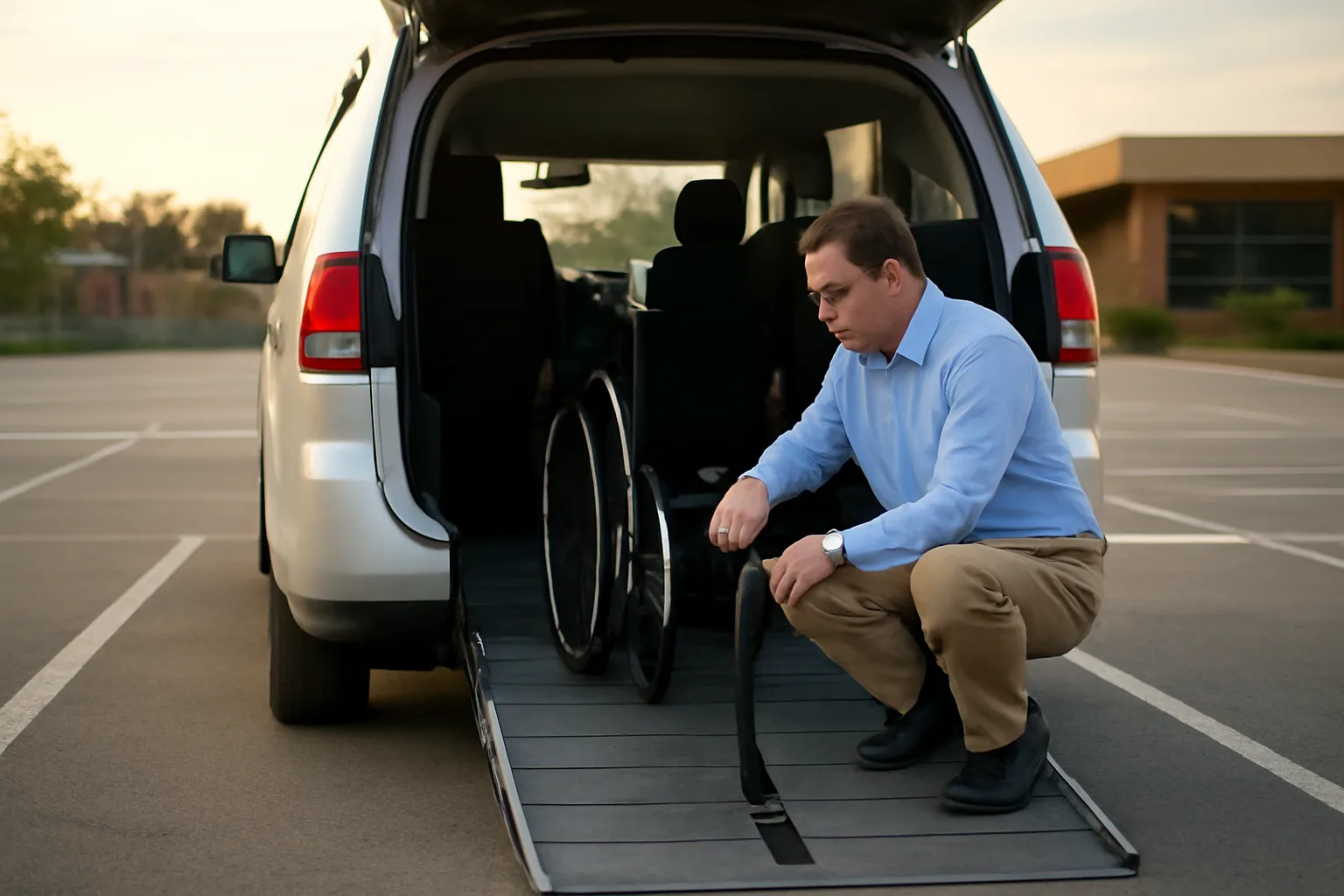
A NEMT business is a subset of medical transportation focused on non-emergency rides, wheelchair van and ambulatory transport, and it's built around one payer relationship above all others: Medicaid. If you're starting with one van and one driver (often yourself), your entire early strategy should be built around getting that single vehicle enrolled and credentialed as fast as possible, not around expansion. The practical differences from a general "medical transportation" business plan: You need your vehicle type to match what the broker or state actually dispatches. A minivan with a fold-out ramp handles ambulatory and wheelchair passengers who can transfer with help; a full-size van with a power lift and multiple tie-down positions handles more wheelchair users at once. Confirm with your broker which vehicle classes they credential (ambulatory, wheelchair, stretcher) because each one usually has separate equipment and inspection requirements. You need a Medicaid-specific driver file. Beyond a clean driving record, brokers commonly require CPR/first aid certification, a passenger assistance or sensitivity training certificate, and an updated background check, sometimes annually. States vary on whether a CDL is required; many wheelchair van operations run under a standard license since the vehicle is below CDL weight thresholds, but confirm your state's specific vehicle weight and licensing rules. You need to plan for multiple, overlapping credentialing tracks. In a brokered state, your Medicaid enrollment with the state agency and your credentialing with the broker are two different applications with two different reviewers, and approval by one does not guarantee approval by the other. For deeper background on how broker relationships work, see our guide to NEMT transportation and the broader non emergency medical transportation overview.
How do you start a non-emergency medical transportation business with just one van?
You absolutely can start with a single wheelchair van, and a lot of owner-operators do exactly that. The equipment and paperwork requirements per vehicle don't really shrink with fleet size, so a one-van operation faces the same checklist as a ten-van company, just applied once. What changes with a fleet of one is your risk exposure and your dispatch flexibility. If your one van is in the shop, you have zero capacity that day, and brokers track no-show and late-trip rates closely; a single missed pickup can hurt your standing more than it would for a company with backup vehicles. Before you commit, ask your target broker directly: how many trips per week can a single-vehicle, single-driver contractor realistically expect, what's the minimum utilization they require to stay active, and what happens to your credential status if you can't cover an assigned trip. Financially, budget beyond just the van purchase or conversion. You'll need commercial insurance (often the single biggest recurring cost for a new operator), a dedicated business bank account and bookkeeping setup for claims and reimbursement timing (Medicaid and broker payments can take weeks, not days), a phone/dispatch system compatible with whatever software the broker uses, and cash reserves to cover slow ramp-up weeks while your credentialing finishes. Nobody publishes reliable national numbers on how long a single owner-operator takes to reach steady trip volume, and any site that gives you a specific revenue estimate for this is guessing. What is knowable and worth checking before you buy: your state Medicaid agency's published enrollment fee (many states charge an application fee tied to the federal Medicare enrollment fee amount, which was $709 for calendar year 2024 under 42 CFR 424.514, adjusted annually) [4], and whether your state requires a surety bond for transportation providers.
How do you enroll as a Medicaid transportation provider with your state?
State Medicaid enrollment is the foundational credential, done through your state Medicaid agency directly, even in states where a broker handles day-to-day dispatch. You cannot skip state enrollment by only credentialing with a broker; brokers typically require proof of active state Medicaid enrollment as a precondition of their own credentialing packet. The general steps mirror any Medicaid provider enrollment: Register for an NPI (National Provider Identifier) through the National Plan and Provider Enumeration System, which is free and required for anyone billing Medicaid. Then locate your state's Medicaid provider enrollment portal, most states now use a centralized online system (many run on the MMIS platform), and select the transportation or NEMT provider type. You'll typically submit business licensing documents, vehicle registration and inspection records, insurance certificates, driver rosters with background check attestations, and your NPI and Tax ID. Some states also require a specific transportation provider agreement or attestation of compliance with Americans with Disabilities Act accessibility standards for wheelchair-accessible vehicles. Processing time is set entirely by the state; CMS does not publish a national turnaround standard for NEMT enrollment specifically, so treat any "X weeks guaranteed" claim online with suspicion. Confirm current fees, forms, and timelines directly with your state Medicaid agency's transportation or provider enrollment unit, since these details change and vary state to state. For a state-by-state starting point, see our medical transportation hub.
How does broker credentialing work with Modivcare, MTM, Access2Care, or SafeRide?
| Business entity proof | Articles of organization, EIN letter | |
|---|---|---|
| State Medicaid enrollment | Active enrollment confirmation or provider number | |
| Vehicle compliance | Registration, annual inspection, lift/ramp certification | |
| Insurance | Certificate of insurance meeting broker's minimum liability limits | |
| Driver files | License, background check, drug test, defensive driving cert | |
| Operational | Dispatch/GPS capability, W-9, direct deposit setup | Because requirements shift by state and by broker contract cycle, the only reliable move is to contact the specific broker operating in your service area and get their current provider application packet directly, then cross-check it against your state Medicaid transportation unit's requirements. Don't assume a checklist from one state's Modivcare contract matches another state's MTM contract; they don't. If you want a structured way to organize all of this paperwork across both tracks at once, that's exactly the gap our $199 State + Broker NEMT Launch Kit is built to close: a single organized packet builder for the state enrollment side and the broker credentialing side, available at /launch-kit-builder. |
About two-thirds of state Medicaid programs manage NEMT through a broker model rather than paying providers directly, according to Medicaid program integrity and transportation policy tracking by CMS and state Medicaid agencies [2]. If your state uses this model, the broker, not the state, is who actually assigns you trips, sets your per-trip or per-mile rate, and monitors your on-time and complaint metrics day to day. Each broker runs its own credentialing process, and they are not interchangeable even within the same state, since a state can contract with different brokers by region or by managed care plan. Typical broker credentialing asks for: | Requirement | Common documentation |
Does Medicaid cover ambulance rides, and how is that different from NEMT coverage?
Yes, Medicaid covers ambulance transportation when it's medically necessary, but this is a distinct benefit from the NEMT wheelchair-van and ambulatory services most owner-operators provide. Ambulance coverage requires the transport to be medically necessary, meaning other means of transportation would endanger the person's health, and it's billed under different procedure codes than NEMT trips [2]. States set their own coverage details and prior authorization rules within federal Medicaid guidelines, so "does Medicaid cover ambulance" doesn't have one national answer on things like mileage reimbursement rates or whether air ambulance is included; that's set at the state level. If your business plan includes both ambulance-level and NEMT-level services, understand that these usually require separate provider enrollments, separate vehicle and staffing standards (ambulances need licensed EMT or paramedic staff, NEMT vehicles generally don't), and separate insurance categories. Most wheelchair-van owner-operators stay entirely in the NEMT lane and never touch ambulance enrollment, which is the simpler and lower-barrier path to entering this industry.
Does Medicare cover medical transportation the way Medicaid does?
No, and this trips up a lot of new owner-operators who assume Medicare works like Medicaid here. Medicare Part B covers ambulance services when other transportation would endanger your health, and covers non-emergency ambulance transportation only with a written order from your doctor showing it's medically necessary [3]. There is no standard Medicare benefit for routine, non-emergency van or sedan rides to a doctor's appointment. The exception is Medicare Advantage. Some Medicare Advantage (Part C) plans offer transportation as a supplemental benefit, and CMS has expanded flexibility for these plans to offer non-medical transportation benefits in recent years . But this varies plan by plan and is not something you can build a business model around the way you can with a state's Medicaid NEMT contract. If you're deciding where to focus your enrollment energy as a new operator, Medicaid is the volume payer; Medicare Advantage transportation benefits are a smaller, plan-specific add-on you might pick up later, not a starting point.
What vehicle and driver requirements should you expect before you apply?
Requirements differ by state and broker, but a realistic baseline for a wheelchair-accessible vehicle includes a lift or ramp meeting accessibility standards, secured wheelchair tie-down and occupant restraint systems, a current state vehicle inspection, and commercial or livery registration where required. Some states also require a specific vehicle age limit (commonly a maximum age or mileage threshold set in the state's transportation contract) and periodic re-inspection, sometimes annually or semi-annually. On the driver side, expect a criminal background check (often run through the state's Medicaid fraud and abuse screening process or a broker-specific vendor), a motor vehicle record check, drug and alcohol testing, and CPR/first aid certification. Many brokers also require passenger assistance training that covers safely helping a wheelchair user transfer, securing mobility devices, and handling behavioral or medical emergencies during a ride. None of this is exotic, but it takes real lead time to schedule and document, so start the driver file paperwork the same week you start the vehicle paperwork, not after. Insurance deserves its own line item because it's often the most expensive recurring cost and the most commonly underestimated one. Confirm minimum liability limits with both your state's for-hire vehicle regulations and your target broker's contract; requirements of $1 million combined single limit per occurrence are common in broker contracts, though this is not universal and must be confirmed for your specific state and broker.
What does the whole process cost, roughly, before your first Medicaid trip?
There's no single national number for this because state fees, insurance markets, and vehicle prices all vary too much to average honestly. What you can plan for as line items: a state Medicaid provider enrollment fee (some states waive this for transportation providers, others charge an application fee in the low hundreds of dollars, and some tie it to the federal institutional provider fee amount, $709 for 2024 under 42 CFR 424.514) [4]; commercial insurance premiums, which are typically the largest recurring monthly cost for a new NEMT operator and vary heavily by state, driving history, and vehicle type; vehicle purchase or wheelchair-van conversion cost, which ranges enormously based on new versus used and ramp versus lift; and driver background check, drug testing, and certification fees, usually well under a few hundred dollars per driver. Do not trust any article, including this one, that gives you a specific total dollar figure for "starting a NEMT business," because state fee schedules, insurance markets, and vehicle costs change constantly and vary by region. The only trustworthy numbers are the ones you pull directly from your state Medicaid agency's current fee schedule and quotes from insurers and vehicle vendors in your actual market.
What ongoing compliance do you need to keep your Medicaid and broker status active?
Enrollment and credentialing are not one-time events. Most states require periodic revalidation of Medicaid provider enrollment, commonly every few years, and brokers typically require annual or more frequent re-verification of insurance certificates, vehicle inspections, and driver background checks. Missing a revalidation deadline is one of the most common, and most avoidable, reasons an active provider suddenly can't bill or get dispatched. Build a simple tracking system from day one: a calendar with your state revalidation date, your broker's credential renewal date, your insurance policy renewal date, and each driver's background check and certification expiration date. Brokers also track performance metrics, on-time pickup rate, no-show rate, complaint counts, and can suspend or terminate a contract for falling below their thresholds, so operational discipline matters as much as paperwork discipline once you're active. For the wider landscape of how these systems fit together, our hub pages on non emergency medical transportation services and emergency medical transport cover adjacent pieces of this industry worth understanding even if you never touch the emergency side directly.
Frequently asked questions
What is NEMT in simple terms?
NEMT means non-emergency medical transportation. It's Medicaid-funded rides, usually by wheelchair van, accessible sedan, or stretcher van, for people who need to get to medical appointments but don't need an ambulance. Federal rule 42 CFR 431.53 requires state Medicaid programs to guarantee this transportation exists for eligible enrollees, which is why nearly every state runs an NEMT program, either directly or through a contracted broker.
How do I start a medical transportation business from scratch?
Form your business entity, get vehicle and driver compliance in place (accessible vehicle, insurance, background-checked drivers), then enroll with your state Medicaid agency and get credentialed with whatever broker manages NEMT in your area. These run largely in parallel, not strictly sequentially, and each state and broker sets its own specific requirements and timelines.
How do I start a NEMT business with only one van?
You follow the same steps as a larger fleet: entity setup, vehicle compliance, driver credentialing, state Medicaid enrollment, and broker credentialing. The main difference is risk exposure. With one vehicle, you have no backup if it's out of service, so ask your target broker about minimum utilization requirements and how a missed trip affects your credential status before you commit.
Does Medicaid cover ambulance rides?
Yes, when medically necessary, meaning other transportation would endanger the person's health. Ambulance coverage is a separate Medicaid benefit from NEMT wheelchair-van services, billed under different codes, requiring licensed EMT or paramedic staff. States set their own specific coverage rules and prior authorization requirements within federal Medicaid guidelines.
Does Medicare cover medical transportation?
Original Medicare covers emergency ambulance transportation and, with a doctor's written order, some non-emergency ambulance transportation. It does not have a broad benefit for routine non-emergency van rides to appointments. Some Medicare Advantage plans add transportation as a supplemental benefit, but that varies by plan and isn't a standard Medicare feature.
What's the difference between state Medicaid enrollment and broker credentialing?
State Medicaid enrollment is your registration as a provider with the state Medicaid agency, required in every state you operate in. Broker credentialing is a separate process with the specific company (Modivcare, MTM, Access2Care, SafeRide, or others) that dispatches trips in your region under contract with the state. You typically need both, and approval by one doesn't guarantee approval by the other.
How long does Medicaid provider enrollment take for NEMT?
There's no single national timeline; CMS doesn't publish a standard NEMT enrollment turnaround, and each state Medicaid agency sets its own processing time. Confirm current expected timelines directly with your state Medicaid transportation or provider enrollment unit, since they vary by state and can change with staffing and application volume.
Do I need a CDL to drive a Medicaid wheelchair van?
Often no, because most wheelchair vans fall under standard vehicle weight thresholds that don't trigger commercial driver's license requirements. But this depends on your specific vehicle's gross vehicle weight rating and your state's licensing rules, so confirm with your state's department of motor vehicles before assuming either way.
What insurance do I need to become an NEMT provider?
Commercial auto liability insurance is required, with limits set by your state's for-hire vehicle rules and, separately, by your broker's contract. A combined single limit of $1 million per occurrence is common in broker contracts, though not universal. Confirm exact minimums with both your state Medicaid agency and your target broker before buying a policy.
How much does it cost to become a Medicaid transportation provider?
Costs vary too much by state and market for one honest total figure. Expect a state enrollment fee (some states waive it for transportation providers; others charge up to a few hundred dollars), commercial insurance premiums as your biggest recurring cost, vehicle purchase or conversion cost, and driver background check and certification fees. Confirm current fee schedules directly with your state Medicaid agency.
Can I get Medicaid NEMT contracts without going through a broker?
In some states, yes, if the state runs NEMT directly rather than through a contracted broker. Most states now use the broker model, per CMS transportation policy tracking, meaning you'll need broker credentialing in addition to state enrollment. Check with your specific state Medicaid transportation unit to see which model your state uses.
What happens if I don't renew my Medicaid enrollment or broker credential on time?
You risk losing your ability to bill Medicaid or receive dispatched trips until you're reinstated, which can take additional processing time. Most states require periodic revalidation (commonly every few years) and brokers require regular re-verification of insurance, inspections, and driver files, often annually. Missing these deadlines is one of the most common causes of a sudden loss of active status.
Sources
- eCFR, 42 CFR 431.53 - Assurance of transportation: States must ensure necessary transportation for Medicaid beneficiaries to and from providers
- Medicaid.gov, Non-Emergency Medical Transportation: Medicaid transportation benefits and coverage overview, distinguishing NEMT from ambulance services
- Medicare.gov, Ambulance Services coverage: Medicare covers emergency ambulance transportation and limited non-emergency ambulance transportation with a doctor's written order
- eCFR, 42 CFR 424.514 - Application fee: Federal provider enrollment application fee was $709 for calendar year 2024
- eCFR (42 CFR 424.518): Screening levels (limited, moderate, high) determine background checks and site visits required for enrolling provider types, including transportation companies.
- Federal Motor Carrier Safety Administration: Non-emergency medical transportation vehicles operating across certain thresholds may need a USDOT number, relevant to vehicle and driver requirements.
- Medicaid.gov CMCS Informational Bulletin: CMS guidance on non-emergency medical transportation program integrity and broker arrangements informs how states manage NEMT broker credentialing and oversight.
- eCFR (42 CFR 440.170): Defines transportation and related travel expenses as an optional Medicaid benefit that states may cover, distinguishing NEMT from ambulance services.
- eCFR (42 CFR 410.40): Establishes Medicare coverage conditions for ambulance services, contrasting with Medicaid's broader NEMT coverage.