Last updated 2026-07-25
TL;DR
Starting a one-van NEMT business typically runs $30,000 to $90,000+ up front once you count the vehicle, commercial insurance, a business entity, driver background checks, and state Medicaid or broker credentialing fees. The vehicle and insurance are the two biggest line items by far. Costs vary a lot by state, so confirm exact fees with your state Medicaid agency before you budget.
What is non-emergency medical transportation (NEMT)?
Non-emergency medical transportation is scheduled transport for Medicaid or Medicare Advantage members who can get to a medical appointment safely but can't drive themselves or ride a regular bus or taxi. Think dialysis three times a week, chemo, physical therapy, or a wheelchair user going to a primary care visit. It's not an ambulance and it's not staffed with paramedics. Federal Medicaid rules actually require this. States must "ensure necessary transportation for beneficiaries to and from providers" and can do it directly, through contracts, or by paying beneficiaries for mileage [1]. That's the legal foundation the whole industry sits on. Most states hand the day-to-day work to regional or statewide brokers like Modivcare, MTM, Access2Care, or SafeRide, and those brokers then credential independent transportation providers (that's you) to actually run the trips. NEMT vehicles range from a regular sedan for an ambulatory rider to a wheelchair van with a lift or ramp, to a stretcher van for someone who can't sit up. Wheelchair vans are the most common entry point for a new owner-operator because demand is steady and the vehicle isn't as expensive as a stretcher rig. See our overview of medical transportation and the broader non emergency medical transportation category for how this fits into the bigger Medicaid transportation system.
Does Medicaid cover ambulance rides, and how is that different from NEMT?
Yes, Medicaid covers ambulance transportation, but that's a separate benefit from NEMT and it's for emergencies or medically necessary transport that requires ambulance-level care. Medicaid.gov describes NEMT specifically as a benefit "to ensure that eligible individuals have transportation to and from providers" when other transportation is unavailable, distinct from the emergency ambulance benefit [1]. Ambulance rides require EMT or paramedic staffing, specific vehicle certification, and typically bill through a different Medicaid provider category than NEMT. If you're picturing a business that runs 911 calls, that's a completely different license, training, and cost structure (and a different article). This piece is about the wheelchair-van, scheduled-appointment side of the business, which is what most new owner-operators actually start with. Does Medicare cover medical transportation? Original Medicare generally does not cover routine NEMT the way Medicaid does. Medicare Part B covers emergency ambulance transport and, in limited cases, non-emergency ambulance transport when a doctor documents medical necessity and provides a written order [2]. Some Medicare Advantage plans now offer NEMT as a supplemental benefit, but it's plan-specific, not a guaranteed federal entitlement like Medicaid NEMT is. If you want that revenue stream, you'd credential separately with the Medicare Advantage plan or its transportation broker, and terms vary by plan and by state.
How much does it cost to buy the wheelchair van itself?
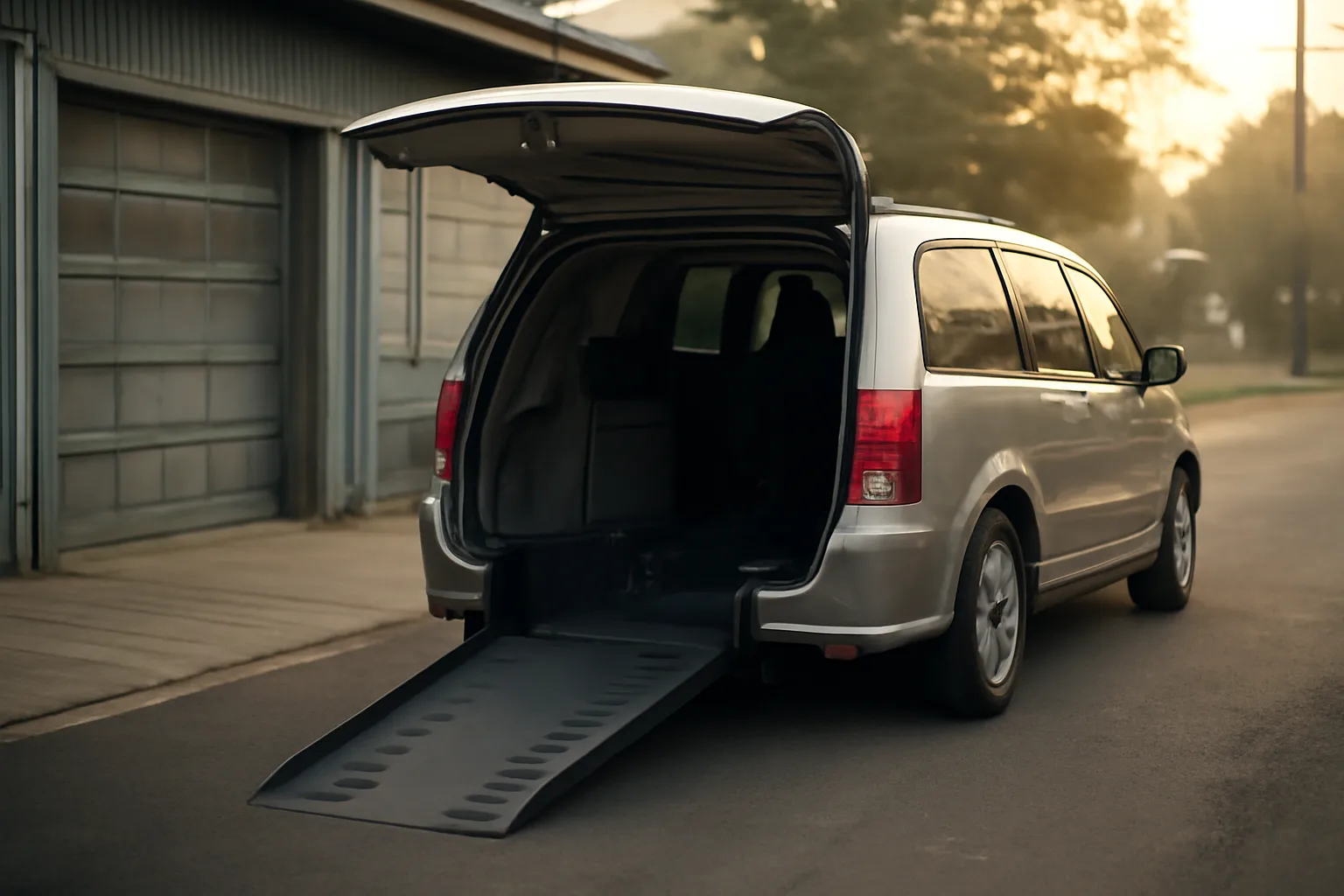
The vehicle is almost always the single biggest expense, and the range is wide. A used, already-converted wheelchair van (Dodge Grand Caravan, Toyota Sienna, or Ford Transit Connect with a factory or aftermarket ramp conversion) typically runs $25,000 to $45,000 depending on mileage, conversion brand, and age. A new mobility van with a factory-installed ramp or lift conversion can run $55,000 to $75,000 or more before any Medicaid-required equipment like a wheelchair securement system. Buying new construction: full-size cutaway vans with a lift and multiple wheelchair positions (used for higher-capacity routes) cost more, often $70,000-$100,000+, but that's usually a second-vehicle purchase once you're established, not a starting point. Don't skip the securement system cost. Brokers and states generally require a specific wheelchair tie-down and occupant restraint system meeting WC19 transportation safety standards, and retrofitting an older van to meet current standards can add a few thousand dollars if the existing system is out of date or missing documentation. Buy-here-pay-here or subprime vehicle financing is common in this industry because many new owner-operators don't have years of business credit. Expect a higher interest rate than a standard auto loan if that's your path, and factor that into your monthly cash flow, more than the sticker price.
What does commercial auto and liability insurance cost for NEMT?
Commercial auto insurance for a wheelchair van is not the same as your personal car policy, and it costs meaningfully more. Expect roughly $600 to $1,500+ per month per vehicle for commercial auto liability, though the real number depends heavily on your state, your driving record, the coverage limits your broker requires, and whether you're insuring one van or a small fleet. Most NEMT brokers set minimum liability limits well above what a personal policy carries, commonly $1,000,000 combined single limit or higher, plus specific requirements for wheelchair passenger coverage. Confirm the exact minimum with your broker and your state Medicaid transportation unit before you shop policies, because underinsuring is one of the most common reasons a credentialing application gets bounced back. You'll likely also need general liability insurance separate from auto, and depending on your state, workers' compensation coverage once you hire your first driver. Budget insurance as an ongoing monthly cost, not a one-time startup fee. This is genuinely the expense that trips up new operators who budgeted for the van and forgot insurance is often the more expensive recurring line.
How do I register a business entity and get the right permits?
Most owner-operators form an LLC, which typically costs $50 to $500 in state filing fees depending on the state (California's is notably higher than most, at $70 to file plus an $800 annual minimum franchise tax [3]). You'll also need an EIN from the IRS, which is free directly through irs.gov. Beyond the entity, check for: - A local business license (city or county, often $50-$400 a year)
- A commercial vehicle registration and, in many states, a for-hire or livery permit through your state DMV or transportation department
- A DOT number if your vehicle or operation crosses certain weight or passenger thresholds (rules vary by state and by vehicle class, so confirm with your state DOT)
- Any state-specific NEMT operator license or certificate that some states require before you can even apply to a Medicaid broker Some states, like Texas and New Jersey, require a distinct NEMT provider permit or certification process before broker credentialing even starts. Others fold that requirement into the broker's own application. There's no substitute for calling your state Medicaid transportation unit directly and asking what's required in your state specifically, because this is one of the areas that varies the most state to state.
How much does Medicaid and broker credentialing cost?
This is the part that surprises a lot of new operators: credentialing itself often costs relatively little in direct fees, but it costs real time, and the indirect requirements (insurance minimums, vehicle inspections, driver background checks) are where the money goes. Broker application fees, when they exist, are usually modest, often in the $0-$300 range, but some brokers charge more for ongoing compliance monitoring or a per-vehicle inspection fee. Driver background checks and drug screening typically run $50-$150 per driver depending on your state and the vendor the broker requires. Some states also require a separate Medicaid provider enrollment application directly with the state (distinct from broker credentialing with Modivcare, MTM, Access2Care, or SafeRide), and that state-level enrollment can carry its own fee or none at all depending on the state's Medicaid provider agreement terms. Federal rule requires states to screen providers by risk level. Under 42 CFR 455.450, providers are assigned to a limited, moderate, or high categorical risk level, and transportation providers are generally treated at the lower end of that scale, which typically means background checks and licensure verification rather than a mandatory site visit or application fee [4]. That said, screening categories and any associated fees are set at the state level, so the honest answer for your specific fee is "confirm with your state Medicaid agency," not a number we can promise here. Budgeting realistically: plan for $500-$2,000 in combined application, background check, and inspection costs across state enrollment and broker credentialing for your first vehicle and driver, on top of the insurance and vehicle costs already covered above.
How do I start a medical transportation business step by step?
Here's the realistic order of operations most new owner-operators actually follow, based on how state and broker requirements typically stack. 1. Decide your service type. Wheelchair van, ambulatory sedan, or stretcher van. Wheelchair van is the most common starting point. 2. Form your business entity (LLC is standard) and get your EIN. 3. Buy or lease your vehicle and get it converted or verified to meet WC19 wheelchair securement standards if it isn't already. 4. Get commercial auto and general liability insurance at whatever minimum limits your state and broker require. 5. Get any state-required transportation permits, DOT numbers, or NEMT operator licenses before applying to a broker. 6. Enroll as a Medicaid provider with your state (some states require this before broker credentialing, some run it in parallel, confirm with your state Medicaid agency). 7. Apply for broker credentialing with whichever broker or brokers manage NEMT in your service region (this could be one broker statewide, or different brokers by county). 8. Complete driver background checks, drug screening, and any required training (defensive driving, passenger assistance, HIPAA). 9. Pass a vehicle inspection, which most brokers require before they'll activate you. 10. Start taking dispatched trips once credentialed and active in the broker's system. The order can shift depending on your state. Some states won't let you enroll as a Medicaid provider until you already have broker approval; others require state enrollment first. That single sequencing question is worth a phone call to your state Medicaid transportation unit before you spend money on anything, because doing steps out of order can mean re-submitting paperwork.
Can I start a NEMT business with just one van?
Yes, and most owner-operators do exactly that. A single wheelchair van with one owner-operator driver is a completely normal, common way to enter this industry, not a compromise. Brokers credential single-vehicle operators routinely; you don't need a fleet to get approved. The practical tradeoffs of one van: your capacity is limited to however many trips you personally (or one hired driver) can physically run in a day, and if that van is in the shop, you have zero backup capacity. Some owner-operators keep a second, older vehicle as a backup for exactly this reason, even before they're ready to hire a second driver. One real cost consideration specific to a one-van operation: several brokers set minimum trip volume expectations or service area coverage requirements as part of the credentialing agreement. That doesn't mean you need multiple vehicles, but it does mean you should ask your broker directly what coverage or availability they expect from a single-vehicle provider before you sign, so you're not surprised by a compliance issue three months in.
What ongoing costs come after the initial startup?
| Commercial auto insurance | $600-$1,500+/month per vehicle | Varies by state, driving record, coverage limits | |
|---|---|---|---|
| Fuel | Varies widely by mileage and vehicle | Vans with ramps often get lower MPG than a sedan | |
| Vehicle maintenance | $100-$400+/month average | Wheelchair lifts and ramps need their own service schedule | |
| Driver wages (if hired) | Set by you, state minimum wage floor applies | Varies by state and local labor law | |
| Broker compliance/re-credentialing | Varies, often annual | Some brokers re-check insurance and background checks yearly | |
| Phone/dispatch software | $0-$150+/month | Some brokers provide a dispatch app free, others don't | Re-credentialing isn't a one-time event. Most brokers and state Medicaid programs require annual or periodic renewal of your insurance certificates, driver background checks, and vehicle inspections. Miss a renewal window and you can get suspended from taking dispatched trips, which is a real cash flow risk worth calendaring carefully from day one. |
Startup cost is only half the picture. The costs that keep running every month are what actually determine whether the business works. | Ongoing cost | Typical range | Notes |
What's the honest total startup cost range for a one-van NEMT business?
Pulling it together, here's a realistic range for a single wheelchair-van startup, not including your first few months of insurance and operating cash reserves: - Used wheelchair van, already converted: $25,000-$45,000
- Commercial insurance (first month + likely deposit): $1,200-$3,000
- LLC formation and EIN: $50-$800 depending on state
- Local business license: $50-$400
- State/DOT permits and NEMT-specific licensing: $0-$1,000+ depending on state
- Driver background check and drug screening: $50-$150 per driver
- Broker application and inspection fees: $0-$500 Add it up and a lean startup on the low end can land around $27,000-$30,000 if you're buying an already-converted used van in a state with light permitting requirements. A more typical range, especially in states with heavier NEMT-specific licensing or higher insurance minimums, is $40,000-$60,000. If you're buying a newer converted van or need a full securement retrofit, $70,000-$90,000+ isn't unusual. Those numbers assume you're not also carrying several months of operating cash as a cushion, which most small business advisors recommend on top of hard startup costs. This article makes zero promises about revenue or trip volume, because those numbers depend entirely on your broker contract, your region's demand, and factors nobody can predict from a blog post. Budget conservatively and confirm every fee with your state Medicaid agency and target broker before you commit money.
Where do broker credentialing rules differ from state Medicaid rules?
This confuses almost every new operator at first, so it's worth being direct about it. State Medicaid enrollment and broker credentialing are two different processes run by two different entities, and passing one doesn't automatically mean you've passed the other. Your state Medicaid agency sets the baseline: who can be a Medicaid transportation provider, what screening category applies, and often what license or permit you need before you're even eligible to bill. The broker (Modivcare, MTM, Access2Care, SafeRide, or a regional company depending on your state) is who the state contracts with to actually manage day-to-day dispatch, driver files, vehicle inspections, and trip payments. In many states you need both a state provider number and broker credentialing before you can take a single dispatched trip. Rules differ broker to broker on things like minimum insurance limits, required driver training modules, inspection frequency, and how fast they re-credential you each year. None of that is standardized nationally, and it changes. The only reliable move is to call the specific broker operating in your county and your state Medicaid transportation unit directly and ask for their current provider requirements in writing, because what was true last year may not be true now. For a deeper look at how NEMT fits into broader nemt transportation systems and how non emergency medical transportation services get organized by state, those hub pages break down the state-by-state variation in more detail. If you're also researching the higher-acuity side of the industry, our emergency medical transport overview explains how that licensing differs from NEMT.
Is there a way to shortcut the paperwork without cutting corners?
There isn't a legal shortcut around insurance minimums, background checks, or vehicle inspections, and you shouldn't want one; those exist to keep vulnerable riders safe, and cutting them is how operators get suspended or sued. What you can shortcut is the research time, because most of the frustration in this process isn't the requirements themselves, it's tracking down which state form, which broker portal, and which insurance certificate wording applies to your specific state and broker combination. That's the gap our $199 one-time State + Broker NEMT Launch Kit is built to close: state-specific enrollment checklists and broker credentialing document templates so you're not reverse-engineering requirements from broker call centers and outdated PDFs. It doesn't replace confirming current fees and rules with your state Medicaid agency and broker directly, and it doesn't guarantee approval, nobody honestly can. It just gets you to that phone call with the right paperwork already organized.
What mistakes cost new NEMT operators the most money?
Underinsuring is the most expensive mistake, because it either gets your credentialing rejected outright or, worse, gets approved and then leaves you exposed if there's an accident. Confirm minimum limits with your broker before buying a cheap policy that looks good on price. Buying the wrong van is second. A used minivan conversion that's cheap up front but doesn't meet current WC19 securement standards can cost more to retrofit than it would have cost to buy a compliant one from the start. Ask for the securement documentation before you buy, not after. Skipping the sequencing question is third. Applying to a broker before confirming whether your state requires Medicaid provider enrollment first (or vice versa) can mean redoing paperwork and losing weeks. A five-minute call to your state Medicaid transportation unit up front saves real money in wasted application fees and re-submissions. Last, underestimating ongoing insurance and maintenance cost relative to the one-time vehicle purchase is common. New operators budget carefully for the van and then get surprised that insurance alone can run $1,000+ a month before they've taken a single trip.
Frequently asked questions
What is non-emergency medical transportation (NEMT)?
NEMT is scheduled transportation for Medicaid (and some Medicare Advantage) members who can travel safely to medical appointments but can't drive or use regular public transit. It covers rides for dialysis, therapy, and routine checkups using sedans, wheelchair vans, or stretcher vans, and is distinct from emergency ambulance service.
Does Medicaid cover ambulance rides?
Yes. Medicaid covers ambulance transportation for emergencies and medically necessary non-emergency transport requiring ambulance-level care, as a benefit separate from NEMT. Medicaid.gov describes NEMT and ambulance coverage as distinct transportation benefits within the program [2]. Coverage details and prior authorization rules vary by state.
Does Medicare cover medical transportation?
Original Medicare Part B covers emergency ambulance transport and limited non-emergency ambulance transport when a doctor certifies medical necessity in writing [3]. It generally doesn't cover routine NEMT like Medicaid does. Some Medicare Advantage plans offer NEMT as a supplemental benefit, but that's plan-specific, not a standard Medicare entitlement.
How do you start a medical transportation business?
Form a business entity, buy or convert a compliant vehicle, get commercial insurance meeting your state and broker's minimum limits, secure any state transportation permits, enroll as a Medicaid provider, apply for broker credentialing (Modivcare, MTM, Access2Care, SafeRide, or your regional broker), pass driver background checks and a vehicle inspection, then start taking dispatched trips.
How much does it cost to start a NEMT business with one van?
A lean startup with a used, already-converted wheelchair van can run $27,000-$30,000. A more typical range, including state permitting and higher insurance minimums, is $40,000-$60,000. Newer vehicles or full securement retrofits can push total startup cost to $70,000-$90,000 or more.
Can I start a NEMT business with just one van?
Yes. Single-vehicle owner-operators are a normal and common way to enter NEMT, and brokers credential them routinely. Your capacity is limited to what one van and driver can run, and some brokers set minimum coverage expectations, so confirm those terms with your specific broker before signing.
What insurance do I need to run a wheelchair van for Medicaid trips?
You'll typically need commercial auto liability insurance well above personal auto minimums, often $1,000,000 combined single limit or higher, plus general liability coverage and, once you hire drivers, workers' compensation in most states. Exact minimums are set by your broker and state, so confirm before purchasing a policy.
How much does Medicaid or broker credentialing cost?
Direct application fees are often modest, roughly $0-$300, but driver background checks typically run $50-$150 per driver and some states require a separate Medicaid provider enrollment with its own requirements. Total credentialing-related costs, excluding insurance and the vehicle, usually fall between $500 and $2,000.
Do I need a state license before I can apply to a broker like Modivcare or MTM?
In some states yes, in others the broker's own application covers state-level requirements. Sequencing genuinely varies by state, so call your state Medicaid transportation unit before applying to any broker to confirm whether state enrollment must come first, run in parallel, or come after broker approval.
What vehicle standards does a wheelchair van need to meet?
Most brokers and states require a wheelchair securement and occupant restraint system that meets WC19 transportation safety standards, verified through documentation from the conversion manufacturer. If you buy a used conversion, ask for that documentation before purchase; retrofitting an outdated system afterward can cost thousands more.
How much does commercial insurance cost per month for a NEMT van?
Expect roughly $600 to $1,500 or more per month per vehicle, depending on your state, driving record, and the liability limits your broker requires. This is often the largest ongoing operating cost after fuel and maintenance, and it should be budgeted as a recurring expense, not a one-time fee.
What's the difference between state Medicaid enrollment and broker credentialing?
State Medicaid enrollment is your provider agreement with the state agency itself, setting eligibility and screening requirements. Broker credentialing is a separate process with the private company (Modivcare, MTM, Access2Care, SafeRide, etc.) the state contracts to manage dispatch and driver files. Many states require both before you can bill for trips.
What ongoing costs should I expect after startup?
Monthly commercial insurance ($600-$1,500+ per vehicle), fuel, vehicle maintenance (often $100-$400+ a month, more for lift systems), driver wages if you hire, and periodic broker re-credentialing (annual insurance and background check renewals) are the main recurring costs beyond the initial vehicle and licensing purchase.
Sources
- Medicaid.gov, Non-Emergency Medical Transportation: States must ensure necessary transportation for Medicaid beneficiaries to and from providers
- Medicare.gov, Ambulance Services coverage: Medicare Part B covers emergency ambulance transport and limited non-emergency ambulance transport with a doctor's written order
- California Franchise Tax Board, LLC Fee and Tax: California charges an $800 annual minimum franchise tax for LLCs plus filing fees
- 42 CFR 455.450, Screening levels for Medicaid providers: Federal rule requires state Medicaid agencies to assign providers to limited, moderate, or high categorical risk screening levels
- Federal Motor Carrier Safety Administration, Interstate operating authority and registration: Commercial passenger-carrying vehicles crossing certain thresholds may require federal operating authority or a USDOT number depending on operation type