Last updated 2026-07-25
TL;DR
Opening an NEMT business means forming a legal entity, getting commercial auto and general liability insurance, equipping a compliant wheelchair van, then enrolling as a Medicaid transportation provider in your state and credentialing with brokers like Modivcare or MTM. Most states require separate applications for state Medicaid enrollment and each broker contract, and timelines commonly run 60 to 120 days.
What is non emergency medical transportation (NEMT)?
Non emergency medical transportation is transport to and from medical appointments for people who don't need an ambulance but can't drive themselves or use regular transit. Think dialysis three times a week, chemo infusions, physical therapy, or a wheelchair user going to a primary care visit. Federal Medicaid rules require states to make sure eligible beneficiaries can get to and from covered services, and NEMT is how most states meet that obligation. The federal regulation sits at 42 CFR 431.53, which says state Medicaid plans must "specify that the Medicaid agency will ensure necessary transportation for recipients to and from providers" [1]. States can run this directly, contract with regional transportation brokers, or use a mix of both. That's why your business relationship might be with a state Medicaid transportation unit, a broker like Modivcare or MTM, or both at once. NEMT is not an ambulance service. You're not doing emergency response, you're not staffing paramedics, and in most states you don't need EMS licensure to run a wheelchair van or ambulatory sedan business. That distinction matters for insurance, driver qualifications, and how state agencies classify and regulate you. If you want more background on how the term gets used across state programs, see medical transportation and non emergency medical transportation services.
How do you start a medical transportation business, step by step?
There's no single national process because each state Medicaid agency and each broker runs its own enrollment. But the sequence is consistent enough to lay out clearly. 1. Pick your entity type and register it (LLC is common) with your Secretary of State. 2. Get an EIN from the IRS and open a business bank account. 3. Get your state and local operating authority: many states require a for-hire or livery permit from the DMV or state transportation department, separate from Medicaid enrollment. 4. Buy or lease a wheelchair-accessible van that meets your state's vehicle age, mileage, and modification standards. 5. Buy commercial auto insurance with the liability limits your state and brokers require, plus general liability. 6. Get vehicle inspections and any required NEMT-specific vehicle permits or decals. 7. Screen and background-check drivers, and get any required defensive driving, wheelchair securement, or CPR/first aid certifications done. 8. Apply for Medicaid provider enrollment through your state's Medicaid Management Information System (MMIS) portal. 9. Apply for broker network credentialing (Modivcare, MTM, Access2Care, SafeRide, or whichever broker holds the contract in your state or region) once you're Medicaid-enrolled, since most brokers require an active Medicaid provider ID first. 10. Wait for site visits, document review, and contract signature before you can accept trips. The order matters. Skipping ahead, buying a van before confirming your state's wheelchair lift and securement standards, or applying to a broker before you have your Medicaid ID, is the most common way new operators waste weeks.
How do you start a NEMT business with just one van?
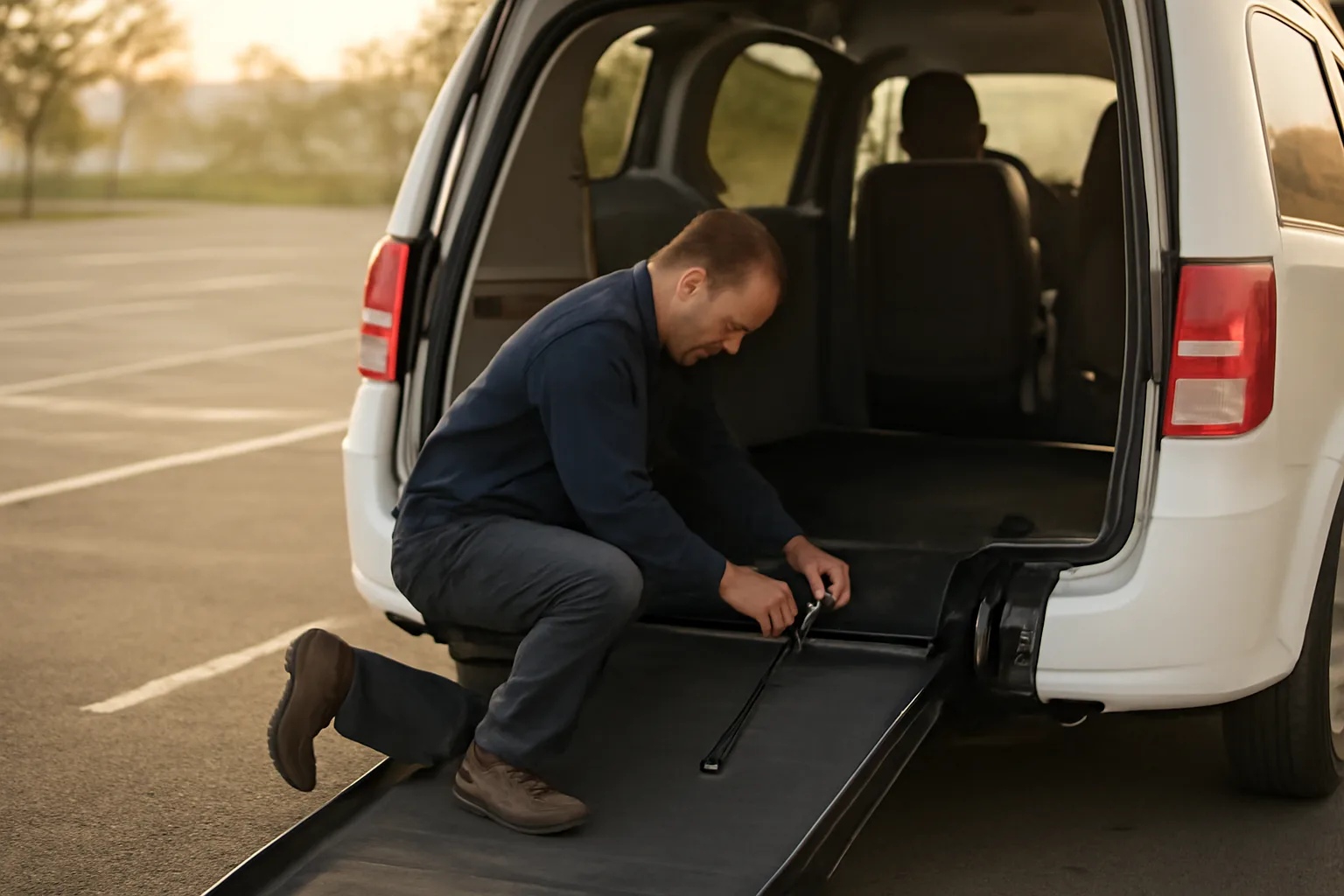
Plenty of owner-operators start with a single wheelchair van, and it's a legitimate way to enter the field. The paperwork burden is close to identical whether you have one van or ten. You still need the entity, the insurance, the Medicaid enrollment, and the broker credentialing, just for one vehicle instead of a fleet. What changes with one van is capacity planning. Some broker contracts ask about fleet size, backup vehicle availability, and after-hours coverage during credentialing. If you only have one van and it breaks down or is in for inspection, you may not be able to accept trips, and a pattern of no-shows or missed trips can affect your standing with a broker. Ask the broker directly during credentialing what their minimum service expectations are; confirm with your broker and state Medicaid agency what backup vehicle or subcontracting rules apply. A single-van operation also means your insurance and vehicle costs are more exposed to one asset. Get a real quote from a commercial auto insurer who writes NEMT policies before you commit to a van purchase, since premiums vary a lot by state, driving record, and vehicle type.
What vehicle and equipment rules apply to a wheelchair van?
Requirements vary by state, but most state Medicaid transportation manuals and many broker credentialing packets cover the same categories: vehicle age limits (often 8 to 10 years or a mileage cap), wheelchair lift or ramp certification, secured wheelchair tie-down systems meeting SAE or ADA-referenced standards, working seatbelts for all passenger positions, first aid kits, and fire extinguishers. Many states also require annual or semi-annual vehicle safety inspections specific to NEMT, separate from standard state vehicle inspection. Some require a distinct permit or decal for wheelchair vans versus ambulatory sedans. Because these specs differ by state and even by broker within a state, don't buy a van based on a general internet checklist. Get the current vehicle standard document from your state Medicaid transportation unit or your target broker before you purchase. For a closer look at how these standards get applied across different program types, see nemt transportation and non emergency medical transportation.
Does Medicaid cover ambulance rides?
Yes. Medicaid covers ambulance transportation when it's medically necessary, meaning the beneficiary's condition requires the level of care and equipment an ambulance provides. This is different from NEMT, which covers people who don't need ambulance-level care but still can't get to appointments on their own. CMS guidance describes ambulance services as a distinct Medicaid benefit category with its own provider enrollment and billing rules, separate from the broker-managed NEMT programs most wheelchair-van operators work in [2]. If you're building a wheelchair-van business, you generally do not need ambulance licensure, EMT certification, or ambulance-level equipment. Confirm with your state Medicaid agency exactly where the line falls, because some states also cover "wheelchair van" or "stretcher van" trips as a middle tier between ambulatory NEMT and full ambulance transport, and those tiers can carry their own separate enrollment rules.
Does Medicare cover medical transportation?
Medicare's coverage of non-emergency transportation is much narrower than Medicaid's. Original Medicare Part B covers ambulance transportation when other transportation could endanger your health, and it covers non-emergency ambulance transport in limited cases, such as a beneficiary who is bed-confined and needs medically necessary transport, but it does not have a general NEMT benefit the way state Medicaid programs do [3]. Some Medicare Advantage plans offer NEMT as a supplemental benefit. CMS finalized changes in 2019 that expanded what counts as a "primarily health related" supplemental benefit for Medicare Advantage plans, which opened the door for plans to cover non-medical transportation for enrollees with chronic conditions [4]. If you want Medicare Advantage trip volume, you'd be contracting with individual MA plans or their transportation vendors, not with Medicaid MMIS, and those contracts run on their own separate credentialing timelines. Don't assume a Medicaid enrollment automatically gets you Medicare Advantage plan work; it doesn't.
How do you enroll as a state Medicaid NEMT provider?
Every state runs Medicaid provider enrollment through its own Medicaid Management Information System, usually with an online portal run by the state Medicaid agency or its fiscal agent. You'll typically submit your business license, EIN, National Provider Identifier (NPI) if the state requires one for transportation providers, proof of insurance, vehicle registration and inspection records, driver background check results, and a completed provider enrollment application. Some states enroll NEMT providers directly and pay them through fee-for-service claims. Other states have moved fully to a broker model, where the state contracts with a single statewide broker (or several regional ones) and individual transportation companies never bill Medicaid directly, they bill or get paid through the broker instead. A growing number of states use a hybrid: state-level provider enrollment as a prerequisite, then broker network credentialing on top of it. Because this varies so much, the only reliable step is to go straight to your state Medicaid transportation unit's page and read the current provider manual. CMS keeps program information on non-emergency medical transportation, including links to state guidance, on its Medicaid.gov benefits page [5], which is a reasonable starting point if you don't already know your state agency's transportation division. Confirm with your state Medicaid agency which model applies before you spend time on paperwork built for the wrong one.
How does broker credentialing work with Modivcare, MTM, Access2Care, or SafeRide?
Brokers manage NEMT networks on behalf of state Medicaid agencies (and sometimes managed care organizations) in most states now. Modivcare and MTM are the two largest national brokers; Access2Care and SafeRide operate in various regions and MCO contracts as well. Each broker runs its own credentialing process, independent of, but usually downstream from, your state Medicaid enrollment. A typical broker credentialing packet asks for: proof of active state Medicaid enrollment or provider ID, current commercial auto insurance certificate naming the broker as certificate holder or additional insured, vehicle inspection reports, driver license and background check documentation, a signed transportation services agreement or subcontractor agreement, and sometimes a site or vehicle inspection visit before your first trip assignment. Broker requirements change fairly often, including things like minimum insurance limits, required driver training modules, and the software or app you must use to accept dispatched trips. There's no shortcut around confirming current requirements directly with the specific broker for your state and county, since the same broker can run different rules in different states depending on its contract terms with each state Medicaid agency. Putting together the state Medicaid application packet and the broker credentialing packet at the same time, rather than doing them sequentially and rediscovering you're missing the same documents twice, is the single biggest time-saver new owner-operators skip. That's the gap a tool like the $199 State + Broker NEMT Launch Kit at /launch-kit-builder is built to close: it organizes both document sets side by side so you're not chasing the same insurance certificate or background check twice.
What licenses and permits does an NEMT business need?
Beyond Medicaid enrollment and broker credentialing, most states require a separate layer of general business and transportation licensing. Common requirements include: a business entity registration with your Secretary of State, an EIN from the IRS, a for-hire vehicle permit or livery/transportation network license from your state DOT or DMV, local city or county business licenses, and vehicle-for-hire inspection stickers or decals. Some states also require a certificate of authority or public convenience and necessity for passenger transportation companies, particularly if you plan to also serve private-pay or non-Medicaid clients. This layer is separate from your Medicaid provider file. It often gets missed by new operators who think Medicaid enrollment alone makes them street-legal. It doesn't. Confirm with your state's transportation regulatory agency (more than Medicaid) what for-hire licensing applies before you put a van on the road.
What insurance does a wheelchair van business need?
At minimum, expect to need commercial auto liability insurance at limits your state or broker sets, often well above personal auto minimums, plus general liability coverage. Many brokers require specific minimum limits (commonly in the $1,000,000 combined single limit range for auto liability, though this varies by broker and state) and want to be listed as a certificate holder or additional insured on your policy. Workers' compensation insurance is typically required once you have employees, and requirements kick in at different thresholds by state. Some states also want proof of commercial general liability separate from the auto policy, and some require specific wheelchair lift or passenger assist liability coverage riders. Get quotes from insurers who specifically write NEMT or livery policies, not standard personal auto insurers, since a standard personal policy will typically exclude commercial passenger-for-hire use entirely and leave you uninsured in a claim.
How long does it take to get NEMT approved and running?
Realistic ranges vary a lot by state and broker workload, and neither this article nor any broker can guarantee approval or a specific timeline. As a general pattern reported by operators and state provider manuals, state Medicaid provider enrollment review commonly runs several weeks to a couple of months once a complete application is submitted, and broker credentialing on top of that can add another few weeks, especially if a site or vehicle inspection is required. The single biggest driver of delay isn't the agency, it's incomplete applications. Missing insurance certificate language, expired background checks, or vehicle inspection reports that don't match the exact form the broker wants are the most common reasons files bounce back. Building your document file once, in the format both your state Medicaid agency and your target broker expect, cuts a lot of that back-and-forth. Confirm current processing timelines directly with your state Medicaid transportation unit and your target broker, since published timelines change and vary by region.
What are the biggest mistakes new NEMT owner-operators make?
Buying the van before confirming vehicle specs. States and brokers have specific age, mileage, and wheelchair securement standards, and a van that doesn't meet them means an expensive retrofit or a resale. Applying to a broker before Medicaid enrollment is complete. Most brokers require an active state Medicaid provider ID as a prerequisite, so a broker application submitted too early just sits, or gets rejected outright. Underestimating insurance costs and requirements. Commercial NEMT auto policies cost meaningfully more than personal auto insurance, and coverage that doesn't meet a broker's stated minimum limits or additional-insured language gets your credentialing file kicked back. Assuming one state's rules apply everywhere. NEMT is state-by-state and broker-by-broker. What worked for someone in another state's Facebook group may not apply to your county at all. Not budgeting for the gap between "credentialed" and actual trip assignment. Even after approval, brokers assign trips based on their own dispatch algorithms and coverage needs in your area, not a guaranteed volume. This article makes no income or trip-volume promises because nobody honestly can; ask your specific broker about their assignment and coverage process during credentialing, not after.
Frequently asked questions
How to start a medical transportation business?
Form a legal business entity, get an EIN, secure commercial auto and general liability insurance, obtain any state for-hire transportation permit, buy a compliant vehicle, then apply for state Medicaid provider enrollment and broker credentialing (Modivcare, MTM, Access2Care, SafeRide, depending on your state). Confirm each requirement with your state Medicaid agency and target broker, since rules vary widely by location.
Does Medicaid cover ambulance rides?
Yes, Medicaid covers medically necessary ambulance transportation as a distinct benefit category from NEMT, under rules CMS administers separately from broker-managed non-emergency transportation programs. Ambulance coverage requires the beneficiary's condition to genuinely need ambulance-level transport, more than an inability to drive themselves to an appointment.
What is NEMT?
NEMT stands for non-emergency medical transportation: rides to and from covered medical services for people who don't need an ambulance but can't get there on their own, such as wheelchair users or dialysis patients. Federal Medicaid regulation 42 CFR 431.53 requires state Medicaid programs to ensure this transportation is available to eligible beneficiaries.
Does Medicare cover medical transportation?
Original Medicare Part B covers emergency and limited medically necessary non-emergency ambulance transport, but it does not have a general non-emergency transportation benefit like state Medicaid programs do. Some Medicare Advantage plans offer NEMT as a supplemental benefit, an option CMS opened up starting with 2019 rule changes on supplemental benefits.
Does Medicaid cover ambulance rides or only wheelchair van trips?
Medicaid covers both, but as separate benefit categories with separate provider enrollment paths. Ambulance rides are covered when medically necessary at that level of care. Wheelchair van and ambulatory NEMT trips are covered under each state's non-emergency transportation assurance, usually managed through a broker rather than direct ambulance billing.
How to start a NEMT business from scratch with no prior transportation experience?
You don't need prior transportation experience, but you do need to work through entity formation, insurance, vehicle compliance, state Medicaid enrollment, and broker credentialing in the right order. Many owner-operators come from driving, caregiving, or unrelated small-business backgrounds. The paperwork sequence matters more than industry experience.
How do you start a medical transportation business with one van?
The licensing, insurance, and credentialing steps are the same for one van as for a fleet. The difference is capacity: with a single vehicle, you have no backup if it's down for repair or inspection, which some brokers factor into credentialing and trip assignment decisions. Confirm minimum fleet or backup vehicle expectations with your target broker.
What is non emergency medical transportation exactly, and who qualifies?
Non emergency medical transportation is Medicaid-funded (or Medicare Advantage-funded, in some plans) transport to medical appointments for beneficiaries who need help getting there but don't need ambulance-level care. Eligibility rules are set by each state Medicaid program and vary; confirm specific qualifying criteria with your state Medicaid agency.
Do I need an NPI number to enroll as an NEMT Medicaid provider?
Some states require transportation providers to have a National Provider Identifier as part of Medicaid enrollment, others don't, depending on how the state's MMIS is structured. Check your specific state Medicaid transportation unit's provider enrollment instructions, since this requirement is not consistent nationwide.
How much does it cost to start an NEMT wheelchair van business?
Costs vary too widely by state, vehicle choice, and insurance market to give one honest number: a used wheelchair-accessible van, commercial insurance, permits, and inspections are the major line items. Get real vehicle and insurance quotes for your specific state before estimating a startup budget; broad national averages aren't reliable enough to plan around.
Can I run NEMT trips for Medicare Advantage plans instead of Medicaid?
Yes, some Medicare Advantage plans offer NEMT as a supplemental benefit and contract with transportation vendors directly, separate from state Medicaid credentialing. This is a different application process from Medicaid MMIS enrollment or Medicaid broker credentialing, so you'd need to contact individual MA plans or their transportation vendor about contracting.
What's the difference between state Medicaid enrollment and broker credentialing?
State Medicaid enrollment registers your business as an approved Medicaid provider in the state's system. Broker credentialing is a separate process with a company like Modivcare or MTM that manages trip dispatch and payment on the state's behalf. Most states require Medicaid enrollment first, then broker credentialing on top of it.
Sources
- eCFR, 42 CFR 431.53 Assurance of transportation: Federal Medicaid regulation requiring states to ensure necessary transportation to and from providers
- Medicaid.gov, Medicaid Benefits: Ambulance Services: Medicaid covers medically necessary ambulance transportation as a distinct benefit category from NEMT
- Medicare.gov, Ambulance Services coverage: Original Medicare Part B covers emergency and limited non-emergency ambulance transport under specific conditions
- Federal Register, Medicare and Medicaid Programs; Policy and Technical Changes to the Medicare Advantage, Medicare Prescription Drug Benefit, and PACE Programs for Contract Year 2019 (84 FR 15680, published April 16, 2019): CMS expanded allowable Medicare Advantage supplemental benefits, opening the door to non-medical transportation benefits starting 2019
- Medicaid.gov, Non-Emergency Medical Transportation: Medicaid.gov provides program information on non-emergency medical transportation benefits
- 42 U.S.C. 1396a(a)(4), Social Security Act Section 1902(a)(4): State Medicaid plans must provide for methods of administration necessary for proper and efficient operation, the statutory basis CMS cites for the transportation assurance regulation at 42 CFR 431.53
- eCFR, 42 CFR 440.170 Transportation: Federal regulation defining transportation as an optional Medicaid benefit states may cover, including NEMT and ambulance services as distinct categories