Last updated 2026-07-25
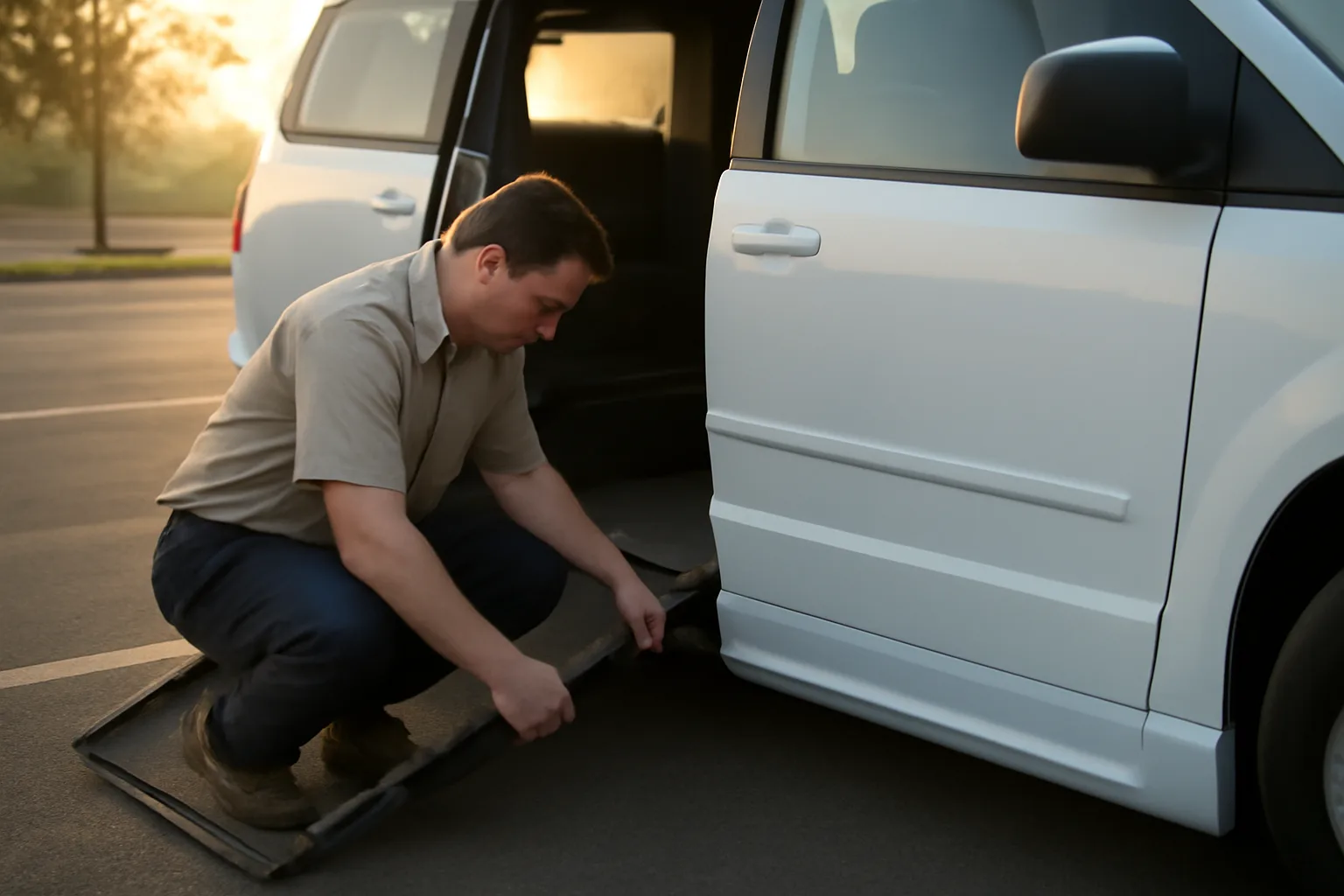
TL;DR
Starting an NEMT business means getting business and vehicle licensing first, then commercial auto and NEMT liability insurance, then state Medicaid enrollment as a transportation provider, then broker credentialing with companies like Modivcare or MTM. Most owner-operators with one wheelchair van spend 60 to 120 days on this before their first paid trip, and the order matters because brokers won't credential you without an active Medicaid provider ID.
What is non-emergency medical transportation (NEMT)?
Non-emergency medical transportation, or NEMT, is transportation to medical appointments for people who don't need an ambulance but can't drive themselves or use regular transit. Think dialysis three times a week, chemo, physical therapy, or a wheelchair user going to a primary care visit. Federal Medicaid rules require states to make sure eligible people can get to and from covered medical services, and NEMT is how most states meet that obligation for non-emergency trips. The federal regulation behind this sits at 42 CFR 431.53, which says a state plan must "specify that the Medicaid agency will ensure necessary transportation for recipients to and from providers" and may do this directly, through contracts, or by paying recipients' costs [1]. Most states now use one statewide or regional broker instead of paying every ride individually, which is why credentialing with a broker is a separate step from enrolling with Medicaid itself. NEMT is not ambulance service. It's wheelchair vans, ambulatory sedans, and sometimes stretcher vans, run by drivers who are not paramedics. If you're picturing lights and sirens, that's emergency medical transport, a different business with different licensing (see emergency medical transport for how that differs). NEMT is the much larger and more accessible market for a new owner-operator, and it's where almost everyone starts.
How do you start a medical transportation business, step by step?
The honest order, in the sequence that actually avoids wasted money, looks like this: 1. Pick your vehicle type and get your business entity, EIN, and any state motor carrier or livery registration in place. 2. Get commercial auto insurance and NEMT-specific liability coverage lined up (you'll need proof for almost every later step). 3. Complete any state-required driver background checks, drug testing, and vehicle inspection. 4. Enroll as a Medicaid transportation provider with your state Medicaid agency. 5. Apply for credentialing with the broker(s) operating in your state or region (Modivcare, MTM, Access2Care, SafeRide, or a state-run alternative). 6. Get scheduled for onboarding, dispatch training, and your first live trips. Skipping ahead doesn't work. Brokers generally require an active state Medicaid provider number before they'll even open a credentialing file, and Medicaid enrollment usually requires your vehicle inspection and insurance to already be current. Confirm the exact sequence and paperwork with your state Medicaid transportation unit, since some states run enrollment and broker credentialing as one combined application and others keep them fully separate. For a one-van operator, the practical bottleneck is almost never the driving part. It's paperwork moving through multiple agencies that don't share a system. Budget real calendar time, more than task time.
How to start an NEMT business with one van (the realistic timeline)
| Business entity + EIN | 1 to 5 days | LLC formation, IRS EIN online | |
|---|---|---|---|
| Commercial insurance quote to bind | 1 to 3 weeks | NEMT liability limits are often higher than standard livery | |
| Vehicle inspection / ADA lift certification | 1 to 2 weeks | Varies by state; some require annual re-inspection | |
| Driver background check + drug test | 2 to 6 weeks | Fingerprint-based checks can be the slowest step | |
| Medicaid provider enrollment | 30 to 90 days | Many states use a centralized Medicaid enrollment portal or contractor | |
| Broker credentialing | 2 to 8 weeks after Medicaid ID issued | Runs in parallel with other brokers if your state has more than one | Add it up and 60 to 120 days from a standing start to your first paid trip is a realistic range for most people, not a worst case. Some states move faster if you already have a livery or taxi license and clean driver history. Others, especially states running Medicaid provider enrollment through a third-party contractor, take longer. One van also means you should think hard about vehicle choice before anything else. A used, ADA-compliant wheelchair van with a working lift or ramp, properly documented, is the baseline almost every broker and state will require for wheelchair-accessible trips. If you're only running ambulatory (non-wheelchair) trips, a sedan or minivan may qualify, but check your state's vehicle standards before you buy, because retrofitting later is expensive. |
One van, one driver (often you), is the most common way people start, and it's a legitimate business model, more than a stepping stone. Here's roughly what the timeline looks like, though every state's exact processing time varies and you should confirm current windows with your state Medicaid agency. | Step | Typical time | Notes |
What licenses and insurance does an NEMT business actually need?
Requirements differ by state, but the categories are consistent across almost every program: Business licensing: an LLC or corporation registered in your state, an EIN from the IRS, and in many states a for-hire or livery vehicle permit from the state DMV or department of transportation. Commercial auto insurance: standard personal auto policies exclude for-hire transportation. You need a commercial policy, and NEMT brokers typically require specific liability limits, commonly in the range of $1 million combined single limit per occurrence, though some brokers and some states require more for wheelchair-accessible vehicles. Confirm exact minimums with your broker and state Medicaid agency, since they are not standardized nationally. Driver requirements: a valid driver's license (commercial license is not usually required for van-sized vehicles, but confirm your state's threshold), a clean or cleanable driving record, a background check, and often drug and alcohol testing. Some states require a specific NEMT driver training or certification course; others leave training to the broker. Vehicle standards: passenger vehicle inspection, and for wheelchair vans, lift or ramp certification and tie-down equipment meeting ADA accessibility standards. See vehicles and equipment guidance for what inspectors typically check. Medicaid provider enrollment: a separate application to your state Medicaid agency (or its enrollment contractor) that gives you a Medicaid provider number, which is usually the prerequisite for broker credentialing. None of these guarantee you'll pass. States and brokers can and do deny applications for incomplete records, insurance gaps, or background check findings, and this article isn't promising an outcome; it's describing the process.
What is the difference between Medicaid enrollment and broker credentialing?
Medicaid enrollment is your relationship with the state. Broker credentialing is your relationship with the private company (or companies) the state hired to manage day-to-day trip dispatch, billing, and driver standards. Many states contract with a small number of national brokers, most commonly Modivcare, MTM, Access2Care, or SafeRide, to run NEMT across some or all of their Medicaid population. The Government Accountability Office has documented this shift toward broker-managed NEMT models and noted the oversight questions it raises for states, in a report examining how states monitor broker performance and beneficiary access [2]. In those states, you generally cannot get Medicaid NEMT trips just by having a state provider number. You also have to pass the broker's own credentialing process, which usually includes its own insurance minimum checks, vehicle inspection, driver file review, and sometimes a separate background check even if you already passed the state's. A smaller number of states still manage NEMT directly or through regional transportation authorities instead of a national broker. If you're in one of those states, your state Medicaid transportation unit is your only real gatekeeper, which can mean a shorter process but also less standardized paperwork. Either way, confirm with your state Medicaid agency which model your state uses before you assume you know the process, because it changes which entity actually approves your ability to bill for trips. See nemt for background on how broker models work state by state.
Does Medicaid cover ambulance rides?
Yes, Medicaid covers ambulance transportation when it's medically necessary, but that's a separate benefit category from NEMT and has its own billing codes and provider requirements. Ambulance transportation under Medicaid generally requires the vehicle and crew to meet state EMS licensing standards (paramedic or EMT staffing, emergency equipment), which is a different regulatory track than an NEMT wheelchair van business. Medicaid.gov's non-emergency medical transportation guidance distinguishes NEMT explicitly: states must ensure transportation to covered services, and "this includes non-emergency medical transportation (NEMT) that many Medicaid beneficiaries need to get to their medical appointments" [3]. Ambulance coverage sits under a different part of the state plan and is billed through ambulance-specific provider enrollment, not the NEMT broker network. If your business plan includes both a wheelchair van fleet and ambulance service down the road, treat them as two separate licensing and enrollment tracks. Don't assume NEMT credentialing gets you anywhere toward ambulance billing, and don't assume ambulance certification substitutes for NEMT vehicle or driver requirements.
Does Medicare cover medical transportation?
Original Medicare's coverage of non-emergency transportation is narrower than Medicaid's. Medicare Part B covers ambulance services when other transportation could endanger the person's health, under the rules at 42 CFR 410.40, which require that transportation by any other means "would endanger the beneficiary's health" [4]. That's an emergency-leaning standard, not a routine dialysis-run standard. Routine NEMT, the kind covered broadly by Medicaid, is not a standard Original Medicare benefit. Some Medicare Advantage plans have added limited non-emergency transportation as a supplemental benefit in recent years, but that varies plan by plan and is not guaranteed or uniform, so a rider's specific Medicare Advantage plan documents are the only reliable source, not a general assumption. For a new NEMT operator, this matters commercially: your bread-and-butter payer is almost always going to be state Medicaid and its brokers, not Medicare, unless you're specifically pursuing Medicare Advantage transportation contracts, which usually run through their own separate vendor networks.
How much does it cost to start an NEMT business?
There's no single verified national figure for total NEMT startup cost, and any site that gives you a precise number is guessing, because the biggest variable, the vehicle, ranges enormously by age, mileage, and whether the wheelchair lift is factory-installed or retrofitted. What's real and citable is the structure of the costs, not a total dollar figure: Vehicle: a used ADA-compliant wheelchair van is typically the largest single expense, and cost varies widely by age, mileage, and conversion type. Get multiple inspections before buying, since a failed lift or damaged conversion is expensive to fix. Insurance: commercial auto and NEMT liability coverage is an ongoing cost, not a one-time cost, and premiums vary by state, driving record, and coverage limits. Licensing and permits: business registration, DMV for-hire permits, and vehicle inspection fees vary by state, often in the range of low hundreds of dollars combined, but confirm your state's actual fee schedule. Medicaid enrollment: most states don't charge NEMT-specific provider enrollment fees, though some route enrollment through a fee-charging contractor. Confirm with your state Medicaid transportation unit. Because this article makes no promises about revenue or trip volume, treat every cost estimate you see online (including here) as a starting point for your own quotes, not a budget you can bank on.
How do you get credentialed with Modivcare, MTM, Access2Care, or SafeRide?
Each broker runs its own application, and none of them publish a universal national checklist, so the accurate answer is: confirm the current requirements directly with the broker operating in your state, because they differ by state contract. That said, the shape of the process is consistent across all four: You'll typically submit your state Medicaid provider number, proof of commercial insurance meeting the broker's minimums, vehicle registration and inspection records, driver license and background check documentation, and sometimes a facility or dispatch capability questionnaire if you're applying as a multi-vehicle company rather than an individual owner-operator. Brokers often run in specific states or regions rather than nationally in an identical way, meaning Modivcare's requirements in one state's Medicaid contract can differ from its requirements in another. This is exactly why generic national checklists are unreliable for this step; the broker's own state-specific onboarding packet is the only authoritative source. Expect a review period after submission, often several weeks, and expect the broker to ask for corrections or additional documents at least once. Building slack into your timeline here saves you from turning down early availability windows while you're still waiting on paperwork. If you want a structured way to organize this across state Medicaid enrollment and multiple broker applications at once, that's the exact gap the $199 RideCredential State + Broker NEMT Launch Kit is built to close, a one-time paperwork organization tool, not a guarantee of approval from any state or broker.
What mistakes do new NEMT owner-operators make most often?
Buying the vehicle before checking state ADA and lift certification standards. A used van that looks fine can still fail inspection over tie-down anchor points, ramp angle, or documentation gaps. Check your state's specific vehicle standards before you sign anything. Assuming one broker's approval means you're approved everywhere. In multi-broker states, or if you plan to serve riders across state lines, each broker and each state Medicaid program requires its own separate credentialing. Underestimating the background check timeline. Fingerprint-based checks routed through state repositories can take weeks longer than a standard commercial background check, and this is one of the most common reasons a projected 60-day timeline turns into 100 days. Letting insurance lapse for even a day during the transition between getting your business licensed and finishing broker credentialing. A gap here can restart parts of the review process. Not reading the state plan amendment or transportation unit's actual provider manual. General articles like this one (including this one) are useful for orientation, but your state's specific manual is the only document that governs your actual application. See non emergency medical transportation and nemt transportation for more on state-by-state variation.
Do you need a special license to drive for NEMT?
Generally no commercial driver's license (CDL) is required for standard wheelchair vans or sedans under the vehicle weight thresholds that trigger CDL rules, but this depends on your vehicle's gross vehicle weight rating and your state's specific passenger-vehicle-for-hire rules. Federal CDL requirements under 49 CFR 383.91 are generally triggered by vehicle weight and passenger count thresholds rather than the nature of the trip itself [5]. What states and brokers do commonly require, separate from a CDL question, is a valid standard driver's license in good standing, a passed background check, sometimes fingerprint-based, and often a defensive driving or passenger-assistance training course specific to transporting people with mobility limitations. Some states also require a specific NEMT driver certificate or registration, distinct from the vehicle-side permitting. Confirm your state's exact driver licensing category with its Medicaid transportation unit or department of motor vehicles, since a few states do apply CDL or specialized passenger endorsement rules to larger multi-passenger vans.
Frequently asked questions
How do I start a medical transportation business from scratch with no industry experience?
Start with your state's Medicaid transportation unit website to learn the enrollment process, then get commercial insurance quotes before buying a vehicle, since insurance requirements affect which van you should buy. Layer in business licensing, driver background checks, and broker credentialing in that order. Confirm every requirement directly with your state agency and target broker rather than relying on general guidance alone.
What is NEMT and who qualifies to use it?
NEMT (non-emergency medical transportation) is transportation to and from covered medical services for people who don't need an ambulance but can't drive or use regular transit. Eligibility is generally tied to Medicaid enrollment and a documented transportation need; states set specific eligibility and prior-authorization rules, which their Medicaid transportation unit publishes.
Does Medicaid cover ambulance rides?
Yes, Medicaid covers medically necessary ambulance transportation as a distinct benefit from NEMT, with its own provider enrollment and EMS licensing requirements. NEMT covers routine, non-emergency trips like dialysis and PT appointments, using wheelchair vans or sedans, while ambulance coverage requires EMS-licensed vehicles and staff.
Does Medicare cover medical transportation?
Original Medicare Part B covers ambulance transportation mainly when other transport would endanger the patient's health, per 42 CFR 410.40. Routine non-emergency transportation isn't a standard Original Medicare benefit, though some Medicare Advantage plans offer limited supplemental transportation benefits that vary by plan, so check the specific plan's documents.
How much does it cost to start an NEMT business with one van?
There's no single verified national total; the biggest variable is the vehicle, which ranges widely based on age, mileage, and whether the wheelchair lift is factory or retrofitted. Add ongoing commercial insurance, state licensing fees, and any broker onboarding costs. Get multiple vehicle and insurance quotes rather than relying on a generic estimate.
How long does it take to get Medicaid NEMT provider enrollment approved?
Timelines vary by state, but 30 to 90 days is a realistic range for many state Medicaid provider enrollment processes, sometimes longer if your state routes enrollment through a third-party contractor. Confirm current processing times directly with your state Medicaid transportation unit, since this is not standardized nationally.
Can I start an NEMT business with just one wheelchair van?
Yes, one van is a common and legitimate way to start. You'll still need to complete the full sequence: business licensing, commercial and NEMT insurance, vehicle inspection and ADA lift certification, driver background checks, state Medicaid enrollment, and broker credentialing, all for that single vehicle.
What's the difference between NEMT and emergency medical transport?
NEMT moves people who don't need emergency care to routine medical appointments, using wheelchair vans or sedans with non-paramedic drivers. Emergency medical transport (ambulance service) requires EMS-licensed vehicles, paramedic or EMT staffing, and a completely different licensing track through state EMS agencies, not Medicaid transportation units alone.
Do I need to be credentialed with every broker, or just one?
You need separate credentialing with each broker operating in your state or region, since Modivcare, MTM, Access2Care, and SafeRide each run independent onboarding processes even within the same state. If your state uses more than one broker, plan to apply to each one you intend to work with.
What insurance minimums do NEMT brokers typically require?
Requirements vary, but many brokers require commercial auto liability in the range of $1 million combined single limit per occurrence, sometimes higher for wheelchair-accessible vehicles. Minimums are not standardized nationally, so confirm exact figures with your specific broker and your state Medicaid agency before buying a policy.
Does a wheelchair van driver need a CDL?
Generally no, standard wheelchair vans usually fall below the gross vehicle weight and passenger thresholds that trigger CDL requirements under 49 CFR 383.91. Some states or larger multi-passenger vans may have different rules, so confirm your vehicle's classification and your state's specific driver licensing requirements before assuming you're exempt.
What's the realistic timeline from deciding to start to your first paid NEMT trip?
For a one-van operator, 60 to 120 days from a standing start is a realistic range, covering business licensing, insurance, vehicle inspection, background checks, Medicaid enrollment (often 30-90 days alone), and broker credentialing. Delays are common, especially around fingerprint-based background checks and multi-agency paperwork.
Sources
- eCFR, 42 CFR 431.53: Federal requirement that state Medicaid plans ensure necessary transportation to and from providers
- U.S. Government Accountability Office, GAO-16-238, Medicaid Nonemergency Medical Transportation: States commonly contract with brokers to manage NEMT for Medicaid beneficiaries, raising oversight questions about access and monitoring
- Medicaid.gov, Non-Emergency Medical Transportation: Definition and federal requirement distinguishing NEMT from other Medicaid transportation benefits
- eCFR, 42 CFR 410.40: Medicare Part B ambulance coverage standard requiring that other transportation would endanger the beneficiary's health
- eCFR, 49 CFR 383.91: Federal CDL requirement thresholds based on vehicle weight and passenger count
- 42 U.S.C. 1396d(a) (Social Security Act Sec. 1905(a)): Statutory definition of medical assistance under Medicaid, including transportation-related services within covered categories