Last updated 2026-07-24
TL;DR
Non-emergency medical transportation (NEMT) in Las Vegas means driving Medicaid members to routine medical appointments, not 911 calls. To operate, you need a Nevada NEMT provider agreement through the state's Medicaid Management Information System (MMIS) contractor, credentialing with the regional broker (Nevada uses a managed transportation broker for most Medicaid MCOs), a compliant wheelchair van, and Nevada Transportation Services Authority or local permitting depending on the trip type.
What is non-emergency medical transportation (NEMT)?
NEMT is scheduled, non-911 transportation for people who need a ride to a medical appointment but don't need an ambulance. Think dialysis three times a week, chemo infusion, physical therapy, or a follow-up with a specialist across town. The federal rule requiring states to cover it is old and specific: 42 CFR 431.53 says state Medicaid plans must "ensure necessary transportation for beneficiaries to and from providers" and may do so through contracts, common carrier arrangements, or mileage reimbursement [1]. In practice this splits into a few vehicle types. Ambulatory sedan or minivan trips for someone who can walk and transfer on their own. Wheelchair van trips for someone in a wheelchair who needs a ramp or lift. Stretcher van trips for someone who must stay lying down but doesn't need medical monitoring. None of these are ambulances, and none of them involve lights, sirens, or emergency medical treatment en route. Las Vegas NEMT work mostly means shuttling Medicaid and some Medicare Advantage members between homes, dialysis centers, and clinics scattered across Clark County. If you're new to the industry, our nemt overview covers the national picture before you get into Nevada specifics.
Does Medicaid cover ambulance rides?
Yes, Medicaid covers ambulance transport, but only when it's medically necessary emergency or urgent transport, not routine rides to a checkup. That's a different benefit than NEMT. Ambulance coverage falls under emergency medical services and is billed separately from the non-emergency transportation benefit that NEMT providers deliver. The federal transportation mandate under 42 CFR 431.53 covers the non-emergency piece: getting a beneficiary to and from a covered service when they have no other means of transportation [1]. Ambulance rides for actual emergencies are covered under a state's ambulance fee schedule and CMS guidance on emergency ambulance services, which is a completely separate reimbursement track from the broker-managed NEMT trips this article is about. If you're picturing running an ambulance company, that's a different business with different licensing (state EMS certification, paramedic or EMT staffing, different vehicle specs). NEMT wheelchair van work doesn't require any of that. Our emergency-medical-transport page walks through where that line sits if you're weighing the two paths.
Does Medicare cover medical transportation?
Original Medicare covers ambulance transportation when it's medically necessary, but it does not generally cover routine non-emergency rides to a doctor's office. CMS states that Medicare Part B covers ground ambulance transportation "when other transportation could endanger your health" and the destination is a covered service [2]. Some Medicare Advantage plans do offer non-emergency transportation as a supplemental benefit, and CMS has allowed MA plans to expand supplemental benefits (including transportation) for members with chronic conditions since the 2019 plan year under the CHRONIC Care Act flexibilities [3]. So in Las Vegas, a fair amount of NEMT-adjacent work actually comes through Medicare Advantage plan transportation vendors rather than straight Medicaid. Worth asking any broker you approach whether they also manage MA transportation networks, because that can be a second stream of trip assignments once you're credentialed.
How do you start a medical transportation business in Nevada?
Start with the entity and insurance, then layer on state enrollment, then broker credentialing, then the vehicle. Skipping the order usually means redoing paperwork. 1. Form your business entity (LLC is standard) and get a federal EIN. 2. Get commercial auto insurance for a wheelchair-accessible vehicle. Livery or paratransit endorsements matter here; a personal auto policy or a standard commercial policy without passenger-for-hire coverage won't satisfy broker requirements. 3. Enroll as a Nevada Medicaid provider through the state's fiscal agent portal (Nevada Medicaid uses Gainwell Technologies as its MMIS contractor) so you have a Nevada Medicaid provider number before you approach brokers [4]. 4. Apply for credentialing with whichever managed transportation broker holds the contract for your region and the Medicaid managed care organizations you want to serve. Confirm with your broker and state Medicaid agency exactly which broker holds Clark County trips right now, because these contracts get rebid. 5. Get any required Nevada Transportation Services Authority (NTSA) certificate or exemption, since Nevada regulates certain for-hire passenger carriers under NRS Chapter 706. 6. Complete driver background checks, vehicle inspections, and any broker-specific training modules. Each broker layers its own document checklist on top of state enrollment: W-9, proof of insurance, vehicle registration, driver MVR reports, and often a facility or home-base inspection. Budget real time for this; it's rarely a same-week process.
How to start a NEMT business with one van
One van is a completely normal way to start, and plenty of owner-operators run exactly this model for years before adding a second vehicle. The math and the paperwork don't change much whether you own one van or five; the credentialing process treats each vehicle individually anyway. With a single wheelchair van you'll typically be limited to one broker's trip assignments at a time in any given shift, so many one-van operators credential with more than one broker or MCO network to diversify where trip requests come from. Confirm with your broker and state Medicaid agency whether dual-credentialing is allowed in Nevada; some broker contracts restrict how many networks a single vehicle can serve simultaneously. The vehicle itself needs to meet whatever ADA-related ramp/lift and tie-down specs your broker requires, current state safety inspection, and commercial insurance rated for the actual seating and wheelchair capacity. A used, high-mileage van that passes inspection is fine to start; brokers generally care about safety compliance and age limits (often 7-10 years, confirm current cutoffs with your broker), not whether the van is new. One mistake new one-van operators make: assuming they can start driving Medicaid trips the day the van is ready. Nevada Medicaid enrollment approval and broker credentialing both take weeks, sometimes longer, and they run somewhat in parallel but not identically. Start both processes as soon as your entity, insurance, and background check paperwork exist, well before the van is fully outfitted.
What does Nevada Medicaid enrollment actually require?
Nevada Medicaid provider enrollment for a transportation provider runs through the state's MMIS contractor portal and requires the standard federal and state provider enrollment documentation: NPI number, EIN, ownership disclosure, background check attestations under 42 CFR 455 Subpart E (federal provider screening rules that apply to all state Medicaid programs), and your business license. Federal regulation puts NEMT providers, along with most non-institutional providers, in the "moderate" categorical risk level for screening purposes, which typically means license verification and database checks rather than the fingerprinting required of "high" risk provider types [5]. States can elevate that risk level, so confirm with the Nevada Medicaid transportation unit which screening tier applies to your NPI type before you assume the moderate-tier requirements are all you'll face. Nevada Medicaid's website is the enrollment portal of record; the state's Division of Health Care Financing and Policy (DHCFP) sets the transportation benefit policy that sits above whatever broker manages day-to-day trip assignment . That distinction matters: the state defines the Medicaid benefit and pays the broker, the broker manages your credentialing file and dispatches your trips. You'll deal with both, and they're not interchangeable when something goes wrong with a payment or a credential.
What does broker credentialing add on top of state enrollment?
State Medicaid enrollment gets you the right to bill Medicaid. Broker credentialing gets you actual trips. In Nevada, and in most states, Medicaid managed care organizations contract with a transportation broker to manage the day-to-day network of drivers, vehicles, and dispatch, rather than paying providers directly claim-by-claim. A broker's credentialing packet commonly asks for: certificate of insurance naming the broker as certificate holder, vehicle inspection report, driver license and MVR history (often a lookback of 3-5 years, varies by broker), drug and background screening results, and vehicle photos showing ramp/lift and tie-down equipment. Some brokers also require a facility inspection if you operate from a home garage versus a commercial lot. Because broker contracts in a given state can change hands (a state rebids its transportation broker contract periodically), it's worth checking directly with the Nevada Medicaid transportation unit and any broker names you've heard (national names in this space include Modivcare, MTM, Access2Care, and SafeRide, though which one, if any, holds the current Nevada contract can shift) rather than assuming a name from an old article is still current. Our broker-guides hub is coming and our non-emergency-medical-transportation-services page both go deeper on how multi-state brokers typically structure these packets.
What licenses and permits does Las Vegas NEMT need beyond Medicaid?
Depending on the trip type and funding source, you may need more than a Medicaid provider number. Nevada regulates certain for-hire ground transportation under NRS Chapter 706, administered by the Nevada Transportation Authority, and some categories of medical transport carriers fall under that authority's certificate requirements. Clark County and the City of Las Vegas may layer additional local business licensing on top of state requirements, since local jurisdictions commonly require a general business license regardless of what state-level transportation authority applies. Confirm with your broker and state Medicaid agency, and separately with the Nevada Transportation Authority, whether your specific vehicle type and trip funding (straight Medicaid fee-for-service versus MCO-managed versus private pay) triggers an NTSA certificate, an exemption, or neither. This is genuinely one of the areas where the rules differ by vehicle class and by whether you're strictly doing broker-dispatched Medicaid trips versus also accepting private-pay wheelchair transport, so don't assume one answer covers both business lines. Don't skip local business licensing just because you have a state Medicaid number. A Medicaid provider number is a billing credential, not a substitute for whatever business license Clark County or the City of Las Vegas requires to operate a commercial vehicle for hire within their limits.
What vehicle and equipment does a Las Vegas wheelchair van need?
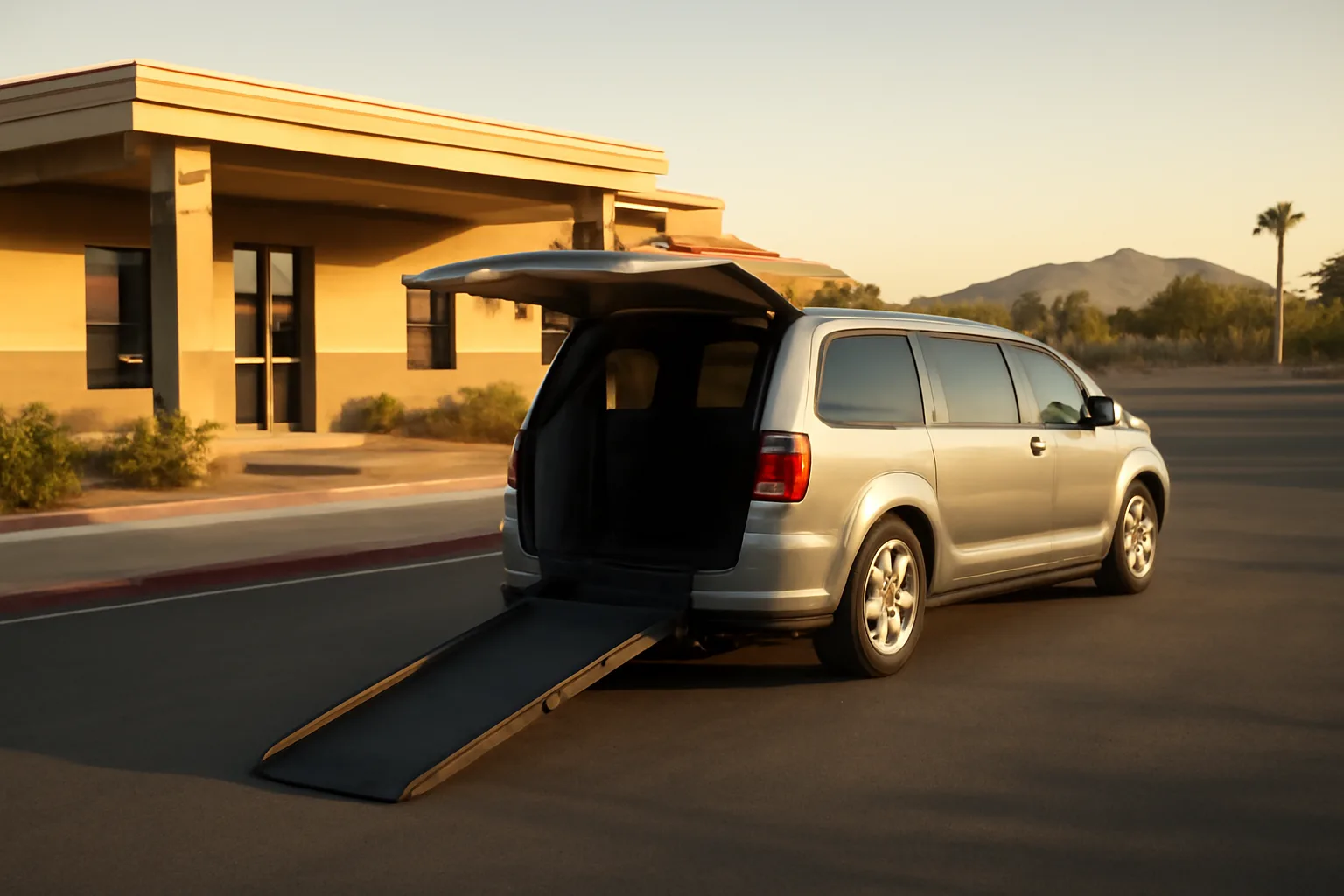
Brokers generally require ADA-compliant wheelchair lifts or ramps, functioning tie-down and occupant restraint systems for wheelchairs (commonly held to WC19 crash-tested standards for the securement hardware itself), current state vehicle inspection, and vehicle age within whatever cutoff the broker sets (commonly somewhere in the 7-10 year range, though this varies by broker and changes over time). A typical setup is a full-size van (Ford Transit, Dodge ProMaster, or similar) or a converted minivan with a side or rear-entry ramp. Full-size vans usually handle two or more wheelchair positions plus ambulatory seating; converted minivans handle one wheelchair position and are cheaper to acquire and run but less flexible for multi-loading trips, which matters in a spread-out market like Las Vegas where dispatchers often try to combine pickups on the way to a dialysis center. Heat is a real operational factor here that doesn't show up in generic NEMT guides written for other climates. Las Vegas summers regularly hit well past 100°F, and both your equipment (lift hydraulics, tie-down webbing, tire pressure) and your passengers (many with health conditions that make heat tolerance worse) need real margin. Budget for a functioning AC system that can cool the cargo area, more than the cab, and factor extra pre-trip inspection time in July and August. Our vehicles-and-equipment hub has model-specific comparisons if you're still deciding between a van and a converted minivan.
How much does it cost to launch NEMT in Las Vegas, and what's actually optional?
The real cost drivers are the vehicle, insurance, and time, not the paperwork itself. A used ADA-compliant wheelchair van typically runs from the high five figures for an older, high-mileage unit to well over $60,000-$70,000 for a newer conversion; new wheelchair-accessible vans from a certified mobility dealer commonly start well above that. Commercial auto insurance with livery/paratransit endorsement for a single vehicle is a recurring annual cost that varies widely by driving record, vehicle type, and state, so get quotes from at least two carriers that specifically write NEMT policies rather than assuming your existing commercial auto agent covers this niche correctly. What's optional, in our view: elaborate branding and signage before you have a single broker contract in hand (get credentialed first, wrap the van later); GPS/dispatch software subscriptions beyond whatever your broker requires you to run, at least in year one; and a second vehicle before your first one is generating consistent trip volume. What's not optional: the insurance endorsement, the background checks, and enough runway to cover months of enrollment and credentialing lead time before your first paid trip, because that timeline is rarely fast. If you want a single, organized starting point for both the state paperwork and the broker packet requirements rather than piecing it together from a dozen agency pages, that's exactly the gap our $199 one-time State + Broker NEMT Launch Kit is built to close. It's a reference tool, not a guarantee of enrollment or credentialing approval; every state and broker still makes its own decision on your application.
How long does Nevada Medicaid and broker approval actually take?
There's no single published number for combined state-plus-broker timeline because it depends on how complete your first submission is and how backed up the reviewing office is that month. What's knowable: Medicaid provider enrollment applications commonly take several weeks at minimum once submitted complete, and that clock resets or pauses whenever the agency requests corrections or missing documents, which is the single most common cause of delay. Broker credentialing tends to run on a separate, often shorter, timeline once your state enrollment is confirmed, but it depends entirely on the specific broker's current backlog and whether your vehicle passes inspection on the first attempt. Confirm current processing time estimates directly with the Nevada Medicaid transportation unit and your target broker before you commit to a start date, lease payment, or driver hire date based on an assumed timeline. The practical move: submit your Nevada Medicaid application and your broker credentialing packet as close to simultaneously as the broker allows, rather than waiting for full state approval before starting the broker paperwork. Many brokers will begin document review before your Medicaid number is finalized, as long as you can show the application is in process.
What ongoing compliance keeps a Las Vegas NEMT provider credentialed?
Credentialing isn't a one-time event. Nevada Medicaid provider enrollment typically requires periodic revalidation (federal rule under 42 CFR 455.414 requires state Medicaid agencies to revalidate enrollment of all providers at least every 5 years) , and brokers layer their own more frequent requirements on top: annual insurance certificate renewal, periodic vehicle re-inspection, updated driver MVR pulls, and refresher training modules. Miss a renewal deadline and brokers commonly suspend trip assignment until the file is current again, which is lost income you can't recover retroactively. Set calendar reminders well ahead of expiration dates for insurance, vehicle inspection, and any state license or NTSA certificate, since "the broker didn't remind me" isn't a defense that gets your trips restored faster. Complaints, accident reports, and rider incident reports also feed back into your credentialing file. A pattern of late pickups or cancelled trips is one of the more common reasons brokers cite for reducing trip volume to a provider or pulling credentialing altogether, separate from any state Medicaid action.
Frequently asked questions
What is non-emergency medical transportation?
Non-emergency medical transportation (NEMT) is scheduled transport to and from covered medical services for people who don't need an ambulance, such as rides to dialysis, chemo, or a specialist visit. Federal Medicaid rule 42 CFR 431.53 requires states to ensure this transportation is available for beneficiaries who have no other way to get to care.
Does Medicaid cover ambulance rides?
Yes, Medicaid covers medically necessary ambulance rides, but that's a separate benefit from NEMT and billed under a different fee schedule. NEMT covers routine, scheduled rides to covered services; ambulance coverage is for emergency or urgent transport that requires actual medical transport equipment and staffing.
Does Medicare cover medical transportation?
Original Medicare Part B covers medically necessary ambulance transportation, per CMS, but generally doesn't cover routine non-emergency rides to a doctor's office. Some Medicare Advantage plans offer supplemental non-emergency transportation benefits under CMS flexibilities that started with the 2019 plan year, so check specific MA plan benefits.
How do I start a NEMT business in Las Vegas?
Form your LLC, get commercial auto insurance with a livery/paratransit endorsement, enroll as a Nevada Medicaid provider through the state's MMIS portal, get credentialed with the transportation broker covering your area, and confirm whether Nevada Transportation Authority permitting under NRS 706 applies to your vehicle and trip types.
Can I start a NEMT business with just one wheelchair van?
Yes. One van is a normal, common way to start, and the enrollment and credentialing process works the same whether you own one vehicle or five. Many single-van operators credential with more than one broker to get more trip assignment opportunities, though confirm with your broker whether that's allowed under their current contract.
How much does it cost to start a wheelchair van NEMT business?
The biggest costs are the vehicle (used ADA-compliant wheelchair vans commonly range from the high five figures to $60,000-$70,000+ depending on age and condition) and ongoing commercial insurance with a livery endorsement. Get quotes from insurers who specifically write NEMT policies, since generic commercial auto coverage often won't satisfy broker requirements.
How long does it take to get credentialed with a NEMT broker?
There's no fixed published number since it depends on submission completeness and the broker's current backlog. Nevada Medicaid provider enrollment commonly takes several weeks at minimum, and broker credentialing runs on a separate timeline afterward. Confirm current estimates directly with the Nevada Medicaid transportation unit and your target broker before setting a launch date.
Do I need a Nevada Transportation Authority permit for NEMT?
It depends on your vehicle type and how trips are funded. Nevada regulates for-hire ground transportation under NRS Chapter 706 through the Nevada Transportation Authority, and some medical transport categories fall under certificate or exemption rules there. Confirm with the NTA and your broker whether your specific setup requires a certificate.
What's the difference between NEMT and an ambulance service?
NEMT is non-emergency, scheduled transport with no medical treatment provided en route; drivers aren't EMTs or paramedics. Ambulance service is licensed emergency medical transport staffed by certified EMS personnel, regulated separately under state EMS law, and reimbursed under a different Medicaid and Medicare benefit than NEMT.
Which NEMT brokers operate in Las Vegas and Nevada?
Nevada Medicaid managed care organizations contract with transportation brokers whose identity can change when the state rebids the contract. Names in this national space include Modivcare, MTM, Access2Care, and SafeRide, but confirm current broker assignment directly with Nevada Medicaid's transportation unit rather than assuming an older source is still accurate.
What documents does Nevada Medicaid provider enrollment require?
Typical requirements include your NPI, EIN, business license, ownership disclosure, and background check attestations under federal screening rules (42 CFR 455 Subpart E). Transportation providers are generally categorized at the moderate risk screening level, though states can elevate this, so confirm current requirements with Nevada Medicaid's enrollment portal.
How often does a NEMT provider need to revalidate with Medicaid?
Federal rule 42 CFR 455.414 requires state Medicaid agencies to revalidate provider enrollment at least every 5 years. Nevada Medicaid may set additional revalidation triggers, such as ownership changes or address changes, so track your revalidation date and respond to any state request promptly to avoid a lapse in billing eligibility.
Does hot weather in Las Vegas affect NEMT vehicle requirements?
There's no separate legal vehicle standard for heat, but practically, Las Vegas summers regularly exceed 100°F and put real strain on lift hydraulics, tie-down materials, and cargo-area cooling. Budget extra time for pre-trip inspections in summer months and make sure the AC system actually cools the passenger and cargo area, more than the driver's cab.
Sources
- 42 CFR 431.53, Assurance of transportation: States must ensure necessary transportation for Medicaid beneficiaries to and from providers
- Medicare.gov, Ambulance Services: Medicare Part B covers ground ambulance transportation when other transportation could endanger health
- Nevada Revised Statutes Chapter 706, Motor Carriers: Nevada regulates for-hire ground transportation carriers under NRS Chapter 706 via the Nevada Transportation Authority
- 42 CFR 424.518, Screening levels for Medicare providers and suppliers: Federal rule sets categorical risk screening levels (limited, moderate, high) applied to provider types including transportation
- 42 CFR 455.414, Revalidation of enrollment: State Medicaid agencies must revalidate enrollment of all providers at least every 5 years