Last updated 2026-07-25
TL;DR
A good NEMT business name is easy to say on the phone, has an available domain and LLC name in your state, and isn't so narrow ('John's Wheelchair Van') that it blocks growth. Naming is the easy part. The hard part is Medicaid provider enrollment and broker credentialing (Modivcare, MTM, Access2Care, SafeRide), which you should start before you settle on branding.
What is non-emergency medical transportation (NEMT)?
Non-emergency medical transportation, usually shortened to NEMT, is transportation to and from medical appointments for people who don't need an ambulance but can't get there on their own. Think dialysis three times a week, wheelchair users going to physical therapy, or a Medicaid enrollee without a car getting to a primary care visit. Federal Medicaid rules actually require this. States must "ensure necessary transportation for beneficiaries to and from providers" and can provide it directly, through contracts, or by paying beneficiaries' costs, per 42 CFR 431.53 [1]. That regulation is the reason NEMT exists as a paid service at all, and it's why almost every state runs some version of a broker system to manage it. Most states don't pay individual drivers directly. Instead they hire a transportation broker (Modivcare, MTM, Access2Care, SafeRide, or a state-specific vendor) to schedule rides and manage a network of transportation providers. If you're picturing a business, you're really picturing two separate approvals: state Medicaid provider enrollment, and broker network credentialing. Neither one cares what your business is named. Both care a lot about your vehicle, insurance, and driver files.
Does Medicaid cover ambulance rides, and how is that different from NEMT?
Yes, but ambulance transport and NEMT are two different benefit categories with different rules, and mixing them up in your business plan is a common early mistake. Medicaid covers ambulance services (emergency and some non-emergency ambulance transport) as a distinct benefit, generally requiring the vehicle and staff to meet state EMS licensing standards [2]. Medicaid.gov describes non-emergency medical transportation separately, as help getting Medicaid beneficiaries to and from covered medical services when they have no other way to get there [3]. In plain terms: an ambulance is for medical need during transport (monitoring, oxygen, a stretcher with clinical staff). NEMT is for access, not acuity. A wheelchair van, a sedan, or a stretcher car that isn't a licensed ambulance falls under NEMT. If you're buying a wheelchair van, you are almost certainly entering the NEMT lane, not the ambulance lane, and your state's EMS office isn't the agency you need. Your state Medicaid transportation unit or your state's designated broker is. Some states carve stretcher van service in with NEMT (non-ambulatory but non-emergency), others treat it closer to ambulance regulation. Confirm with your state Medicaid agency which category a stretcher van falls under before you buy one, because the licensing and insurance minimums can differ substantially.
Does Medicare cover medical transportation?
Medicare's NEMT coverage is much thinner than Medicaid's. Original Medicare Part B covers ambulance transportation when other transportation "could endanger your health" and the destination is medically necessary, per Medicare.gov [4]. Routine rides to a dialysis clinic or a checkup in a wheelchair van are generally not a Medicare Part B benefit. Where Medicare-adjacent NEMT work exists, it's usually through Medicare Advantage plans that offer transportation as a supplemental benefit, not through original Medicare itself. Coverage, trip limits, and the vendor network vary by plan and by year, so if a Medicare Advantage plan is part of your revenue plan, confirm directly with that specific plan's care coordination or transportation vendor, because there's no single federal answer that applies to every plan. This matters for naming and business strategy too. If most of your work will be Medicaid NEMT through a broker, your state's brand and program name (say, referencing your state's Medicaid managed care transportation program) can be a smart, searchable hook. If you're chasing Medicare Advantage supplemental rides, don't build your whole brand story around Medicaid; the payer mix is different and the contracts run through separate plan-level vendors.
How do you start a medical transportation business? (The real sequence)
Most new owner-operators try to pick a name first and figure out licensing later. Flip that order. Here's the sequence that actually avoids wasted money: 1. Confirm the vehicle type your state accepts for NEMT (ambulatory sedan, wheelchair van, stretcher van) and check state accessibility vehicle standards before you buy anything. 2. Form your business entity (LLC is standard) and get a federal EIN. 3. Get commercial auto insurance quotes specific to NEMT use, not personal or standard livery insurance; NEMT often needs higher liability limits than a normal rideshare policy. 4. Apply for state Medicaid provider enrollment as a transportation provider. Every state Medicaid agency has its own transportation provider enrollment page and packet; there is no single national application. 5. Apply for broker network credentialing (Modivcare, MTM, Access2Care, SafeRide, or your state's specific broker) once state enrollment is underway or complete, because most brokers require an active Medicaid provider number as a prerequisite. 6. Set up driver files: background checks, driving record pulls, defensive driving and passenger assistance training, drug testing where required. 7. Get your vehicle inspected to the standard your state or broker requires (often an annual DOT-style inspection plus wheelchair lift/tie-down certification). Only after steps 1 through 3 does naming even matter in a practical sense, because your name shows up on your Articles of Organization, your EIN paperwork, your insurance certificate, and your Medicaid provider application. Changing it later means re-filing several of those. Pick something you can live with before you file, not after.
How to start a NEMT business with one van (a realistic starter plan)
One van is genuinely enough to start; the industry is full of owner-operators who launched with exactly one wheelchair van. What one van cannot do is diversify your risk. If that van is in the shop for a week, or a driver quits, you have zero capacity that week. Plan for that reality rather than pretending it won't happen. With one vehicle, focus your energy on the paperwork that gates everything else: your state Medicaid enrollment application and at least one broker credentialing application. Trying to sign with every broker in your state on day one usually backfires; each broker has its own portal, insurance certificate requirements, and sometimes its own driver training modules. Pick the one or two brokers that actually run the most volume in your county (ask your state Medicaid transportation unit which broker manages which region, since it's often split by county or region) and get those files airtight. A single-van operation also needs a real answer for driver backup. If you are the only driver, what happens to your scheduled trips when you're sick? Some brokers will drop you from active rotation if you no-show too many rides, regardless of the reason. Line up at least one backup driver, even part time, before you're fully booked. For the actual mechanics of comparing what each broker wants (insurance minimums, inspection forms, background check standards), see broker credentialing basics and general program structure at non-emergency medical transportation.
How to start a non-emergency medical transportation business (state enrollment specifics)
State Medicaid transportation enrollment is not one form. Some states run NEMT as a fee-for-service Medicaid benefit managed directly by the state Medicaid agency's transportation unit. Others carve the entire benefit out to a single statewide broker, or split it regionally among two or three brokers. A few states fold NEMT into managed care organization (MCO) contracts, meaning you may need to credential with each MCO's transportation vendor separately. Because of that variation, the honest answer to "how do I enroll" is: find your specific state's Medicaid transportation unit page and read the current provider enrollment packet, since requirements (insurance minimums, vehicle age limits, driver background check lookback periods) differ by state and change over time. Medicaid.gov's state-by-state contact structure is the starting point if you don't already know your state agency's transportation unit contact [3]. Expect most states to ask for some combination of: a state business license, a valid Medicaid provider agreement or enrollment number, proof of commercial auto insurance meeting a stated minimum (often well above personal auto minimums), vehicle registration and inspection records, and a roster of drivers with background checks and, in many states, a drug and alcohol testing program. Some states also require a certificate of need or a separate transportation network company or ambulance service license depending on vehicle type, so confirm with your state Medicaid agency exactly which license category a wheelchair van (versus a stretcher van) falls under before you file anything.
What do NEMT brokers like Modivcare, MTM, Access2Care, and SafeRide actually require?
| Insurance minimums | Some require higher per-occurrence limits than your state Medicaid minimum | |
|---|---|---|
| Vehicle age limits | Some brokers cap vehicle age (for example, no vehicles over 7 to 10 years old); varies by contract | |
| Driver background lookback | Lookback period for criminal history and driving record varies by broker and state | |
| Onboarding time | Ranges widely; some brokers process faster than others depending on current application volume | |
| Dispatch technology | Each broker uses its own driver app or dispatch software, requiring separate training | No broker guarantees approval or a set number of trips once you're credentialed, and none of them promise a timeline publicly. Anyone who tells you otherwise is guessing. For a broader look at how the credentialing landscape works across brokers, see nemt transportation. |
Each broker runs its own credentialing process, and none of them are affiliated with RideCredential or with each other. Requirements shift over time, so treat anything below as a general shape, not a checklist to submit blind; confirm current specifics directly with each broker before you apply. Across most broker applications, expect to submit: proof of an active Medicaid provider number in that state, commercial auto insurance certificates naming the broker as certificate holder in many cases, vehicle photos and inspection documentation, driver license and background check records, and a completed provider application specific to that broker's portal. Some brokers require in-person or virtual orientation sessions before activating you in their dispatch system. Here's a rough comparison of what tends to differ broker to broker (confirm current details directly, since broker policy changes without much public notice): | Factor | What varies by broker |
How to pick a NEMT business name that actually helps you
A name matters far less than your Medicaid enrollment status, but it's not nothing. It shows up on your vehicle (if you brand it), your Google Business Profile, and every broker portal search. A few practical filters work better than brainstorming lists: Avoid over-narrowing. "[City] Wheelchair Van Service" boxes you into wheelchair-only trips and one city. If you later add ambulatory sedans or expand counties, the name fights you. A slightly broader name (something with "transport," "transit," "mobility," or "care" in it, paired with your region) tends to age better. Check three things before you fall in love with a name: your Secretary of State's business entity search (to confirm the LLC name is available in your state), a basic domain availability check, and a plain Google search for the exact name plus "NEMT" or "transportation" to see if a same-named company already operates nearby, which causes real confusion with brokers and patients alike. Skip words that imply a license or capability you don't have yet. Calling yourself an "ambulance service" or "medical transport EMS" when you're running wheelchair vans, not licensed ambulances, invites regulatory headaches and confuses referral sources who need to know the difference for billing purposes. Sample naming directions that tend to work across most states (adapt to your city or county name, and always run the availability checks above first):
- Geographic + mobility: "[County] Mobility Transit," "[Region] Access Transportation"
- Care-forward: "[City] CareRide," "Comfort Care Transport of [State]"
- Simple and durable: "[Last name] Medical Transit LLC," "[City] Non-Emergency Transport"
- Broker-neutral (won't need changing if you add ambulatory service later): "[Region] Patient Transit," "[City] Health Access Rides" None of these guarantee anything with a broker or a state agency. Naming is branding. Enrollment is the business.
What licenses, insurance, and vehicle standards does a wheelchair van need?
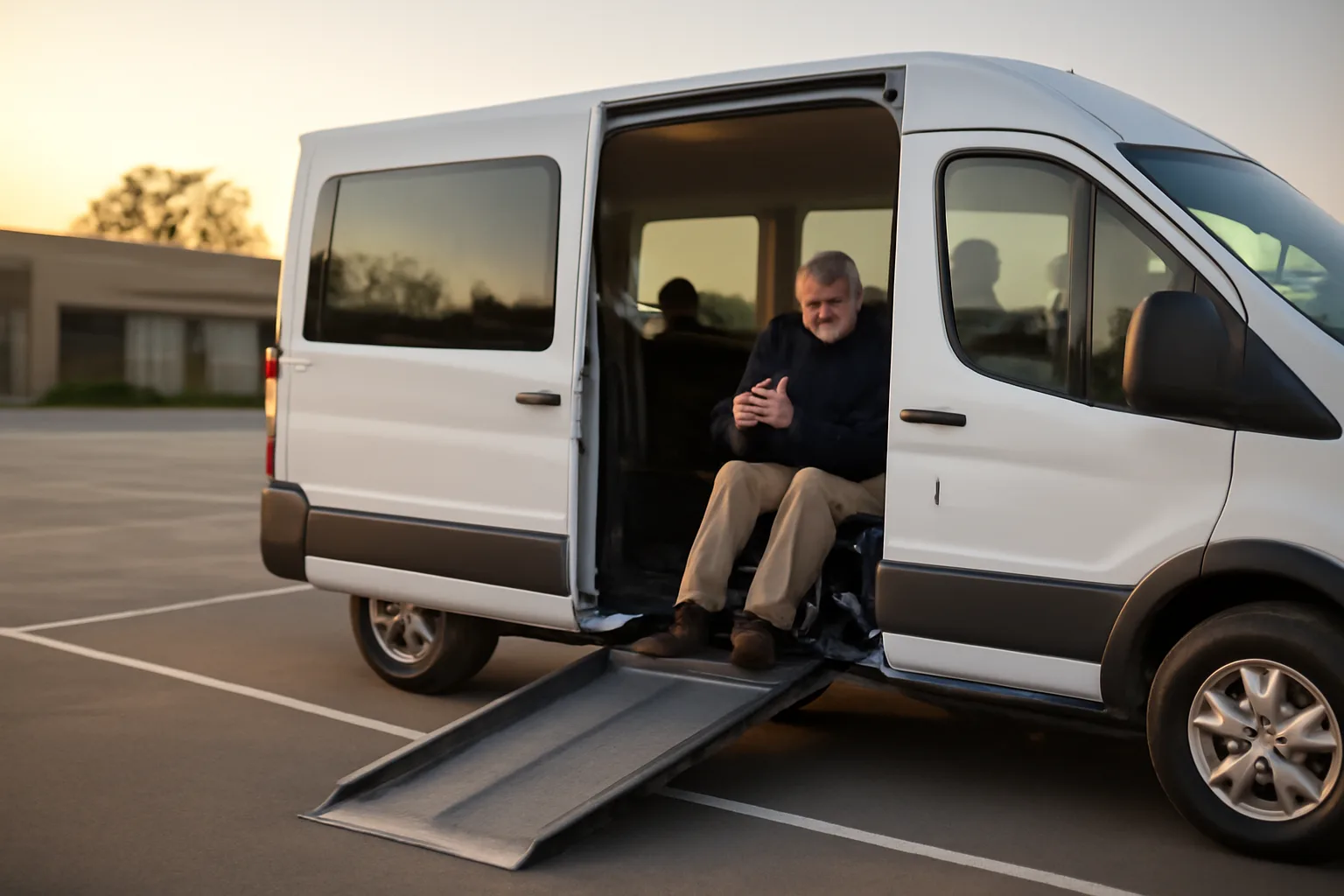
Requirements vary by state, but a few things are close to universal. Your vehicle needs a working wheelchair lift or ramp, secure wheelchair tie-down anchors (usually a four-point system), and passenger restraints appropriate for a wheelchair user, more than the vehicle's original seatbelts. Federal Transit Administration guidance under 49 CFR Part 38 sets accessibility specifications for vehicles used in public transportation service, including lift and securement standards, and many state Medicaid programs layer additional inspection requirements on top [5]. Commercial auto insurance for NEMT is not the same product as a personal auto policy or even standard rideshare insurance. Most states and brokers require specific liability minimums (commonly in the range of $500,000 to $1,000,000 combined single limit, though this varies significantly by state and broker, so confirm the exact figure required in your state and by your chosen broker before buying a policy). Driver requirements typically include a valid driver's license (commercial license requirements vary depending on vehicle size and state), a clean or explainable driving record, a criminal background check, and in many states specific passenger assistance or sensitivity training for transporting wheelchair users and people with cognitive or mobility impairments. Some states also require a state-specific NEMT driver certification course. Vehicle inspections are usually annual at minimum, sometimes more frequent for lift and tie-down function specifically. Keep every inspection record; brokers frequently audit these during recredentialing cycles, which often happen annually.
What does it actually cost to get a NEMT business enrolled and credentialed?
There's no single national fee schedule, because state Medicaid enrollment fees and broker application costs vary by state and by broker, and some categories change year to year. What's consistent is the shape of the spending: entity formation and EIN (often under $200 depending on state filing fees), commercial insurance (a recurring annual cost, not one-time, and the largest ongoing expense for most single-van operators), a compliant wheelchair-accessible vehicle (new or used, with lift and tie-down systems, representing the single largest upfront capital cost), driver background checks and training, and Medicaid provider enrollment fees (some states charge an application fee, others don't; confirm with your specific state Medicaid transportation unit). Broker credentialing itself is typically free to apply, since brokers profit from trip volume, not application fees, but confirm this with each broker directly since policy can vary. Where owner-operators actually lose money is in guessing at paperwork, submitting incomplete applications, missing an insurance requirement a broker didn't clearly publish, and having to resubmit weeks later. That's the gap a state and broker paperwork kit is built to close. RideCredential's $199 one-time State + Broker NEMT Launch Kit walks through the state Medicaid enrollment packet and broker credentialing checklists (Modivcare, MTM, Access2Care, SafeRide) so you're not guessing at requirements broker by broker; it doesn't promise approval, since no legitimate service can. You can start building your specific state and broker checklist at /launch-kit-builder.
How long does it take to get approved by a state and a broker?
There's no published national average, and any specific number you see online for "NEMT approval time" should be treated skeptically unless it names the state and broker. Timelines depend on how complete your first submission is, current application volume at the state agency or broker, and whether your insurance certificate and vehicle documentation match exactly what's requested. What's true across most states: incomplete applications are the single biggest delay driver. Missing a single insurance endorsement, submitting a vehicle inspection form that's expired, or leaving a driver background check pending are the most common reasons files sit for extra weeks. Building your file completely before first submission, rather than submitting fast and fixing errors piecemeal, is generally faster in total elapsed time even though it feels slower up front. Most states also require periodic recredentialing, commonly annual, so treat this as an ongoing compliance cycle, not a one-time hurdle. Set a calendar reminder for your insurance renewal date and your broker recredentialing date well before they're due; a lapsed policy for even a few days can trigger a suspension from active dispatch rotation.
Frequently asked questions
What is NEMT?
NEMT stands for non-emergency medical transportation: rides for people who need help getting to medical appointments but don't require an ambulance. It covers wheelchair vans, ambulatory sedans, and stretcher vans. Federal Medicaid rules require states to ensure this transportation exists for beneficiaries under 42 CFR 431.53, usually delivered through state-contracted brokers.
Does Medicaid cover ambulance rides?
Yes. Medicaid covers ambulance services as a distinct benefit from NEMT, generally requiring the vehicle and crew to meet state EMS licensing standards. This is different from wheelchair van or sedan NEMT rides, which don't require ambulance licensing. Confirm the exact coverage rules and vehicle categories with your state Medicaid agency, since they vary by state.
Does Medicare cover medical transportation?
Original Medicare Part B covers ambulance transportation when other transport would endanger your health, per Medicare.gov, but it generally doesn't cover routine non-emergency rides in a wheelchair van or sedan. Some Medicare Advantage plans offer NEMT as a supplemental benefit through their own vendor networks; confirm coverage details directly with the specific plan.
How do I start a medical transportation business?
Form your business entity, get commercial auto insurance built for NEMT use, confirm your state's accepted vehicle types, apply for state Medicaid provider enrollment, then apply for broker credentialing (Modivcare, MTM, Access2Care, SafeRide, or your state's broker). Set up driver background checks and training before your first ride, since brokers audit these files.
How do you start a NEMT business with just one van?
One van is enough to launch. Focus on getting your state Medicaid enrollment and one or two broker credentialing files complete and accurate rather than spreading thin across every broker in your state. Line up a backup driver early, since a single-vehicle operation has zero redundancy if that van or driver is unavailable.
What licenses do I need for a wheelchair van NEMT business?
Typically: a state business license/LLC, state Medicaid provider enrollment, broker credentialing with your regional broker(s), commercial auto insurance meeting state/broker minimums, vehicle inspection certification (including lift and tie-down function), and driver background checks with state-required training. Exact requirements vary by state, so confirm the current packet with your state Medicaid transportation unit.
How much does NEMT insurance cost?
There's no single figure, since it depends on your state, vehicle count, and driving records, but commercial NEMT auto insurance is a recurring annual cost, not one-time, and usually the largest ongoing operating expense for a single-van operator. Liability minimums required by states and brokers commonly range higher than standard personal auto coverage; confirm exact minimums with your broker and state.
Do NEMT brokers guarantee trip volume once I'm credentialed?
No. Being credentialed with a broker like Modivcare, MTM, Access2Care, or SafeRide means you're eligible to receive dispatched trips, not guaranteed a set volume. Trip assignment depends on the broker's current demand in your area, your service radius, and your active vehicle capacity. No credentialing service or broker can promise trip volume.
Can I name my NEMT business anything I want?
Mostly yes, but check three things first: your Secretary of State business entity search to confirm the LLC name is available, domain availability, and whether a similarly named transportation company already operates in your area. Avoid names implying ambulance or EMS-level service if you're only running wheelchair vans, since that misleads referral sources.
What is the difference between NEMT and ambulance transport?
Ambulance transport is for medical need during transit, requiring licensed EMS vehicles and staff. NEMT is for access, moving people who don't need medical monitoring en route but can't get to appointments on their own, using wheelchair vans, sedans, or stretcher vans. They're billed and licensed under separate categories in most states.
How long does state Medicaid NEMT enrollment take?
There's no published national average and it varies heavily by state and application completeness. Incomplete submissions (expired insurance certificates, missing vehicle inspection forms, pending driver background checks) are the most common cause of delay. Building a complete file before first submission is generally faster overall than submitting quickly and fixing errors afterward.
Do I need a commercial driver's license (CDL) to drive a wheelchair van?
Usually not for a standard wheelchair van, since CDL requirements are based on vehicle weight and passenger capacity, not the fact that it's medical transport. Larger vans or multi-passenger vehicles may cross CDL thresholds under your state's licensing rules. Confirm the exact weight and passenger-count thresholds with your state's driver licensing agency.
What is a NEMT broker and why do I need to credential with one?
A NEMT broker (Modivcare, MTM, Access2Care, SafeRide, or a state-specific vendor) is a company most state Medicaid agencies hire to schedule rides and manage the transportation provider network. Credentialing with a broker is usually required to receive dispatched Medicaid trips, separate from your state Medicaid provider enrollment itself.
Sources
- 42 CFR 431.53, eCFR: States must ensure necessary transportation for Medicaid beneficiaries to and from providers
- Medicaid.gov, Ambulance Services: Medicaid covers ambulance services as a distinct benefit category from NEMT
- Medicaid.gov, Non-Emergency Medical Transportation: Definition and structure of NEMT as a Medicaid benefit for beneficiaries with no other transportation
- Medicare.gov, Ambulance Services coverage: Medicare Part B covers ambulance transportation when other transportation could endanger health
- 49 CFR Part 38, eCFR (Americans with Disabilities Act Accessibility Specifications for Transportation Vehicles): Federal accessibility specifications apply to vehicles used in transportation service, including wheelchair lifts and securement systems
- 42 CFR 440.170, eCFR: Federal definition of transportation as a Medicaid benefit category, distinguishing it from other medical assistance services