Last updated 2026-07-25
TL;DR
A medical transportation business plan for NEMT covers your service area, one vehicle to start, state Medicaid provider enrollment, broker credentialing (Modivcare, MTM, and similar), insurance, and driver requirements. There's no single national template because Medicaid NEMT rules are set state by state under 42 CFR 440.170(a), so your plan has to match your specific state Medicaid agency's requirements.
What is NEMT and how is it different from an ambulance?
Non-emergency medical transportation (NEMT) is scheduled transport for people who need to get to medical appointments, dialysis, or therapy but don't need an ambulance or emergency care during the ride. Think wheelchair vans, ambulatory sedans, and stretcher vans, not lights-and-sirens rigs. Federal Medicaid rules require states to make sure eligible people can get to and from providers. The regulation says state Medicaid plans must "specify that the Medicaid agency will ensure necessary transportation for recipients to and from providers" [1]. States can run this directly, contract with a broker, or mix both models. That single fact, direct-run versus broker-run versus hybrid, is why the rules you'll actually operate under vary so much from state to state. Ambulances are a separate Medicaid benefit category (emergency and non-emergency ambulance transport under 42 CFR 440.170(a)), usually billed through a different provider type and often reimbursed at different rates than NEMT. If you're running a wheelchair van or ambulatory sedan business, you're in the NEMT lane, not the ambulance lane. Don't confuse the two when you're researching enrollment forms; some states even split them into different provider manuals entirely. For a broader look at how NEMT fits into the Medicaid transportation picture, see medical transportation and nemt.
Does Medicaid cover ambulance rides?
Yes. Medicaid covers ambulance transportation as a distinct benefit under 42 CFR 440.170(a), separate from the NEMT benefit that covers wheelchair vans and non-ambulance rides. Coverage details, prior authorization rules, and reimbursement rates for ambulance transport are set by each state Medicaid agency. The federal regulation gives states room to define "necessary transportation" broadly, covering both emergency ambulance runs and non-emergency transport, but it does not set one uniform national rate or one uniform prior authorization process [1]. If you're building a wheelchair van business, ambulance coverage rules mostly matter to you as background. You need to know the line between what an ambulance handles (medical necessity requiring in-transit care) and what your van handles (a member who is stable but can't get to the clinic on their own). Check your state Medicaid agency's ambulance and NEMT provider manuals separately. Some states, like Texas through its Medical Transportation Program, publish separate sections for emergency ambulance and non-emergency transport, and the enrollment paths are not interchangeable.
Does Medicare cover medical transportation?
Medicare Part B covers emergency ambulance transportation when it's medically necessary, and it covers non-emergency ambulance transportation in limited situations, generally when a doctor certifies it's medically required and other transport would endanger the patient's health [2]. Medicare does not broadly cover routine non-emergency medical transportation the way state Medicaid NEMT programs do. This is the single most common confusion new owner-operators run into. Medicaid NEMT is a state-run benefit for Medicaid enrollees getting to routine appointments; Medicare's transportation coverage is narrower and ambulance-focused. Medicare Advantage plans are a separate story: some offer supplemental transportation benefits as part of their plan design, but that's decided plan by plan, not guaranteed by traditional Medicare [2]. If your business plan leans on Medicare Advantage transportation benefits as a source of income, confirm the specific plan's supplemental benefit language directly with that insurer. Don't assume it exists just because one plan in your state offers it.
How do you start a medical transportation business, step by step?
Start with the business basics before you touch a Medicaid application: form your legal entity (LLC is common), get an EIN from the IRS, and get general liability and commercial auto insurance quotes so you know your real fixed costs. Then layer in the NEMT-specific steps. Here's the realistic sequence most new operators follow: 1. Business entity formation and EIN. 2. Commercial auto insurance and general liability insurance quotes (get these early; they affect your vehicle budget). 3. Vehicle purchase or lease (wheelchair-accessible van, ADA-compliant lift or ramp). 4. State-specific vehicle inspection and permitting (some states require a separate NEMT vehicle permit or decal). 5. Driver requirements: background checks, drug testing, defensive driving or passenger assistance training, sometimes a specific NEMT driver certification. 6. State Medicaid provider enrollment (this can take weeks to months depending on the state). 7. Broker credentialing with the transportation broker(s) operating in your region (Modivcare, MTM, Access2Care, and others vary by state and county). 8. Trip dispatch software or a manual system for scheduling, GPS tracking, and mileage logs, since brokers typically audit these. The order matters less than the overlap: state enrollment and broker credentialing can often run in parallel, but both usually require your vehicle and insurance paperwork already in hand, so don't apply too early. For a walkthrough of the enrollment side specifically, see non emergency medical transportation.
How to start a NEMT business with just one van
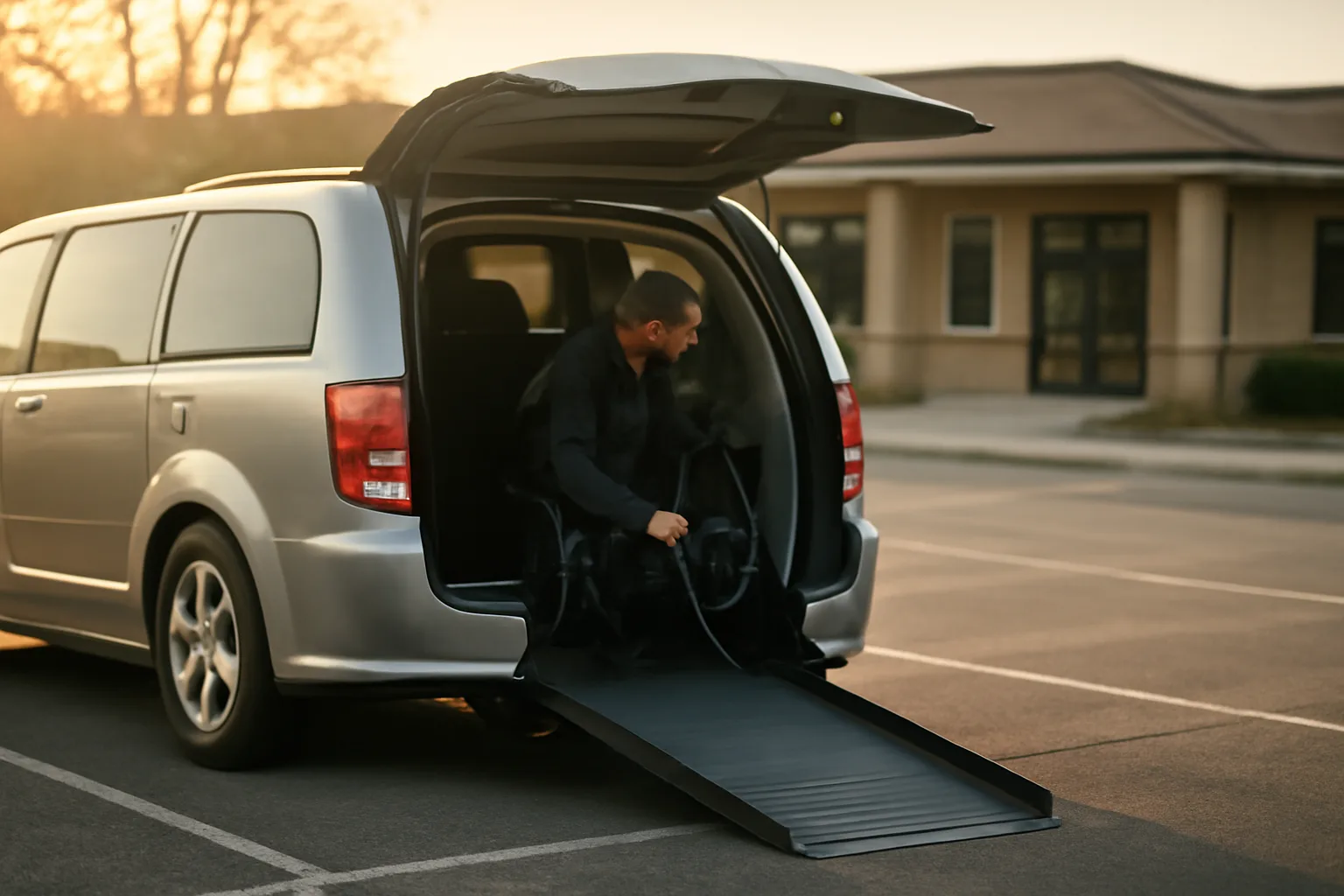
You can absolutely start with one wheelchair van; plenty of owner-operators do. The core requirements (entity formation, insurance, driver background checks, state Medicaid enrollment, broker credentialing) apply whether you own one van or twenty. What changes with a single vehicle is your risk exposure and your scheduling flexibility, not your paperwork burden. With one van, your business plan should be honest about capacity limits. You can't take every trip a broker offers you, and dispatch systems track your on-time performance and trip acceptance rate, which matters for staying in good standing. A missed pickup with one van and no backup driver is a bigger operational problem than the same miss at a ten-van company. Most states don't set a minimum fleet size to enroll as a Medicaid NEMT provider, but they do require your vehicle(s) to meet specific standards: functioning wheelchair lifts or ramps, secure wheelchair tie-downs, and passing a state or third-party vehicle inspection. Confirm your state's exact vehicle inspection requirements with your state Medicaid transportation unit before you buy, especially if you're buying used. One practical tip: budget for a backup driver or a mutual-aid arrangement with another small operator before you take your first trip. Brokers do not care that your one van broke down; a no-show still counts against your record.
How to start a non-emergency medical transportation business the right way
"The right way" mostly means sequencing your paperwork so you're not paying for things twice. A lot of new owner-operators buy a van first, then discover their state requires a specific lift certification or a different insurance endorsement, and they have to redo work. Before you buy a vehicle:
- Call your state Medicaid transportation unit (or check its NEMT provider manual) to confirm vehicle standards, driver qualification rules, and whether you need a separate transportation permit from your state DOT or DMV.
- Ask which broker(s) hold the NEMT contract in your county, since in broker-managed states you'll need both the state Medicaid provider number and separate broker credentialing.
- Get insurance quotes for commercial auto coverage that specifically covers wheelchair-accessible passenger transport, more than general commercial auto, since some insurers price these differently. After you have the vehicle:
- Complete state Medicaid provider enrollment. Requirements commonly include a National Provider Identifier (NPI), proof of insurance, vehicle inspection documentation, and background checks on all drivers.
- Apply for broker credentialing. Each broker (Modivcare, MTM, Access2Care, SafeRide, and others depending on your state and contract) runs its own credentialing process on top of state enrollment, with its own document checklist and sometimes its own onboarding orientation.
- Set up your trip logging and mileage documentation system before your first trip, not after your first audit. For state-by-state specifics, non emergency medical transportation services and nemt transportation walk through what documentation states commonly ask for.
What goes into a medical transportation services business plan?
A usable NEMT business plan has the same bones as any small transportation business plan, plus a section that proves you understand Medicaid enrollment and broker credentialing specifically. Skip the generic 40-page template you'll find on business-plan sites; a lender or your own planning process needs something more concrete. Core sections worth including: - Business summary: entity type, service area (county or region), vehicle type(s), and which population you're serving (wheelchair, ambulatory, stretcher).
- Regulatory and licensing plan: your state Medicaid enrollment path, the broker(s) you'll credential with, vehicle inspection and driver qualification requirements specific to your state.
- Insurance and liability plan: commercial auto coverage limits, general liability, and how you'll handle claims involving a passenger with a disability.
- Vehicle and equipment plan: number of vans, lift/ramp type, maintenance schedule, replacement timeline.
- Staffing plan: driver qualifications, background check process, training (defensive driving, passenger assistance, HIPAA basics since you're handling protected health information from broker dispatch systems).
- Operations plan: how trips get assigned (broker dispatch software vs. your own scheduling), how you log mileage and pickup/drop-off times for broker audits, backup vehicle or driver plan.
- Financial plan: startup costs (vehicle, insurance, permits, software), ongoing costs (fuel, maintenance, insurance renewal), and a break-even framework based on your actual cost structure rather than a borrowed industry average, since per-trip reimbursement rates vary by state and by broker contract. Notice what's missing from that list: made-up trip-volume forecasts. Reimbursement rates and trip volume depend entirely on your state's Medicaid rate schedule and the broker's dispatch volume in your county, both of which you should get directly from the broker contract and your state's published Medicaid transportation fee schedule, not from a generic business plan template.
How does Medicaid provider enrollment actually work for NEMT?
Enrollment is state-run. Each state Medicaid agency (or its designated NEMT broker) sets its own application, required documents, and timeline, so there is no single federal NEMT enrollment form. The federal rule only requires that states "ensure necessary transportation" for Medicaid enrollees; it leaves the mechanics to the states [1]. Common documents states and brokers ask for, though exact requirements vary: - Business license and entity documents (Articles of Organization or Incorporation)
- Employer Identification Number (EIN)
- National Provider Identifier (NPI), typically Type 2 for the organization
- Proof of commercial auto insurance meeting state minimums
- Vehicle registration and inspection certificates
- Driver background check results (many states require checks against state and federal exclusion lists)
- W-9 and banking information for direct deposit of reimbursements States handle exclusion screening under a federal framework, too. Federal regulation requires state Medicaid agencies to check the Social Security Act Section 1128 and 1156 exclusion status of providers and to deny or terminate enrollment for excluded individuals or entities, and CMS directs states to check the HHS Office of Inspector General's List of Excluded Individuals/Entities (LEIE) as part of that screening, both before enrollment and monthly thereafter [3]. Some states run NEMT enrollment entirely in-house through the state Medicaid agency; others contract it out to a broker who handles credentialing on the state's behalf. In broker-managed states, you may need to complete both a state Medicaid provider enrollment (to get a provider number) and separate broker credentialing (to get dispatched trips), and the two processes don't always run on the same timeline. Confirm with your state Medicaid agency's transportation unit whether NEMT in your state is broker-managed, state-run, or a hybrid, since this single fact changes your whole enrollment sequence.
How does broker credentialing work with Modivcare, MTM, Access2Care, and SafeRide?
Brokers run their own credentialing process on top of, not instead of, state Medicaid enrollment in most states. Each broker sets its own document checklist, insurance minimums, vehicle inspection standard, and sometimes its own driver training or orientation requirement, separate from what the state Medicaid agency requires. This matters because the brokers hold different contracts in different states and even different counties within the same state. Modivcare, MTM, Access2Care, and SafeRide are the names new operators hear most often, but which broker (if any) holds the contract in your service area depends entirely on your state's current Medicaid transportation contract, and these contracts do change hands periodically when states rebid them. Before you invest time in credentialing paperwork: 1. Confirm which broker currently holds the NEMT contract for your specific county or region. Call your state Medicaid transportation unit directly; broker contracts change, so don't rely on outdated forum posts. 2. Ask the broker for their current owner-operator or subcontractor credentialing packet. 3. Compare their vehicle, insurance, and driver requirements against your state's Medicaid requirements. They usually overlap heavily but aren't always identical. 4. Ask about their dispatch software and whether it requires specific hardware (a tablet or phone app) as a condition of getting trips assigned. No broker publishes guaranteed acceptance rates for new owner-operators, and nobody outside the broker's own compliance office can promise you'll get credentialed on a specific timeline. Treat any claim otherwise with real skepticism.
What insurance and vehicle requirements should be in the plan?
Insurance requirements for NEMT vehicles are set by your state, and they're typically higher than standard personal auto minimums because you're transporting people with mobility limitations. Commercial auto liability limits for NEMT vehicles commonly run higher than a standard personal policy; some states and broker contracts specify particular per-occurrence minimums, so get the exact figure from your state Medicaid transportation unit and from your broker's credentialing packet rather than assuming a number. Your wheelchair van itself needs to meet ADA-related accessibility standards: a working lift or ramp, secure wheelchair tie-down systems, and, in most states, a passing vehicle inspection specific to NEMT (separate from your regular state vehicle inspection). Federal accessibility design standards for vehicle lifts and securement points come from the ADA Standards for Transportation Vehicles under 49 CFR Part 38 [4], which many state NEMT vehicle inspection checklists reference or build on. Some states require this inspection annually; others tie it to your Medicaid re-enrollment cycle. Don't skip requesting a written list of vehicle inspection criteria before you buy a used van. A cheap used wheelchair van that fails your state's lift inspection or lacks proper tie-down anchor points is not actually cheap once you factor in the retrofit cost.
What should the financial section of the plan actually say?
Be honest about what you don't know yet. Per-trip reimbursement rates for NEMT are set by state Medicaid fee schedules and, in broker-managed states, by the rate the broker pays subcontractors, which is often lower than the state's fee-for-service rate because the broker takes a management cut. These numbers vary so much by state and by broker contract that any generic figure floating around online is close to useless for your actual plan. What you can and should put real numbers on: - Vehicle purchase or lease cost (get actual quotes for wheelchair-accessible vans, new and used)
- Insurance premium quotes (call at least two commercial auto insurers that specifically write NEMT policies)
- Fuel and maintenance estimates based on your actual vehicle's mileage and your local fuel prices
- Software or dispatch technology costs, if the broker requires a specific platform
- Driver wages if you're hiring, or your own time cost if you're driving
- State enrollment and any permit fees (these are usually modest, but they vary by state) Build your break-even model around your real fixed costs. Then ask your target broker directly for their current per-trip and per-mile rate structure before you finalize anything. Don't publish or rely on trip-volume or income figures pulled from generic online templates; they're not tied to your state's actual Medicaid rate schedule and they'll mislead you or a lender.
Where should you go for the actual paperwork and confirmation?
Two sources matter more than anything else: your state Medicaid agency's transportation unit (sometimes called the Medical Transportation Program, or listed under "NEMT" in the state Medicaid provider manual) and the specific broker's credentialing office for your region. Everything else, including this article, is background context. Federal Medicaid regulation on transportation, 42 CFR 440.170(a), tells you the baseline obligation states have to "ensure necessary transportation" [1], but the actual enrollment form, required documents, vehicle standards, and broker contract are entirely state-level and broker-level decisions. Medicaid.gov's non-emergency medical transportation page is a useful starting point for understanding the federal framework [5], but it will point you back to your state for the actual application. If you want a structured starting document that walks through the state enrollment forms and broker credentialing checklists side by side instead of hunting through dozens of separate PDFs, that's the specific gap the RideCredential Launch Kit is built to close; it's a $199 one-time reference package, not a guarantee of approval from any state or broker. You can look at it at /launch-kit-builder, but confirm every specific requirement directly with your state Medicaid agency and broker before you submit anything, since rules change and no third-party document overrides the official one.
Frequently asked questions
How to start a medical transportation business?
Form your business entity, get commercial auto and liability insurance, buy or lease a wheelchair-accessible van that meets your state's inspection standards, complete driver background checks, enroll as a provider with your state Medicaid agency, and get credentialed with whichever broker holds the NEMT contract in your area. Timelines and exact document requirements vary by state, so confirm specifics with your state Medicaid transportation unit.
Does Medicaid cover ambulance rides?
Yes, Medicaid covers ambulance transportation under 42 CFR 440.170(a), as a benefit separate from non-emergency medical transportation (NEMT). Coverage rules, prior authorization requirements, and reimbursement rates for ambulance rides are set individually by each state Medicaid agency, so confirm specifics with your state Medicaid transportation unit rather than assuming national uniformity.
What is NEMT?
NEMT stands for non-emergency medical transportation: scheduled rides (wheelchair van, ambulatory sedan, or stretcher van) for people who need to get to medical appointments but don't require ambulance-level care during transport. States must ensure Medicaid enrollees have necessary transportation to providers under 42 CFR 440.170(a), and most states run NEMT through a contracted broker or directly through the state Medicaid agency.
Does Medicare cover medical transportation?
Medicare Part B covers emergency ambulance transportation and limited non-emergency ambulance transportation when medically necessary and certified by a doctor. It generally does not cover routine non-emergency medical transportation the way state Medicaid NEMT programs do. Some Medicare Advantage plans offer supplemental transportation benefits, but that varies plan by plan, not through traditional Medicare.
How to start a NEMT business?
Start with entity formation, insurance, and a wheelchair-accessible vehicle that meets your state's inspection standards. Then complete driver background checks, apply for state Medicaid provider enrollment, and get credentialed with your regional broker (commonly Modivcare, MTM, Access2Care, or SafeRide depending on your state's contract). State and broker requirements run in parallel but aren't identical, so confirm both separately.
How do you start a medical transportation business?
You start it like any small transportation business plus regulated healthcare-adjacent compliance: business formation, insurance, vehicle standards, driver background checks, and two layers of enrollment (state Medicaid and broker credentialing). There's no single national process; every state Medicaid transportation unit sets its own rules under the federal framework in 42 CFR 440.170(a).
What is non emergency medical transportation?
Non-emergency medical transportation (NEMT) is transport for Medicaid enrollees (and some Medicare Advantage members) getting to routine medical appointments, dialysis, or therapy, using wheelchair vans, ambulatory vehicles, or stretcher vans rather than ambulances. Federal Medicaid rule requires states to ensure this transportation is available, but each state designs and runs its own program or broker contract.
How to start a medical transportation business with one van?
One van is enough to start; there's typically no state-mandated minimum fleet size for Medicaid NEMT enrollment. Focus on getting your single vehicle fully compliant (lift/ramp, tie-downs, inspection), completing state enrollment and broker credentialing, and having a backup driver or vehicle plan since a missed pickup with no backup hurts your standing with brokers.
How to start a non-emergency medical transportation business?
Confirm your state's vehicle, insurance, and driver requirements before buying a van, then complete state Medicaid provider enrollment and broker credentialing with the broker(s) operating in your county. Set up trip logging and mileage documentation before your first ride, since brokers commonly audit this data.
Do I need both state Medicaid enrollment and broker credentialing?
In most states, yes. Many states contract NEMT out to a broker (like Modivcare or MTM), which means you typically need a state Medicaid provider number and separate broker credentialing to actually get dispatched trips. Some states run NEMT directly without a broker. Confirm your state's specific model with its Medicaid transportation unit.
What vehicle requirements does a wheelchair van need for NEMT?
Requirements vary by state but commonly include a functioning wheelchair lift or ramp, secure wheelchair tie-down anchor points, and a passing state or broker-specific vehicle inspection separate from standard vehicle registration. Federal accessibility design standards for lifts and securement come from 49 CFR Part 38. Insurance minimums for NEMT vehicles are also often higher than standard personal auto policies. Get the exact checklist from your state Medicaid transportation unit before buying.
Can I get NEMT trip-volume or income figures for my business plan?
No reliable general figure exists because per-trip reimbursement rates and trip volume depend entirely on your state's Medicaid fee schedule and your broker's contract terms in your specific county. Build your financial plan around your actual fixed costs (vehicle, insurance, fuel) and ask your target broker directly for their current rate structure rather than relying on generic online numbers.
Sources
- Cornell Legal Information Institute, 42 CFR 440.170: Federal Medicaid regulation requiring states to ensure necessary transportation for recipients to and from providers, and defining transportation and ambulance service coverage
- Medicare.gov, Ambulance Services coverage: Medicare Part B covers emergency ambulance transportation and limited medically necessary non-emergency ambulance transportation
- Medicaid.gov, Non-Emergency Medical Transportation: Federal overview of the NEMT benefit and state role in administering non-emergency medical transportation for Medicaid enrollees
- 42 CFR 455.436, Federal database checks for excluded providers: State Medicaid agencies must check the LEIE and other federal exclusion databases before enrollment and monthly thereafter
- eCFR, 49 CFR Part 38, ADA Accessibility Specifications for Transportation Vehicles: Federal accessibility design standards for vehicle lifts, ramps, and wheelchair securement systems used in NEMT vehicle inspections
- Social Security Act Section 1128, Exclusion of Certain Individuals and Entities from Participation in Medicaid: Statutory basis for excluding individuals and entities from Medicaid program participation, which underlies state provider exclusion screening