Last updated 2026-07-25
TL;DR
NEMT (non-emergency medical transportation) is transport to and from medical appointments for people who don't need an ambulance but can't drive themselves. Medicaid must cover it under federal rule 42 CFR 431.53. Starting a business means state Medicaid enrollment, broker credentialing (Modivcare, MTM, and similar), a compliant wheelchair van, driver background checks, and the right insurance, in that order.
What is NEMT (non-emergency medical transportation)?
NEMT stands for non-emergency medical transportation. It's transport for someone who has a medical appointment, dialysis session, therapy visit, or pharmacy pickup, but doesn't need an ambulance or emergency response. Think sedan rides for a Medicaid member going to a primary care visit, or wheelchair van trips for someone who uses a mobility device and can't use a regular taxi or rideshare. The federal government requires state Medicaid programs to make sure eligible people can actually get to and from covered services. That's not a courtesy, it's baked into the regulation. Under 42 CFR 431.53, states must "ensure necessary transportation for recipients to and from providers" and may do that directly, through contracts, or by paying recipients or providers for transportation costs [1]. Most states now run this through a broker model. Instead of Medicaid paying transportation companies directly, the state contracts with a transportation broker (Modivcare, MTM, Access2Care, SafeRide Health, or a state-specific broker) who manages trip scheduling, dispatch, and payment to a network of local NEMT providers. If you own a wheelchair van, you're not billing Medicaid directly in most states, you're credentialing with the broker instead. Confirm the specific model with your state Medicaid agency, because a handful of states still pay providers directly or use regional transportation management contracts instead of a single statewide broker. For background on how this fits into the wider medical transportation industry, see medical transportation and nemt transportation.
Does Medicaid cover ambulance rides?
Yes, but that's a different benefit than NEMT. Federal Medicaid regulation defines ambulance service as transportation by a vehicle designed and equipped to respond to medical emergencies and requires that, except in an emergency, the provider certify in writing that ambulance transport was medically necessary, per 42 CFR 440.170 [2]. That's a separate benefit category from NEMT, with its own medical necessity documentation. NEMT is the opposite case: the person doesn't need medical monitoring during the ride, they just need a lift to get to care they'd otherwise miss. A wheelchair van driver isn't providing medical care en route. They're providing safe, accessible transport. If you're planning to buy an ambulance instead of a wheelchair van, you're looking at a completely different licensing path (state EMS licensure, paramedic/EMT staffing, different insurance class) and that's outside the scope of standard NEMT credentialing. See emergency medical transport if that's actually your plan. Worth knowing: some states' Medicaid programs treat "ambulette" or "invalid coach" transport (non-emergency but stretcher or wheelchair-dependent) as a hybrid category with its own licensing rules, separate from both standard ambulance and standard curb-to-curb NEMT. Confirm how your state Medicaid agency classifies wheelchair van and stretcher van service before you assume it falls under general NEMT rules.
Does Medicare cover medical transportation?
Mostly no, and this trips people up constantly. Original Medicare (Part A and Part B) covers ambulance services when medically necessary, but it does not generally cover routine non-emergency transportation like wheelchair van rides to a doctor's office [3]. Medicare.gov states plainly that Medicare Part B covers ground ambulance transportation when other transportation could endanger your health, and that non-emergency ambulance transport is only covered with a written order from your doctor certifying it's medically necessary [3]. Some Medicare Advantage (Part C) plans do offer non-emergency transportation as a supplemental benefit, but that's plan-specific, not a guaranteed Medicare benefit. The Centers for Medicare & Medicaid Services confirms that Medicare Advantage plans may offer supplemental benefits beyond original Medicare, including transportation, as long as CMS approves the plan's bid, per 42 CFR 422.102 [4]. If you're building a business plan around Medicare Advantage transportation contracts, you'll be dealing with individual MA plan networks and their own transportation vendors (often the same brokers: Modivcare and MTM both run MA transportation networks in many markets), not a single federal NEMT benefit like Medicaid's. The practical takeaway for a new operator: your primary payer relationship is almost certainly going to be state Medicaid (through a broker), not Medicare. Medicare Advantage broker contracts can be worth pursuing later, but confirm with each MA plan's transportation vendor directly since eligibility and rates vary.
How do you start an NEMT business (step by step)?
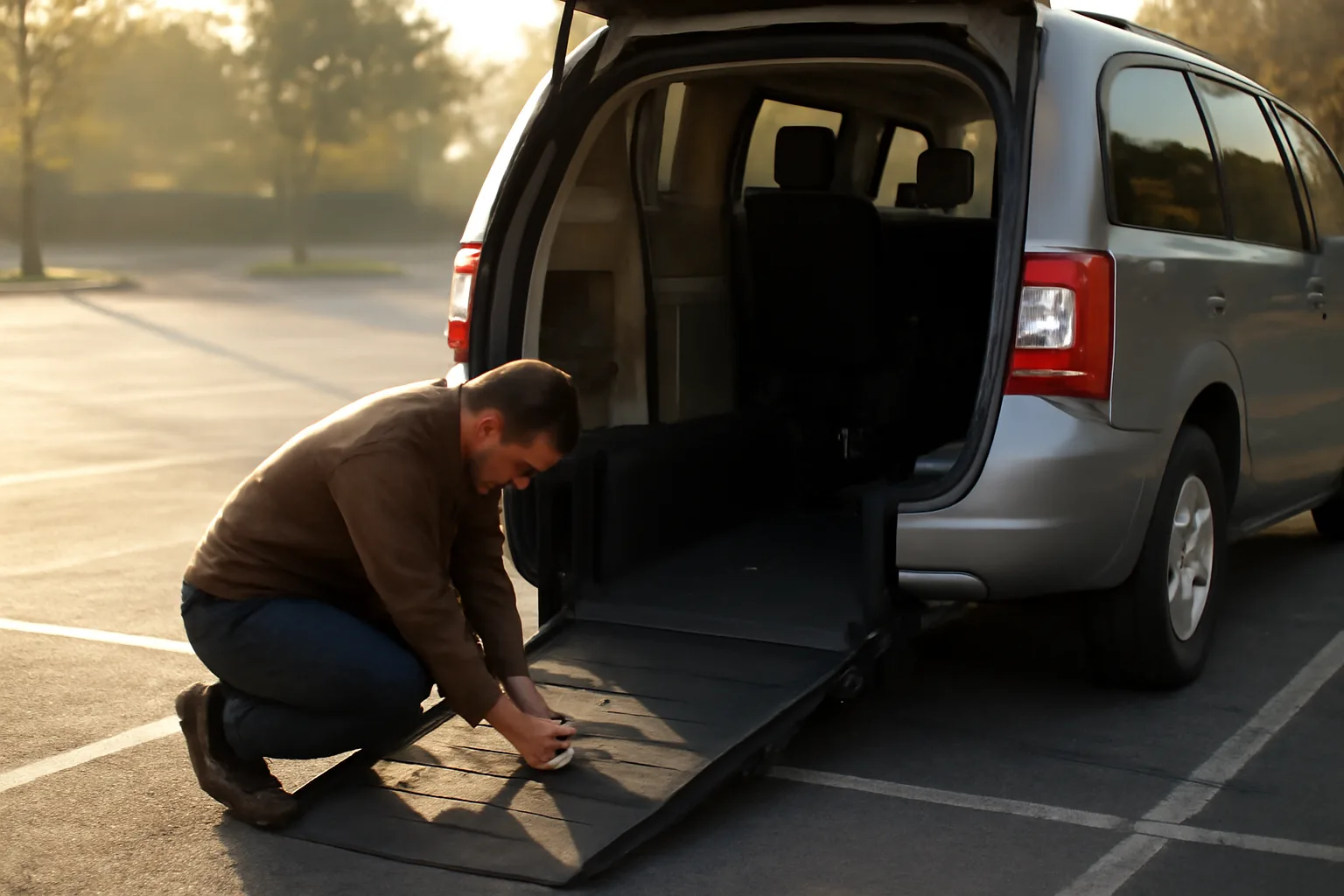
Here's the realistic order of operations, based on how every state Medicaid transportation unit and broker credentialing packet is structured. 1. Form your business entity (LLC is standard) and get an EIN from the IRS. 2. Get commercial auto insurance and general liability coverage sized to NEMT, not personal auto. See our insurance guidance if that hub exists in your state's context, and separately confirm minimum limits with your state Medicaid agency and broker, because required limits vary by state and by broker contract. 3. Buy or lease a wheelchair-accessible van that meets ADA and state vehicle inspection standards (tie-downs, lift or ramp, secured wheelchair positions). 4. Get any required state-level operating authority. Many states require a separate NEMT or "ambulette" operating permit or certificate of need before you can even apply for Medicaid enrollment. This step alone can take weeks to months depending on the state. 5. Enroll as a Medicaid transportation provider with your state Medicaid agency (this is separate from broker credentialing). 6. Apply for network credentialing with the broker(s) operating in your state or region (Modivcare, MTM, Access2Care, SafeRide, or a state-specific broker). 7. Complete driver requirements: background checks, drug screening, defensive driving or passenger assistance training, and any state-mandated NEMT driver certification. 8. Pass vehicle inspection specific to the broker or state (wheelchair securement checks are common). 9. Get your provider or National Provider Identifier (NPI) number if your state requires it for billing. 10. Start taking dispatched trips once your broker activates your account. Each of those steps has its own paperwork trail, and states differ enormously in sequencing. Some let you get broker-credentialed before full state Medicaid enrollment closes out; others require Medicaid enrollment first. There is no shortcut around confirming the order with your specific state Medicaid transportation unit before you spend money on a van or insurance policy you can't use yet.
How much does it cost to start an NEMT business with one van?
Costs vary by state, but the fixed pieces are predictable. A used wheelchair-accessible minivan (Dodge Grand Caravan, Toyota Sienna, or similar with a factory or aftermarket conversion) commonly runs $18,000 to $35,000 depending on age, mileage, and conversion quality; new conversions from major upfitters can run well above $45,000. Commercial auto insurance for a single NEMT vehicle is commonly quoted in the few-thousand-dollars-per-year range but varies sharply by state, driving record, and coverage limits, so get a real quote rather than budgeting off an average. State-level fees add up separately: entity formation ($50 to $500 depending on state), state NEMT operating permit or certificate application fees (these vary widely and some states charge none, others charge several hundred dollars), and broker credentialing application fees (some brokers charge nothing to apply, others have processing fees). Driver background checks and drug screening typically run $50 to $150 per driver depending on the vendor and how many checks are bundled. The honest range for launching with one van, after the vehicle itself, is commonly a few thousand dollars in permits, insurance setup, and credentialing costs, though this depends entirely on your state's specific fee schedule. Nobody publishes a single national number for this because every state Medicaid agency and every broker sets its own fees, and we won't invent one. Confirm exact current fees with your state Medicaid transportation unit and the broker(s) active in your region before budgeting.
What does Medicaid broker credentialing actually involve?
Broker credentialing is the process by which companies like Modivcare, MTM, Access2Care, and SafeRide Health vet and onboard transportation providers into their dispatch network. This is separate from, and happens in addition to, your state Medicaid provider enrollment. Typical credentialing packets ask for: proof of business entity and EIN, commercial auto insurance certificates naming the broker as certificate holder, vehicle registration and inspection records, driver rosters with license numbers, background check results (often including sex offender registry and Medicaid/Medicare exclusion list checks), drug testing program documentation, and W-9 or banking information for payment setup. Some brokers also require a facility or vehicle inspection visit before activation. Each broker runs its own portal and its own timeline. It's common for operators to be credentialed with one broker in a state but not another, especially in states where multiple brokers split regions or lines of business (fee-for-service Medicaid versus managed care plans, for example). If your state uses more than one broker, you'll likely need to repeat much of this paperwork for each one. For a broader look at how broker relationships work across states, see nemt and non emergency medical transportation services.
What vehicle and driver requirements do NEMT operators need to meet?
At minimum, expect these categories of requirement, though exact thresholds are set state by state and broker by broker: - Vehicle: working wheelchair lift or ramp, functioning tie-down/securement system, current state vehicle inspection, commercial or livery plates where required, vehicle age limits (some brokers won't credential vehicles over a certain age, commonly somewhere in the 7-to-10-year range, but confirm the exact cutoff with your broker).
- Driver: valid driver's license (commercial license not usually required for a standard wheelchair van, but confirm with your state), clean-enough motor vehicle record, criminal background check, drug and alcohol screening, and completion of passenger assistance or wheelchair securement training.
- Insurance: commercial auto liability at limits set by your state and broker (these numbers differ meaningfully by state, so don't assume your personal auto policy or a generic commercial policy meets the requirement).
- Compliance: many states now require drivers to complete NEMT-specific training modules or certification programs, and some require enrollment in a controlled substance and alcohol testing consortium if you operate under certain vehicle weight classes governed by federal drug and alcohol testing rules for commercial drivers at 49 CFR Part 382 [5]. Because every one of these thresholds is state-specific and broker-specific, and because they change, treat any number you read online (including in this article) as a starting point to verify, not a final answer. Confirm current requirements with your broker and state Medicaid agency before buying a vehicle or hiring a driver.
What is the difference between NEMT and regular ambulance service?
NEMT is for people who need a ride but not medical care during that ride. Ambulance service is for people whose medical condition requires monitoring, intervention, or rapid emergency response during transport. The regulatory split follows that logic. NEMT sits under each state's Medicaid transportation assurance obligation (42 CFR 431.53) [1] and is typically brokered. Ambulance transport (both emergency and non-emergency ambulance) is billed under a distinct Medicaid benefit category tied to medical necessity certification under 42 CFR 440.170 [2], and requires state EMS licensure for the vehicle and clinically trained staff (EMTs or paramedics). A wheelchair van operator does not need EMT certification, does not administer care, and does not need EMS vehicle licensure. If you're weighing whether to enter NEMT or ambulance transport, know that they are functionally separate businesses with separate state agencies overseeing them (EMS office versus Medicaid transportation unit), separate vehicle standards, and separate staffing requirements. Most new owner-operators start in NEMT precisely because the barrier to entry is lower: no clinical licensure, no EMS certificate of need in most states, just a compliant vehicle, trained drivers, and credentialing paperwork.
Do you need a special license to start a medical transportation business?
It depends entirely on your state, and this is one of the most inconsistent parts of NEMT regulation nationally. Some states require a specific NEMT operating permit, ambulette license, or transportation network registration before you can enroll as a Medicaid provider. Others fold that authority into general Medicaid provider enrollment with no separate state transportation license. A few require a Certificate of Need, similar to what's used in ambulance licensure, showing there's demand in your service area before granting a new operator authority. What's consistent across every state: you'll need a standard business license or entity registration (LLC, corporation), a commercial auto insurance policy meeting state minimums, and compliance with your state's Medicaid provider enrollment process, which usually includes an NPI number, a signed provider agreement, and disclosure of ownership and criminal history for anyone with a controlling interest in the business, consistent with federal provider disclosure rules at 42 CFR 455.104 [6]. Because licensing structure varies this much, the only reliable first move is contacting your state Medicaid agency's transportation unit directly and asking what's required in your state specifically, before you buy a vehicle. Some owner-operators skip this and buy the van first; that's backwards, because if your state requires a Certificate of Need or caps new provider enrollment in your area, you could own a van you can't use for Medicaid trips.
Is starting an NEMT business with one van realistic, or do you need a fleet?
One van is a completely normal way to start. Brokers credential single-vehicle owner-operators all the time, and state Medicaid provider enrollment doesn't require a minimum fleet size in the overwhelming majority of states. What one van limits is trip volume and scheduling flexibility, since a single vehicle can't cover overlapping pickup windows or serve multiple regions simultaneously. The operational reality with one van: you (or your one driver) are the whole business. If the van is in the shop, you have zero capacity. If your driver calls in sick and you don't drive yourself, same problem. Some brokers factor this into how many trips they'll dispatch to you, since a broker managing thousands of daily rides needs providers who can reliably cover assigned routes. Most owner-operators we've seen described in state Medicaid provider directories and broker network materials start with one van, prove they can run clean, on-time, compliant trips for a period, then reinvest in a second vehicle. That's a reasonable, low-risk way to learn broker portals, dispatch software, and documentation requirements before scaling. We're not going to hand you a projection of how many trips or how much revenue you'll see doing this, because that number depends entirely on your local Medicaid population, broker trip volume, and your own operating hours, none of which we can know from here.
Where does a $199 launch kit fit into this process?
If you've read this far, you've noticed the same pattern repeating: state-specific forms, broker-specific portals, and requirements that genuinely differ depending on where you operate. That's the real friction in NEMT startup, not the driving itself. RideCredential's State + Broker NEMT Launch Kit is a one-time $199 packet that organizes the state Medicaid enrollment steps and the major broker (Modivcare, MTM, Access2Care, SafeRide) credentialing checklists for your specific state, so you're not hunting across a dozen agency websites and broker portals trying to figure out what order to do things in. It doesn't replace your state Medicaid agency's own forms or guarantee broker approval (nobody legitimate can promise that), but it saves the research time of piecing together requirements from scratch. Whether you use a kit like that or build your own checklist from your state Medicaid transportation unit's website, the sequence matters more than the tool: entity, insurance, vehicle, state permit, Medicaid enrollment, broker credentialing, driver compliance, then trips.
Frequently asked questions
What is NEMT in simple terms?
NEMT (non-emergency medical transportation) is a ride to and from medical care for people who don't need an ambulance but can't get there on their own, often because they use a wheelchair or have no other transportation. Medicaid must cover it under federal rule 42 CFR 431.53, usually delivered through a state-contracted broker network of local providers.
Does Medicaid cover ambulance rides?
Yes. Federal Medicaid rules at 42 CFR 440.170 require that ambulance transport, outside of true emergencies, be certified in writing as medically necessary. This is a separate benefit from NEMT and requires its own documentation, distinct from routine wheelchair van or sedan transport to appointments.
Does Medicare cover medical transportation?
Original Medicare covers ambulance transportation when medically necessary but generally does not cover routine non-emergency rides like wheelchair van trips to a doctor's visit. Some Medicare Advantage plans offer non-emergency transportation as an extra benefit under their supplemental benefit authority, but that varies by plan, not by standard Medicare rules.
How do you start a NEMT business from scratch?
Form an LLC, get commercial auto and liability insurance, buy a compliant wheelchair van, secure any state-required NEMT operating permit, enroll with your state Medicaid agency, get credentialed with the broker(s) in your state, complete driver background checks and training, pass vehicle inspection, then start taking dispatched trips.
How much does it cost to start a NEMT business with one van?
Beyond the van itself (commonly $18,000 to $35,000 used, more for new conversions), expect entity formation fees, state permit fees, insurance setup, and broker/state credentialing costs. Exact totals vary sharply by state and broker, so confirm current fee schedules with your state Medicaid agency rather than relying on a national average.
Do I need a commercial driver's license (CDL) to drive a wheelchair van?
Usually no. Standard wheelchair vans and minivans typically don't require a CDL since they fall under the weight and passenger thresholds that trigger CDL rules. Larger cutaway or bus-style vehicles carrying more passengers may require one. Confirm vehicle-specific licensing requirements with your state's DMV and your broker.
What's the difference between NEMT and ambulance transport?
NEMT moves people who need a ride but no medical care during transit. Ambulance transport is for people whose condition requires monitoring or intervention en route, requires EMS licensure and clinically trained staff, and is billed under a separate Medicaid benefit category tied to medical necessity certification under 42 CFR 440.170.
Can you run an NEMT business with just one van?
Yes, many owner-operators start with a single wheelchair van. Most states and brokers don't set a minimum fleet size for enrollment. The tradeoff is limited capacity: one van covering one trip at a time, with zero redundancy if that vehicle needs repairs or the driver is unavailable.
Do you need a special license to operate an NEMT business?
It depends on the state. Some states require a distinct NEMT or ambulette operating permit before Medicaid enrollment; others fold authority into standard Medicaid provider enrollment with no separate transportation license. Always confirm directly with your state Medicaid agency's transportation unit before purchasing a vehicle.
What is broker credentialing and how is it different from Medicaid enrollment?
Medicaid enrollment registers you as an approved provider with your state's Medicaid program. Broker credentialing is a separate process where companies like Modivcare, MTM, Access2Care, or SafeRide vet and onboard you into their dispatch network so they can assign you rides. You typically need both, and each broker in your state may run its own separate credentialing process.
Does Medicaid pay for wheelchair van transportation to dialysis?
In most states, yes, wheelchair van transport to recurring medical services like dialysis is a common and heavily used NEMT trip type, since it's a scheduled, medically necessary, non-emergency ride. Coverage specifics and any prior authorization requirements vary by state, so confirm the details with your state Medicaid transportation unit.
How long does it take to get credentialed as an NEMT provider?
There's no single national timeline. It depends on your state's Medicaid enrollment processing time, whether a separate state operating permit is required, and each broker's own application backlog. Ranges of several weeks to a few months are common; confirm current processing estimates directly with your state agency and target broker.
Sources
- eCFR, 42 CFR 431.53: States must ensure necessary transportation for Medicaid recipients to and from providers
- eCFR, 42 CFR 440.170: Medicaid ambulance coverage requires written certification of medical necessity outside of emergencies
- Medicare.gov, Ambulance Services coverage page: Medicare Part B covers ambulance transportation when other transportation could endanger health, and non-emergency ambulance transport needs a doctor's written order
- eCFR, 49 CFR Part 382: Federal drug and alcohol testing rules apply to commercial motor vehicle drivers, relevant to NEMT drivers operating certain vehicle classes
- eCFR, 42 CFR 455.104: Medicaid provider enrollment requires disclosure of ownership and controlling interest information
- eCFR, 42 CFR 422.102: Medicare Advantage plans may offer supplemental benefits, including transportation, beyond original Medicare when approved by CMS