Last updated 2026-07-25
TL;DR
Starting a NEMT business means getting your business and vehicle licensed at the state level, carrying commercial auto and general liability insurance, enrolling as a Medicaid transportation provider, and credentialing with brokers like Modivcare or MTM. Most solo operators can do this with one wheelchair van, but the paperwork takes 60 to 120 days, so start it before you buy the van, not after.
What is non-emergency medical transportation (NEMT)?
Non-emergency medical transportation is scheduled transport for people who need help getting to a medical appointment, dialysis, or a pharmacy, but don't need an ambulance or emergency care. NEMT covers rides in wheelchair vans, ambulatory sedans, and stretcher vans for people who are stable but can't drive themselves or use a regular taxi or rideshare. Federal Medicaid rules require states to make sure enrollees can get to and from covered services, and NEMT is how most states meet that requirement. The Centers for Medicare & Medicaid Services (CMS) describes this as an assurance built into Section 431.53 of the Medicaid regulations, which requires state Medicaid plans to "specify that the Medicaid agency will ensure necessary transportation for recipients to and from providers" [1]. States meet that obligation differently: some run NEMT in-house, most now contract it out to a broker. That broker model matters a lot for anyone starting out. If your state uses a broker, you don't get trip referrals just because you're a licensed Medicaid provider. You also have to pass that broker's separate credentialing process. Read more on nemt and non emergency medical transportation basics before you spend money on a vehicle.
How do you start a medical transportation business, step by step?
The order matters more than people expect. Most new operators buy the van first and then discover the paperwork takes months, which burns cash on a vehicle sitting idle. Here's the sequence that actually works. 1. Pick your business structure and register it (LLC is standard) with your Secretary of State. 2. Get an EIN from the IRS. 3. Check your state's NEMT-specific licensing. Some states require a separate 'ambulance service' or 'medical transportation' permit through the state Department of Health or Department of Transportation, on top of standard business registration. 4. Get your vehicle inspected and permitted per state rules (wheelchair lift certification, ADA equipment, annual safety inspection). 5. Buy or bind commercial auto insurance and general liability before you drive a single Medicaid trip. 6. Enroll as a Medicaid transportation provider through your state Medicaid agency's provider enrollment portal. 7. Apply for credentialing with the broker(s) operating in your service area (Modivcare, MTM, Access2Care, SafeRide, or a state-run system). 8. Complete driver background checks, drug testing, and any required training (defensive driving, passenger assistance, HIPAA). 9. Get your NPI number if your state requires one for billing. 10. Wait for approval, then start taking trip assignments. Budget 60 to 120 days from step 6 to step 8 being fully done. That range isn't a guarantee, timelines vary heavily by state and by how backed up the broker's credentialing queue is; confirm current processing times with your broker and state Medicaid agency.
How do you start a NEMT business with just one van?
Yes, you can start with one wheelchair van, and plenty of owner-operators do exactly that. A single-van operation is not a disadvantage during credentialing; brokers credential you as a transportation provider entity, not by fleet size, and many broker networks are built mostly on small and solo operators. The practical difference with one van is that you have zero redundancy. If that van is in the shop, you have no trips going out and no income. Build that into your insurance and maintenance budget from day one: a roadside assistance plan, a relationship with a mechanic who can turn around lift repairs fast, and a maintenance log the broker can ask for during audits. One-van operators also need to be honest about hours. Brokers assign trips based on your stated service area and availability windows. If you're a solo owner-driver, you can't take overnight dialysis runs and morning school-transport-adjacent trips in the same day. Set your availability window in the broker portal conservatively, then expand once you've proven you can hit pickup windows reliably. A one-van business still needs the same paperwork as a ten-van fleet: business registration, vehicle permit, commercial insurance, Medicaid enrollment, and broker credentialing. There's no shortcut version of the process for small operators.
Does Medicaid cover ambulance rides, and how is that different from NEMT?
Yes. Medicaid covers ambulance transportation as a distinct benefit category from NEMT, and the two have different rules, different billing codes, and often different licensing requirements. Ambulance transport is for emergencies or situations requiring medical monitoring en route; NEMT is for stable patients who just need a ride. CMS guidance separates 'emergency' and 'nonemergency' transportation under the broader Medicaid transportation benefit, and each state Medicaid plan spells out coverage rules for both [1][2]. If you're planning to run ambulances (BLS/ALS transport with EMTs or paramedics aboard), that's a completely different licensing track through your state EMS office, not the NEMT provider enrollment path this article covers. Don't conflate the two when you're researching requirements; a wheelchair van company and an ambulance company file with different state agencies and carry different insurance minimums. If your business plan includes both a wheelchair van fleet and a stretcher-van or ambulance service later, plan on separate licensing tracks for each vehicle class. See emergency medical transport for where that line sits in most states.
Does Medicare cover medical transportation?
Medicare's coverage of NEMT is much narrower than Medicaid's. Traditional Medicare (Part B) generally covers ambulance transportation only when other transportation could endanger your health, and it does not cover routine non-emergency rides to a doctor's office the way Medicaid does. Medicare.gov states that Part B covers ground ambulance transportation when "you need to be transported safely and could be harmed by transportation by other means, and other conditions are met" [3]. Some Medicare Advantage (Part C) plans add limited NEMT as a supplemental benefit, often a set number of one-way trips per year, but that's plan-specific and not a federal Medicare guarantee. If a Medicare Advantage plan in your area offers a transportation benefit, it typically contracts through the same brokers (Modivcare, MTM) that manage state Medicaid NEMT, so credentialing with a broker can open both revenue lanes at once. Confirm which Medicare Advantage plans in your state route through a broker you're already credentialed with before assuming the trips will show up automatically. Bottom line for planning purposes: build your business case around Medicaid NEMT and broker contracts, and treat any Medicare Advantage transportation trips as a bonus, not a base.
How do you enroll as a Medicaid NEMT provider in your state?
Every state Medicaid agency runs its own provider enrollment process, usually through an online portal run by the agency or its fiscal agent. There's no single federal NEMT enrollment; you apply state by state, and if you plan to operate across a state line, you enroll separately in each state. Typical requirements across states include: a valid business license, proof of commercial auto insurance meeting state minimums, vehicle registration and inspection records, driver rosters with background check results, and sometimes a completed W-9 and direct deposit form for claims payment. Some states also require a surety bond or a compliance attestation specific to transportation providers. Because requirements and portals differ (and change), the accurate move is to go straight to your state Medicaid transportation unit's page and confirm the current application, fee, and document list before you file anything. CMS publishes state-by-state Medicaid program overviews that are a reasonable starting point if you don't already know your state unit's name [4]. Medicaid provider enrollment and broker credentialing are two separate approvals. Getting your Medicaid provider number does not automatically put you in a broker's network; you still apply separately to Modivcare, MTM, Access2Care, SafeRide, or whichever broker holds the transportation contract in your region. Confirm with your broker and state Medicaid agency exactly which approval unlocks trip assignments in your area, because that varies by state.
What does broker credentialing with Modivcare, MTM, Access2Care, or SafeRide involve?
Most states now contract NEMT management to a private broker instead of running it directly, and that broker controls who actually gets trip assignments. Getting your Medicaid provider number is necessary but usually not sufficient; you also apply to become a credentialed transportation provider in the broker's network for your county or region. Broker applications generally ask for: proof of insurance (often with the broker listed as an additional insured), vehicle inspection and maintenance records, driver background checks and drug screening results, driver training certifications, and a signed provider agreement covering rates, service standards, and on-time performance requirements. Brokers also typically run their own onboarding orientation and require ongoing compliance documents (updated insurance certificates, vehicle re-inspections) on a recurring schedule, more than at signup. Each broker's specific document list, timeline, and portal differ, and they update these fairly often. Confirm current requirements directly with the broker operating in your county, not from a generalized list, because a document that's optional for one broker's region can be mandatory for another's. If you're trying to get this paperwork organized once instead of chasing it broker by broker and state by state, that's the exact gap the $199 one-time State + Broker NEMT Launch Kit is built for: a structured document and application checklist you can use at the launch-kit-builder. It doesn't replace confirming details with your state Medicaid agency and broker, but it keeps you from missing a document nobody warned you about.
What insurance does a NEMT business need?
At minimum, expect to carry commercial auto liability insurance meeting or exceeding your state's minimum for vehicles-for-hire, plus general liability coverage. Brokers frequently require higher limits than the state's bare legal minimum, commonly requiring combined single limits well above standard personal auto policies, and many require the broker be named as an additional insured on your certificate. Wheelchair vans need specific attention to lift and securement equipment coverage; a standard commercial auto policy doesn't always automatically cover wheelchair lift liability, so ask your agent directly whether ADA lift equipment and passenger securement are included or need an endorsement. You'll also want workers' compensation coverage once you hire any driver who isn't you. Don't guess on limits. Get the specific minimum dollar figures from your state's for-hire vehicle regulations and from each broker's provider agreement, because both numbers are set independently and the broker's number is often the higher of the two.
What vehicle and driver requirements should you expect?
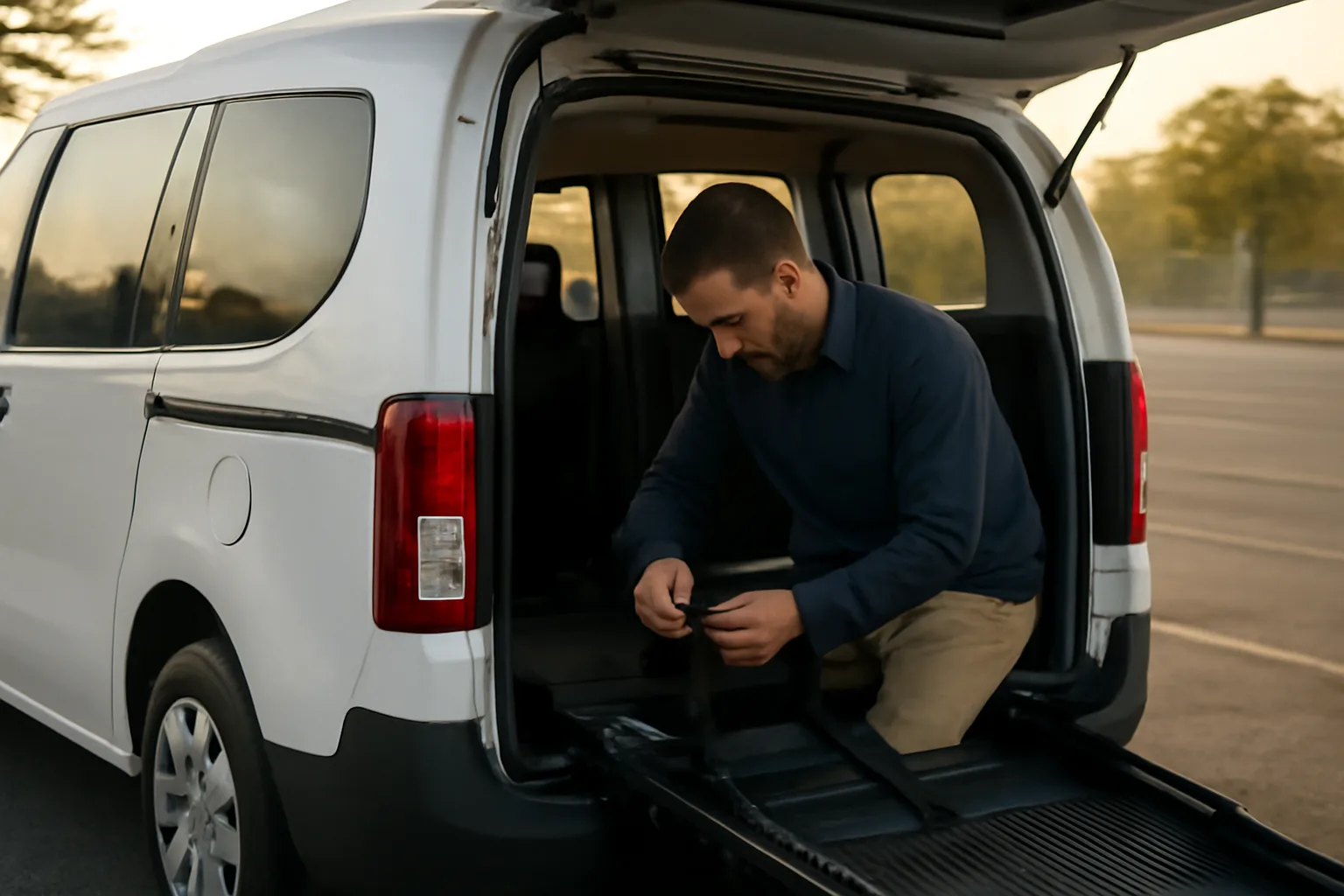
Vehicle requirements generally include: a working wheelchair lift or ramp certified to the manufacturer's ADA specification, wheelchair securement straps meeting a recognized standard (commonly referenced as WC19 in the industry, a voluntary standard developed through work supported by the National Highway Traffic Safety Administration [5]), a current state vehicle inspection, and sometimes a maximum vehicle age limit set by the broker (many broker contracts cap vehicle age at 7 to 10 years, though this varies by broker and state). Driver requirements typically include a valid driver's license (commercial license requirements vary by vehicle size and state), a clean driving record check, a criminal background check, drug and alcohol screening, and completion of passenger assistance or defensive driving training. Some states or brokers also require CPR/First Aid certification for wheelchair van drivers. Build a simple compliance calendar before your first trip: insurance renewal date, vehicle inspection due date, driver recertification dates, and broker re-credentialing date. Missing one of these is the single most common reason an otherwise good NEMT provider gets suspended from a broker network mid-contract.
How much does it cost to start a non-emergency medical transportation business?
Costs vary enormously by state and by whether you're buying new or used, so treat any single number with suspicion. The wheelchair van itself is the biggest cost: a used ADA-compliant conversion van commonly runs somewhere in the tens of thousands of dollars, while new conversions cost considerably more. Beyond the vehicle, budget for: business registration and any state NEMT permit fees, commercial insurance premiums (which run higher than personal auto due to the passenger-for-hire classification), background check and drug screening fees per driver, vehicle inspection and lift certification fees, and any broker application or onboarding fees. This article won't hand you a total dollar figure, because state fees, insurance markets, and broker requirements differ too much for one number to be honest. What's consistent everywhere is that the paperwork and credentialing timeline, not the vehicle purchase, is what trips people up. Line up your insurance quote and confirm your state's Medicaid enrollment document list before you sign for the van, not after.
What's the realistic timeline from decision to first trip?
Plan on 60 to 120 days minimum from the day you start your business registration to the day a broker actually assigns you a trip, and treat that as a range, not a promise, since it depends entirely on your state's backlog and which broker holds the contract in your area. A rough sequence: business registration and EIN (1 to 2 weeks), vehicle purchase and inspection (2 to 6 weeks depending on availability), insurance binding (days once you have a quote, but get the quote early), Medicaid provider enrollment (state portals vary widely, some process in a few weeks, others take two months or more), broker credentialing (often the longest single step, frequently 30 to 60 days once your application is complete and documents are in order). The biggest time-killer is submitting incomplete applications. Missing one insurance endorsement or one background check result can send your file back to the bottom of a queue. Read the document checklist twice before you submit anything, and confirm directly with the broker and your state Medicaid agency that your document versions are current, since forms and requirements get updated without much public notice.
Frequently asked questions
How do you start a medical transportation business?
Register your business entity, get any state-required NEMT license, buy and inspect a compliant vehicle, secure commercial insurance, enroll as a Medicaid transportation provider through your state Medicaid agency, and credential with the broker(s) operating in your area (Modivcare, MTM, Access2Care, SafeRide, or your state's system). Expect 60 to 120 days total; confirm specific steps with your state Medicaid agency.
What is NEMT?
NEMT stands for non-emergency medical transportation: scheduled rides for Medicaid or Medicare Advantage enrollees who need help reaching medical appointments, dialysis, or pharmacies but don't need an ambulance. Federal Medicaid rules require states to ensure enrollees have transportation to covered services, under 42 CFR 431.53, and most states meet that through NEMT broker contracts.
Does Medicaid cover ambulance rides?
Yes, Medicaid covers ambulance transportation as a separate benefit from NEMT, generally for emergencies or situations needing medical monitoring en route. Each state Medicaid plan sets specific coverage rules and rates for ambulance transport, distinct from the wheelchair-van and sedan NEMT benefit. Ambulance licensing runs through your state EMS office, not the NEMT provider enrollment process.
Does Medicare cover medical transportation?
Original Medicare Part B covers ground ambulance transportation mainly when other transport methods could endanger your health, per Medicare.gov guidance, and doesn't cover routine non-emergency rides. Some Medicare Advantage plans add limited NEMT as a supplemental benefit, often through the same brokers used for Medicaid, but this is plan-specific, not a standard Medicare benefit.
What is non-emergency medical transportation?
Non-emergency medical transportation is transport for people stable enough to avoid an ambulance but unable to get to medical care on their own, typically in wheelchair vans, ambulatory sedans, or stretcher vans. It's funded mainly through state Medicaid programs and, to a lesser extent, Medicare Advantage supplemental benefits, usually managed through regional transportation brokers.
How do you start a NEMT business with one van?
You go through the same steps as any NEMT operator: business registration, vehicle licensing, insurance, Medicaid enrollment, and broker credentialing. Brokers credential providers regardless of fleet size, but a one-van operation has no backup if that vehicle breaks down, so budget for fast repair turnaround and set conservative availability hours in the broker portal.
How much does it cost to start a NEMT business?
Costs vary by state and vehicle condition; a used ADA-compliant wheelchair van commonly costs tens of thousands of dollars, with new conversions costing more. Add commercial insurance premiums, background check and drug screening fees, vehicle inspection fees, and any state or broker application fees. There's no single honest total figure since state fees and insurance rates differ too widely.
Do you need a special license to drive a wheelchair van for Medicaid trips?
It depends on your state and the vehicle's passenger capacity; some states require only a standard driver's license with a clean record, others require a commercial driver's license above a certain seating threshold. Nearly all brokers require a background check, drug screening, and passenger assistance or defensive driving training regardless of license class. Confirm the license class rule with your state DMV.
How long does NEMT broker credentialing take?
Broker credentialing commonly takes 30 to 60 days once your application and documents (insurance certificate, vehicle inspection, driver background checks) are complete, though this varies by broker and region. Incomplete submissions are the most common cause of delay. Confirm current processing timelines directly with the broker operating in your county before planning a start date.
Can you run NEMT trips before your Medicaid provider enrollment is approved?
No. You need an approved Medicaid provider enrollment (and, separately, broker credentialing) before billing for Medicaid-funded NEMT trips. Operating or billing before approval can jeopardize your enrollment and any broker contract. Confirm your exact approval status with your state Medicaid agency's provider enrollment unit before scheduling your first Medicaid trip.
What's the difference between Medicaid provider enrollment and broker credentialing?
Medicaid provider enrollment is your registration with the state Medicaid agency as an approved transportation provider type. Broker credentialing is a separate application to the private company (Modivcare, MTM, Access2Care, SafeRide, or similar) that actually dispatches trips in your region. In most states you need both, and they run on separate timelines and separate document requirements.
What insurance limits do NEMT brokers typically require?
Brokers often require commercial auto liability limits higher than the state's bare legal minimum for vehicles-for-hire, plus general liability coverage, and frequently require the broker listed as an additional insured. Exact limits vary by broker and state. Ask your insurance agent for the broker's specific minimum limits in writing before binding a policy, since guessing can leave you underinsured for credentialing.
Sources
- CMS, Code of Federal Regulations 42 CFR 431.53 (Assurance of transportation): States must assure necessary transportation for Medicaid recipients to and from providers
- Medicaid.gov, Non-Emergency Medical Transportation: Medicaid's NEMT benefit and its distinction from emergency ambulance transportation
- Medicare.gov, Ambulance Services coverage: Medicare Part B covers ground ambulance transportation mainly when other transport could endanger health
- Medicaid.gov, State Overviews: Directory point for locating each state's Medicaid agency and transportation unit contacts
- National Highway Traffic Safety Administration, Docket NHTSA-2009-0093 on wheelchair transportation safety standards: Federal rulemaking record referencing wheelchair securement and transportation safety standards work
- 42 CFR 440.170, Transportation services: Federal regulation defining transportation as a covered Medicaid service state plans may include