Last updated 2026-07-25
TL;DR
NEMT (non-emergency medical transportation) is Medicaid-covered rides to medical appointments for people without another way to get there. Medicaid must cover it under federal rule 42 CFR 431.53; Medicare generally does not, except limited ambulance and some Medicare Advantage transport benefits. Starting a business means an LLC, the right vehicle, state and broker enrollment, and insurance, usually a 60-120 day process.
What is non-emergency medical transportation (NEMT)?
NEMT is transportation to and from medical appointments for people who have no other way to get there and don't need an ambulance. Think dialysis three times a week, chemo, physical therapy, a wheelchair user going to a specialist. It's not a 911 response and it's not driven by paramedics. It's a driver, a vehicle (sedan, wheelchair van, or stretcher van), and a scheduled or same-day pickup. The federal rule that makes NEMT exist is 42 CFR 431.53, which requires state Medicaid programs to "ensure necessary transportation for recipients to and from providers" and to describe how they meet that requirement in their state plan [1]. States don't run this in-house anymore in most cases. They contract it out to transportation brokers like Modivcare, MTM, Access2Care, or SafeRide, who then subcontract the actual driving to local companies, a lot of them one-van or two-van operators. So when people ask what is nemt, the honest short answer is: it's the transportation benefit inside Medicaid (and sometimes Medicaid managed care and some Medicare Advantage plans) that gets people to non-emergency medical care, run through state-hired brokers rather than paid directly by the state in most places now.
Does Medicaid cover ambulance rides and NEMT rides?
Yes, Medicaid covers both, but they're different benefits with different rules. NEMT (a van or sedan ride to an appointment) is required for all state Medicaid programs under 42 CFR 431.53 [1]. Ambulance transport (emergency or medically necessary non-emergency ambulance) is billed separately under a different provider type and requires medical necessity documentation, usually a physician certification statement for scheduled non-emergency ambulance trips. CMS describes NEMT coverage plainly: "States must ensure that eligible, qualified Medicaid beneficiaries have transportation to and from providers" and that this can be met "through state broker contracts" among other methods [2]. Ambulance coverage sits under a state's separate ambulance transportation policy, and Medicaid.gov's benefits page confirms transportation is one of the mandatory or optional benefit categories states must address in their state plan [3]. So the phrase "does medicaid cover ambulance" and "does medicaid cover ambulance rides" both get the same answer: generally yes, for medically necessary transport, but ambulance companies enroll as a different provider type than wheelchair-van NEMT companies, with different fee schedules, different vehicle and staffing requirements (EMTs, more than trained drivers), and different state licensing. If you're buying a wheelchair van, you're going into the NEMT lane, not the ambulance lane. Don't confuse the two when you're reading state Medicaid provider manuals; searching the wrong section wastes hours.
Does Medicare cover medical transportation?
Mostly no, and this trips up a lot of new owner-operators who assume Medicare works like Medicaid here. Original Medicare (Part B) covers ambulance transportation only when it's medically necessary and other transportation would endanger the person's health, per CMS's ambulance services coverage rules [4]. It does not cover routine rides to a dialysis chair or a follow-up visit in a wheelchair van. Medicare Advantage (Part C) plans are a different story. CMS's Medicare Managed Care Manual allows Medicare Advantage plans to offer supplemental benefits, and transportation to medical appointments is one of the benefits plans can choose to include, at the plan's discretion [5]. So a Medicare Advantage enrollee might have a transportation benefit through their specific plan, coordinated by a broker, while a traditional Medicare enrollee generally does not have that option outside emergency or medically necessary ambulance use. If you want Medicare Advantage trips as part of your business, you'll be credentialing with the broker that specific plan uses in your state or region, which is a separate contract from your state Medicaid NEMT enrollment. Confirm with the broker and the specific Medicare Advantage plan what's required, because MA transportation benefit design varies plan to plan and CMS doesn't standardize it the way it standardizes Medicaid NEMT.
How do you start a medical transportation business?
At the core, starting a medical transportation business (NEMT specifically, since that's the segment open to owner-operators without ambulance licensure) has five real steps: form the business entity, get the right vehicle, secure insurance, enroll as a Medicaid transportation provider in your state, and credential with the broker(s) that manage rides in your area. Most states route Medicaid NEMT trips through one or more contracted brokers rather than paying you directly, so you typically need both a state Medicaid provider number and a broker network agreement. Skipping either one means you can't actually get dispatched trips or get paid for them. Here's the rough sequence, in the order that avoids the most rework: 1. Pick your entity type (LLC is standard) and get an EIN. 2. Get your state's required PUC or NEMT operating permit, if your state requires one for non-ambulance medical transport (many do, some route this through the DMV or a state transportation commission). 3. Buy or convert your vehicle to meet ADA wheelchair lift/tie-down standards if you're running wheelchair-accessible. 4. Get commercial auto insurance with the liability limits your state and broker require (often $1,000,000 combined single limit is asked for by brokers, though exact numbers vary; confirm with your broker and state Medicaid agency). 5. Enroll as a Medicaid transportation provider through your state Medicaid agency's provider enrollment portal. 6. Apply for network credentialing with the broker(s) operating NEMT in your state (Modivcare, MTM, Access2Care, SafeRide, or a regional broker), which usually means a separate application, vehicle inspection, and driver background checks on top of what the state already required. Realistically this whole process runs 60 to 120 days for a first-time operator, longer if your state has a moratorium on new NEMT provider enrollment in certain counties (some states cap NEMT provider slots regionally to manage program cost, so check that before you buy a vehicle).
How to start a NEMT business with one van
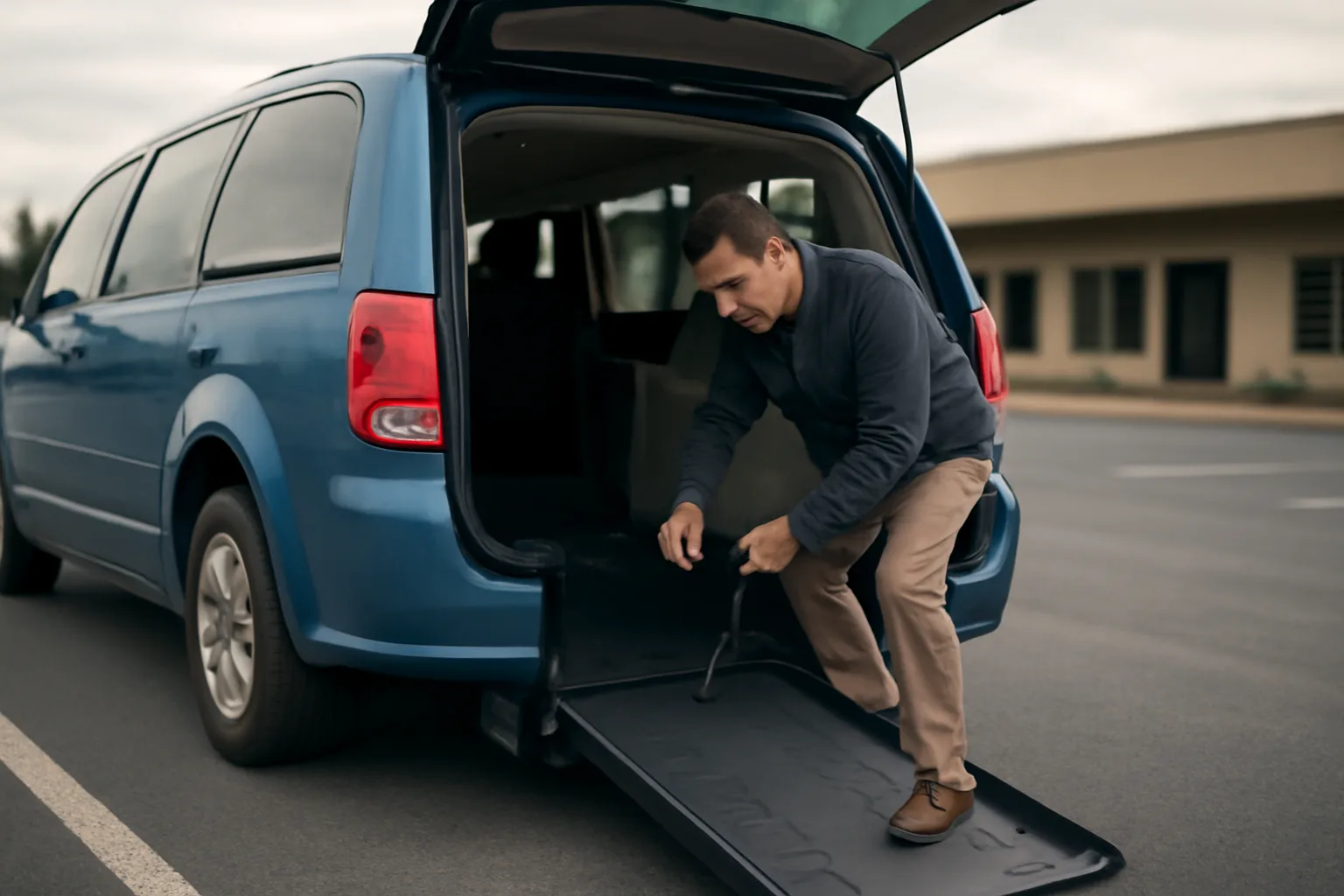
One van is a completely normal way to start, and plenty of owner-operators run exactly this for a year or two before adding a second vehicle. The requirements don't change much between one van and five; you still need the same insurance minimums, the same driver background check, and the same broker application. What changes is your capacity, and some brokers will ask how many vehicles you have as part of network need assessment, since a few brokers pause onboarding new solo operators in oversaturated ZIP codes. With one van, a wheelchair-accessible minivan (Dodge Grand Caravan, Chrysler Pacifica, or a full-size van conversion) with a certified lift or ramp conversion is the most flexible vehicle choice, because it lets you serve both ambulatory and wheelchair Medicaid members, which is a broader trip pool than an ambulatory-only sedan. Budget-wise, expect the conversion itself (if you're buying a used van and adding a wheelchair conversion) to run into five figures depending on the conversion company and whether it's new or reconditioned; a factory-converted new wheelchair van from a mobility dealer costs considerably more than a used converted one. Insurance for a single wheelchair van used commercially for NEMT is going to run higher than a personal auto policy, and it varies heavily by state and driving record, so get quotes from at least two commercial auto insurers who specifically write NEMT or paratransit policies before you commit to a purchase. One real practical tip: get your state Medicaid enrollment and broker credentialing paperwork moving before you finalize the vehicle purchase, not after. Some states and brokers require a specific vehicle inspection form with VIN and lift certification attached to the application, and others want proof of insurance in place first. Ordering matters, and getting it backwards costs you weeks.
How to start a non-emergency medical transportation business (the credentialing side)
This is where new operators lose the most time, so it deserves its own section. Two separate credentialing tracks run in parallel: your state Medicaid enrollment and your broker network application. They are not the same thing and one doesn't automatically get you the other. State Medicaid enrollment usually happens through the state's provider enrollment portal (often the same system hospitals and doctors use), and requires your business license, EIN, vehicle registration and inspection, driver's license and background check results for each driver, and proof of insurance. Some states also require a separate transportation network company or NEMT-specific permit issued by the state Department of Transportation or Public Utilities Commission, on top of the Medicaid enrollment itself; confirm with your state Medicaid agency's transportation unit which layers apply where you operate. Broker credentialing is a private-company process layered on top. Modivcare, MTM, Access2Care, and SafeRide (and various regional brokers) each run their own vendor/provider application, often through an online portal, and each wants its own documentation package: insurance certificates naming the broker as certificate holder, vehicle inspection photos, driver orientation completion, sometimes a defensive driving certificate, and background check results that meet the broker's specific lookback period and disqualifying offense list (which can be stricter than the state's own Medicaid exclusion check). A practical way to think about it: the state says you're allowed to bill Medicaid for NEMT. The broker decides whether you get dispatched trips in your service area. You need both. If you only do one, you either can't get paid (no state enrollment) or can't get trips (no broker credentialing). See our related coverage on nemt transportation requirements and non emergency medical transportation services for state-by-state specifics, since this varies enough that a national generalization will mislead you on details like document lists and timelines.
What does the wheelchair van itself need to meet?
Your vehicle needs to satisfy federal ADA accessibility standards if it's marketed and used as wheelchair-accessible, plus whatever inspection standard your state or broker layers on top. The core federal regulation covering accessible vehicles used in transportation service is 49 CFR Part 38, the Department of Transportation's ADA accessibility specifications for transportation vehicles, which sets requirements for lifts, ramps, and securement systems [6]. Beyond that baseline, brokers typically want an annual (sometimes semi-annual) vehicle inspection with a specific checklist: working wheelchair lift or ramp, functioning tie-down/securement straps rated for the weight, seatbelts for wheelchair passengers, working interior lighting, a first aid kit, and sometimes a fire extinguisher and reflective triangles. None of this is exotic. Most of it mirrors basic commercial passenger vehicle safety standards, but brokers audit it more often than a standard DMV inspection would. Age limits on vehicles matter too. Several brokers and states set a maximum vehicle age or mileage cap for enrollment (commonly somewhere in the 5 to 10 year or under-150,000-mile range depending on the broker and vehicle class), so a high-mileage used conversion van that looks like a bargain might get rejected at inspection. Confirm current age/mileage caps with your broker and state Medicaid agency before buying, because these thresholds get adjusted and aren't uniform nationally.
What insurance and licensing does an NEMT owner-operator need?
Commercial auto liability insurance is the non-negotiable one, and NEMT-specific policies typically require higher limits than a personal policy or a standard commercial policy, because you're transporting a vulnerable population. Broker contracts commonly specify a minimum combined single limit, frequently cited in the $1,000,000 range by brokers in vendor manuals, though the exact figure is set by each broker and state contract and does change, so confirm current minimums with your broker and state Medicaid agency rather than assuming a number. On top of auto liability, expect to need: - General liability insurance, sometimes required by the broker separately from auto.
- Workers' compensation insurance if you have employees (required in nearly every state once you have W-2 drivers, with a few narrow exceptions).
- A background check for every driver, run against your state's Medicaid exclusion list and often the federal List of Excluded Individuals/Entities maintained by the HHS Office of Inspector General.
- Driver training specific to passenger assistance and, if you're transporting wheelchair users, securement training (CTAA's Passenger Assistance Safety and Sensitivity, PASS, certification is one widely accepted training standard brokers reference). Licensing requirements for the business itself vary by state. Some states require a separate NEMT operating permit or certificate through the Department of Transportation, Public Utilities Commission, or a state Health and Human Services transportation office, layered on top of standard business licensing and the Medicaid provider enrollment. There's no single federal license for NEMT companies; it's state by state, which is exactly why the phrase "confirm with your state Medicaid agency" shows up so often in this business, because generic national guidance can leave out a state-specific permit that stops your application cold.
How much does it cost to enroll and credential (state + broker)?
| Business formation (LLC, EIN) | Often under $500 depending on state filing fees | |
|---|---|---|
| State Medicaid provider enrollment fee | Many states charge an application fee (some tied to the federal Medicare/Medicaid provider screening fee schedule, which CMS updates annually) [7] | |
| State NEMT/transportation operating permit | Varies widely by state, from no separate fee to several hundred dollars | |
| Commercial auto insurance (annual) | Varies heavily by state, driving record, and vehicle count; get multiple NEMT-specific quotes | |
| Driver background checks | Typically under $100 per driver but recurring | |
| Broker credentialing application | Many brokers don't charge an application fee directly, but require paid third-party items (inspections, background checks) as part of the package; confirm with each broker | The federal application fee for institutional Medicaid providers is set annually by CMS and published in the Federal Register (it was $709 for calendar year 2024, for example, though it changes yearly and doesn't apply uniformly to every provider type in every state) [7]. Whether that specific fee applies to your NEMT enrollment depends on how your state classifies transportation providers, so check your state's provider enrollment fee schedule directly rather than assuming the federal figure applies. |
There's no single national fee, and any article that gives you one flat number is guessing. Costs break into a few buckets, and they vary a lot by state and broker. | Cost category | Typical range or note |
How long does state and broker credentialing actually take?
Budget 60 to 120 days from a standing start (no entity, no vehicle yet) to your first dispatched trip, and that's an honest range, not a best case. If you already have the entity, vehicle, and insurance in place and you're just doing the paperwork, 30 to 60 days is more realistic for state Medicaid enrollment plus broker credentialing combined, though it depends entirely on your state's processing backlog and which broker you're applying to. A few things reliably slow this down: incomplete driver background check paperwork, insurance certificates that don't list the broker correctly as certificate holder, vehicle inspection scheduling delays, and states with a provider enrollment moratorium in certain counties (meaning they're not accepting new NEMT providers there regardless of how clean your application is). Call your state Medicaid transportation unit before you spend money on a vehicle if you're in a market you suspect might be saturated. One place new operators genuinely save time is by assembling the full document package (entity docs, insurance, vehicle inspection, driver files) once and reusing it across both the state application and every broker application, since brokers and states ask for overlapping documents. Building that packet methodically the first time, rather than scrambling to produce one document at a time as each portal asks for it, is the single biggest time-saver we've seen work. If you want a structured starting point for organizing that paperwork by state and broker, RideCredential's $199 Launch Kit Builder puts the state-specific and broker-specific document checklists in one place, though you can absolutely assemble the same list yourself directly from your state Medicaid transportation unit's website and each broker's vendor portal.
What mistakes do new owner-operators make most often?
Buying the vehicle before confirming state and broker vehicle-age and equipment requirements is the most expensive mistake, because a van that doesn't meet the lift, tie-down, or age/mileage standards fails inspection and you're stuck with a vehicle you can't enroll. A close second is assuming Medicaid NEMT enrollment automatically means broker trips. It doesn't. You need the separate broker credentialing agreement, and in a lot of counties there's exactly one broker holding the state contract, so if that broker isn't accepting new vendors right now, your Medicaid enrollment alone gets you zero trips. Third is underestimating insurance cost and structure. Owner-operators sometimes shop for the cheapest commercial auto policy without checking whether it meets the broker's specific limit and additional-insured language requirements, then have to redo it (and pay for two policies briefly) once the broker rejects the certificate. Fourth, and this one is subtle: assuming your state's rules generalize to a neighboring state, or that one broker's requirements match another broker's requirements. Modivcare, MTM, Access2Care, and SafeRide each run their own credentialing standards and paperwork, and they change over time, so treat every broker relationship as its own process rather than copying what worked with a different broker in a different state.
Where do you go for state-specific and broker-specific requirements?
Start with your state Medicaid agency's transportation or NEMT unit page (search "[your state] Medicaid non-emergency medical transportation provider" and look for a .gov result), which will list the current broker(s) holding the contract in your region, the state's provider enrollment portal link, and any state-specific vehicle or permit rules. Medicaid.gov's transportation coverage page is a good starting reference for how the federal requirement works, but it will point you to your state for the actual rules and portal [2][3]. From there, contact the broker(s) directly (Modivcare, MTM, Access2Care, SafeRide, or a regional broker) for their vendor/provider credentialing application, insurance certificate requirements, and vehicle inspection checklist. Ask specifically whether they're currently accepting new vendors in your ZIP code or county, since network capacity limits are common and not always posted publicly. For general background on how the broader NEMT and medical transportation landscape works across states, see our overview pages on medical transportation, non emergency medical transportation, and emergency medical transport for how the ambulance side differs from the NEMT side you'll actually be operating in.
Frequently asked questions
What is NEMT?
NEMT stands for non-emergency medical transportation. It's Medicaid-covered (and sometimes Medicare Advantage-covered) transportation to and from medical appointments for people who don't need an ambulance but also don't have another way to get there. It's usually delivered by a state-contracted broker network of local drivers using sedans, wheelchair vans, or stretcher vans, not by paramedics or 911 crews.
Does Medicaid cover ambulance rides?
Yes, generally, when the ambulance transport is medically necessary. Ambulance coverage is a separate benefit from NEMT (wheelchair van/sedan rides), billed under a different provider type with its own fee schedule and physician certification requirements for scheduled non-emergency ambulance trips. Confirm your state's specific ambulance coverage policy with your state Medicaid agency, since documentation rules vary.
Does Medicare cover medical transportation?
Original Medicare Part B covers ambulance transportation only when medically necessary and when other transportation would endanger the patient's health, per CMS coverage rules. It does not cover routine wheelchair-van or sedan rides to appointments. Some Medicare Advantage (Part C) plans offer transportation as a supplemental benefit, but that's plan-specific and not guaranteed across all Medicare Advantage enrollees.
How do you start a medical transportation business?
Form your business entity, get the required vehicle and equipment, secure commercial auto insurance meeting broker minimums, enroll as a Medicaid transportation provider through your state's portal, and get credentialed with the broker(s) operating NEMT in your area, such as Modivcare, MTM, Access2Care, or SafeRide. Budget 60 to 120 days for a first-time applicant.
How do I start a NEMT business with just one van?
One van is a normal starting point. The paperwork requirements (insurance, background checks, state enrollment, broker credentialing) are the same whether you have one van or five; only your trip capacity differs. Get your state and broker credentialing process moving before finalizing your vehicle purchase, since some applications require vehicle-specific documentation like VIN and lift certification.
What vehicle equipment does a wheelchair van need for NEMT?
It needs a working wheelchair lift or ramp, securement/tie-down straps rated for weight, seatbelts for wheelchair passengers, and it should meet the DOT's ADA accessibility specifications for transportation vehicles under 49 CFR Part 38. Brokers typically add their own inspection checklist and may set maximum vehicle age or mileage limits, so confirm current thresholds with your broker before buying.
Do I need both state Medicaid enrollment and broker credentialing?
Yes, in almost every state now. State Medicaid enrollment lets you bill Medicaid; broker credentialing (with Modivcare, MTM, Access2Care, SafeRide, or a regional broker) is what actually gets you dispatched trips, since most states route NEMT through contracted brokers rather than paying providers directly.
How much does it cost to start a NEMT business?
Costs vary a lot by state: entity formation is often under $500, state provider enrollment may carry a fee tied to CMS's annual application fee schedule (recently around $709 for some provider types), commercial insurance and the vehicle itself are the largest variable costs, and broker credentialing often has no direct fee but requires paid inspections and background checks.
What is the difference between NEMT and ambulance transport?
NEMT is non-emergency transportation in a sedan, wheelchair van, or stretcher van, driven by trained drivers, not EMTs. Ambulance transport requires licensed EMS staff and is used for emergencies or medically necessary transport where the patient's condition requires monitoring or clinical care en route. They're regulated and billed as entirely separate provider categories.
How long does NEMT credentialing take?
Realistically 60 to 120 days from scratch, or 30 to 60 days if you already have your entity, vehicle, and insurance in place. Delays commonly come from incomplete driver background checks, insurance certificates that list the broker incorrectly, vehicle inspection scheduling, or state-level enrollment moratoriums in oversaturated counties.
Which brokers manage Medicaid NEMT in most states?
The largest national brokers are Modivcare, MTM, and Access2Care, with SafeRide and various regional brokers holding contracts in specific states or counties. Each state typically has one or a small number of brokers holding the active Medicaid NEMT contract, and that can change when the state re-bids the contract, so confirm the current broker for your county directly with your state Medicaid transportation unit.
Can I run a NEMT business without a wheelchair van, just a sedan?
Yes, ambulatory-only NEMT (sedan transport for members who can transfer without a wheelchair) is a valid and common way to start, and it has a lower vehicle cost. It does limit your trip pool compared to a wheelchair-accessible vehicle, since wheelchair users make up a meaningful share of NEMT demand in most Medicaid programs.
Sources
- eCFR, 42 CFR 431.53: States must ensure necessary transportation for Medicaid recipients to and from providers
- Medicaid.gov, Non-Emergency Medical Transportation: States must ensure eligible beneficiaries have transportation to and from providers, including through broker contracts
- Medicaid.gov, Medicaid Benefits: Transportation is a benefit category states must address in their state plan
- CMS, Medicare Coverage Database, Ambulance Services LCD L33790: Medicare Part B covers ambulance transport only when medically necessary and other transport would endanger health
- CMS, Medicare Managed Care Manual, Chapter 4: Benefits and Beneficiary Protections: Medicare Advantage plans may offer transportation as a supplemental benefit at plan discretion
- eCFR, 49 CFR Part 38, ADA Accessibility Specifications for Transportation Vehicles: Federal accessibility specifications apply to lifts, ramps, and securement in transportation vehicles
- Federal Register, CMS Medicare, Medicaid, and CHIP Programs Provider Enrollment Application Fee for 2024: CMS sets an annual institutional provider enrollment application fee, published for calendar year 2024 at $709