Last updated 2026-07-25
TL;DR
Starting a Medicaid transportation business means enrolling as a Medicaid provider with your state agency, getting credentialed with the regional broker (Modivcare, MTM, or similar), buying or converting a vehicle that meets ADA and state specs, and carrying commercial auto and general liability insurance before you take your first trip.
What is NEMT and how is it different from an ambulance?
NEMT stands for non-emergency medical transportation. It moves Medicaid (and some Medicare Advantage) members to and from covered medical appointments when they have no other way to get there, but they don't need emergency care or clinical monitoring on the way. Think dialysis three times a week, a wheelchair user going to physical therapy, or a rural senior with no car heading to a specialist two counties over. An ambulance is a different animal entirely. Ambulances (and the lesser-used category, non-emergency ambulance transport for stretcher patients who need medical monitoring) are licensed under state EMS rules, staffed by EMTs or paramedics, and billed through a completely different Medicaid fee schedule than NEMT. If you're picturing a wheelchair van or an ambulatory sedan service, you're in NEMT, not ambulance. The Centers for Medicare & Medicaid Services (CMS) describes NEMT as transportation "for Medicaid beneficiaries who need to get to and from medical services and have no other means of transportation" under the program's guaranteed assurance of transportation [1]. States are required to guarantee this. It's not a nice-to-have benefit; the federal regulation at 42 CFR 431.53 requires state Medicaid plans to "specify that the Medicaid agency will ensure necessary transportation for beneficiaries to and from providers" [2]. That's the entire reason your business exists: it's a federally mandated benefit that states pay contractors, brokers, and independent operators to deliver. If you're weighing NEMT against ambulance-level service, read up on emergency medical transport before you commit to a vehicle type, because the licensing paths genuinely diverge from day one.
Does Medicaid cover ambulance rides, and does it cover NEMT too?
Yes to both, but they're billed and regulated separately. Medicaid covers emergency ambulance transport as a mandatory service in every state, and it covers NEMT to non-emergency medical appointments as part of the transportation assurance requirement under federal law [2]. States decide how to deliver NEMT though: some run it in-house through county transportation offices, most contract it out to a managed transportation broker like Modivcare, MTM, Access2Care, or SafeRide, and a handful use a mix of both by region. CMS's own guidance is blunt about the reasoning: NEMT exists because a missed appointment costs the system more than a paid trip. A frequently cited 2005 study for the Transportation Research Board estimated that transportation barriers contribute to missed care that, extrapolated, could cost the health system well into the billions annually, though the precise national figure has never been re-verified at scale and you should treat any specific dollar total you see quoted online with real skepticism. If you're building a business plan, don't confuse the two revenue streams. Ambulance billing requires EMS licensure, clinical staff, and a separate NPI taxonomy code. NEMT billing goes through your state Medicaid transportation program or through the broker's trip management system, and it pays per trip, per mile, or a blended rate depending on the state.
Does Medicare cover medical transportation?
Original Medicare (Part A/B) covers ambulance transportation only when it's medically necessary and other transportation would endanger the patient's health, per federal Medicare regulations governing ambulance services at 42 CFR 410.40 [3]. It does not cover routine NEMT to a doctor's office or dialysis unless you're enrolled in a Medicare Advantage (Part C) plan that has added transportation as a supplemental benefit. That gap matters for your business plan. A growing number of Medicare Advantage plans now offer a set number of one-way trips per year as a supplemental benefit, and some contract with the same brokers (Modivcare, MTM) that run state Medicaid NEMT networks. So a single broker credentialing file can sometimes open both a Medicaid contract and a Medicare Advantage supplemental transportation contract in the same market. Ask your broker rep directly whether their contract covers Medicaid only, Medicare Advantage only, or both, because the answer changes what trips show up in your app queue.
How to start a medical transportation business: the real order of operations
Most new operators get the sequence backwards. They buy the van first, then try to figure out enrollment. Flip it. 1. Confirm your state's NEMT delivery model. Some states manage NEMT directly through the state Medicaid transportation unit; most contract it to a regional broker. You need to know which one governs your county before you file anything. 2. Register your business entity (LLC or corporation) and get an EIN from the IRS. 3. Enroll as a Medicaid provider with your state Medicaid agency. This is separate from broker credentialing and it's usually free or low-cost, but it can take weeks to months depending on the state's backlog. Confirm current processing times with your state Medicaid agency. 4. Get your vehicle inspected and lettered to state and broker specs, and get commercial insurance bound. 5. Apply for broker credentialing (Modivcare, MTM, Access2Care, SafeRide, or whichever broker holds the contract in your region). This includes background checks, vehicle inspection, insurance verification, and driver qualification file review. 6. Complete any state-required driver training (defenders course, passenger assistance, wheelchair securement) before your first credentialed trip. Skipping step 3 is the single most common mistake. Brokers will not credential a vehicle or driver group that isn't already tied to an active state Medicaid provider enrollment, because the broker is contractually required to bill the state on your behalf, and they can't do that without your provider number on file. For a state-by-state breakdown of enrollment portals and fee schedules, see medical transportation.
How to start a NEMT business step by step (the credentialing checklist)
| Business entity | Articles of organization, EIN letter | |
|---|---|---|
| Medicaid provider enrollment | State Medicaid provider application, NPI number | |
| Vehicle compliance | State DOT/DMV inspection, ADA lift/ramp certification if wheelchair-accessible | |
| Insurance | Commercial auto liability (limits set by state, often $1M combined single limit for wheelchair vans), general liability | |
| Driver background | State criminal background check, sex offender registry check, motor vehicle record | |
| Driver training | Defensive driving, passenger assistance techniques, wheelchair securement, sometimes CPR/first aid | |
| Broker application | Broker-specific onboarding portal, W-9, direct deposit form | Some states also require a certificate of need or a separate state-level NEMT operating permit before Medicaid enrollment is even possible; a few states fold that review into the Medicaid application itself. This is exactly the kind of detail that changes by state and sometimes by county broker region, so don't assume your neighbor's checklist matches yours. For a broker-by-broker comparison of what Modivcare, MTM, Access2Care, and SafeRide each ask for in their onboarding packets, see nemt and nemt transportation. |
Here's what most state Medicaid agencies and brokers ask for, gathered from public state Medicaid transportation provider manuals. Exact items vary by state, so confirm with your broker and state Medicaid agency before you assume this list is complete for your market. | Requirement | Typical documentation |
How do you start a medical transportation business with one van?
You can absolutely start with a single wheelchair van. Most owner-operators do. The question isn't whether one van is enough, it's whether your paperwork and staffing can support even one credentialed vehicle. A one-van operation still needs: a business entity, Medicaid provider enrollment, broker credentialing, commercial insurance, at least one background-checked and trained driver (which can be you), and a vehicle that passes state and broker inspection. Nothing about the checklist shrinks because you only have one van. What does shrink is your trip capacity and your ability to cover no-shows or breakdowns, since a single vehicle out of service means zero revenue that day. Most brokers will credential a one-van independent contractor the same as a fleet, as long as every document is clean. Where one-van operators run into trouble is scheduling flexibility: some broker contracts require a minimum on-time performance percentage and a minimum number of trips accepted per week, and a solo operator with one vehicle and no backup driver can struggle to hit those numbers during a slow week or a maintenance issue. Ask the broker directly what their on-time and acceptance-rate thresholds are before you sign, and confirm what backup plan (if any) they expect from single-vehicle contractors.
What vehicle and equipment specs do wheelchair-van operators need?
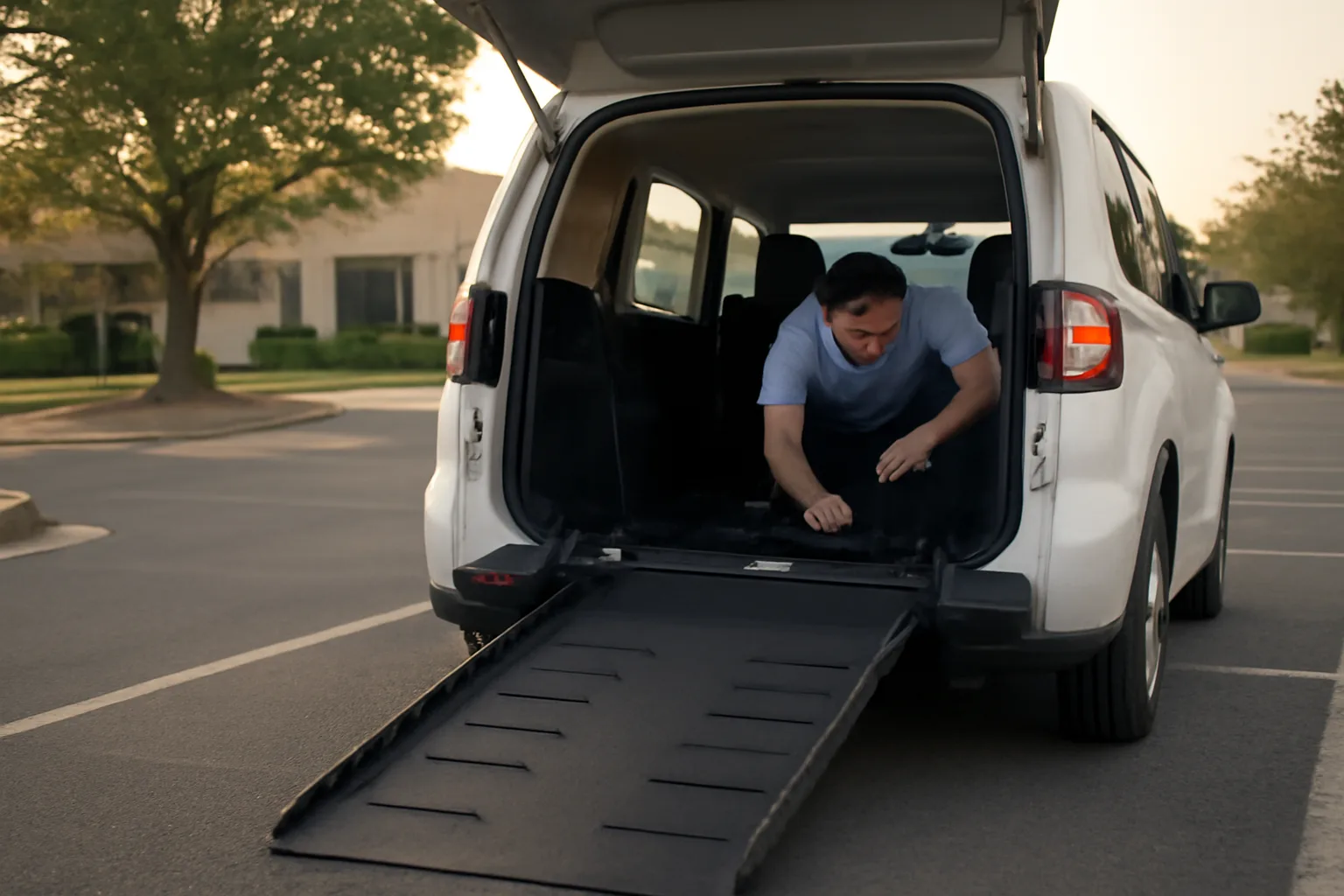
Wheelchair-accessible vans used for Medicaid NEMT generally need a functioning wheelchair lift or ramp, a four-point (or better) wheelchair securement system, and passenger restraints that meet the vehicle's original equipment or a certified conversion standard. Federal Motor Vehicle Safety Standard 222 governs wheelchair securement and occupant restraint systems in vehicles used for people who remain seated in their wheelchairs during transport [4]. Most state Medicaid transportation units and brokers also require an annual (sometimes semi-annual) vehicle inspection covering the lift mechanism, tie-downs, interior cleanliness, and signage. Vehicle age limits are common too; some states or brokers cap vehicle age at 8 to 10 years or a mileage threshold, though the exact cutoff varies enough that you need to confirm it directly with your broker and state Medicaid agency rather than assume a national standard. Don't buy a van and then go looking for compliance information. Get the spec sheet from your target broker first (lift weight capacity, tie-down count, interior camera requirements if any) and buy or convert to that spec. Retrofitting a van that fails inspection costs far more than getting it right the first time.
How do state Medicaid agencies and brokers actually differ in the enrollment process?
State Medicaid provider enrollment and broker credentialing are two separate gates, and conflating them is the most common early mistake. State Medicaid provider enrollment gives you a provider number and puts you in the state's system as an eligible NEMT vendor. It's governed by state Medicaid rules, and federal guidance requires states to maintain a provider enrollment process, sometimes with an application fee, for anyone billing the program [5]. This step is usually done through the state Medicaid agency's own portal or paper application, and fees (if any) are typically nominal, sometimes under $100, though some states charge a periodic revalidation fee. Confirm current fees with your state Medicaid agency. Broker credentialing is a private contractual process. Modivcare, MTM, Access2Care, and SafeRide each run their own onboarding portal, background check vendor, and insurance verification process, layered on top of (not instead of) your state enrollment. A broker can decline to credential you even if your state Medicaid enrollment is active, because broker contracts include their own minimum standards (vehicle age, service area coverage, driver ratios) that go beyond the state's baseline. The practical upshot: you need both, in that order, and you should expect the broker's paperwork to be more granular and more frequently updated than the state's. For details on broker-specific onboarding, see non emergency medical transportation and non emergency medical transportation services.
What insurance do I need before I can be credentialed?
At minimum, expect to carry commercial auto liability insurance (personal auto policies exclude for-hire passenger transport) and general liability coverage. Wheelchair-van operators typically need higher liability limits than standard sedan NEMT because of the added risk of transporting a passenger who can't self-evacuate in an emergency; limits commonly cited by brokers run from $1 million to $1.5 million combined single limit, but this is set by the broker contract and sometimes by state insurance minimums for commercial passenger vehicles, so confirm the exact number with your broker and your state's department of insurance before you bind a policy. Some brokers also require workers' compensation coverage if you have any employees (more than yourself as an owner-operator), and some require a named-insured endorsement listing the broker as an additional insured on your policy. Don't wait until credentialing week to shop insurance. Wheelchair-van commercial policies take underwriting time, and some carriers want to see your driver's MVR and the vehicle's VIN before quoting.
How long does it actually take to get up and running?
There's no single national timeline, and anyone who quotes you an exact number of days for every state is guessing. What's true across most states: business entity formation takes days, Medicaid provider enrollment can take anywhere from a couple of weeks to a few months depending on the state's application backlog, and broker credentialing (once your Medicaid enrollment is active) typically adds several more weeks for background checks, vehicle inspection scheduling, and insurance verification. The biggest hidden delay is usually vehicle inspection scheduling and driver background check turnaround, not the paperwork itself. If you're on a tight timeline, start your Medicaid provider enrollment and your insurance quote process on the same day, and don't wait for one to finish before starting the other. A $199 one-time State + Broker NEMT Launch Kit style document set (a compiled checklist mapped to your specific state and target broker) can save real time here, mainly because it tells you which of the two dozen documents brokers commonly ask for actually applies in your state, instead of you calling three different broker reps to find out. It won't get you approved faster than the state or broker's own processing time allows, and it's not a substitute for confirming current requirements directly with them.
What mistakes shut down new NEMT applications before they start?
The single biggest one: buying a vehicle before confirming broker specs. A used minivan conversion that looked fine on paper can fail lift-capacity or tie-down-count requirements, and now you're paying for a second conversion. The second most common: assuming Medicaid enrollment and broker credentialing are the same application. They're not, and submitting to the broker before your state provider number is active just gets your file sent back. Third: underestimating insurance lead time. Wheelchair-van commercial policies with the liability limits brokers require aren't always same-day quotes, especially for a brand-new operator with no claims history. Fourth: skipping driver training documentation. Even if you're the only driver, brokers want to see dated certificates for passenger assistance and wheelchair securement training, more than a verbal assurance that you know how to strap a chair down. None of these mean you can't get approved. They mean the order you do things in determines whether you're driving paying trips in two months or six.
Frequently asked questions
How to start a medical transportation business from scratch?
Form your business entity, confirm which broker or state agency manages NEMT in your county, enroll as a Medicaid provider with your state Medicaid agency, get a compliant vehicle inspected and insured, then apply for broker credentialing (Modivcare, MTM, Access2Care, SafeRide, or your regional equivalent). Confirm the exact document list and fees with your state Medicaid agency and target broker, since both vary by state.
Does Medicaid cover ambulance rides?
Yes, emergency ambulance transport is a mandatory Medicaid benefit in every state. Non-emergency ambulance transport for stretcher patients who need medical monitoring is billed separately from routine NEMT and requires EMS licensure, which is a different regulatory path than wheelchair-van or sedan NEMT.
What is NEMT?
NEMT stands for non-emergency medical transportation: rides to and from covered medical appointments for Medicaid (and some Medicare Advantage) members who have no other transportation and don't need ambulance-level clinical care. States must guarantee this transportation under 42 CFR 431.53, and most deliver it through contracted brokers.
Does Medicare cover medical transportation?
Original Medicare covers ambulance transport only when medically necessary and other transport would endanger the patient. It generally does not cover routine NEMT rides to a doctor's office. Some Medicare Advantage (Part C) plans add a limited number of NEMT trips per year as a supplemental benefit, often through the same brokers used for Medicaid.
How to start a NEMT business as a new owner-operator?
Enroll with your state Medicaid agency first, then get broker-credentialed. In between, get your vehicle inspected to broker specs, bind commercial auto and general liability insurance, and complete required driver training (passenger assistance, wheelchair securement). Doing broker credentialing before state enrollment is the most common reason applications get bounced back.
How do you start a medical transportation business with no experience in healthcare?
You don't need a healthcare background. You need a clean business entity, Medicaid provider enrollment, a compliant vehicle, commercial insurance, and completed driver training. Brokers care about your background check, insurance, and vehicle compliance, not prior clinical experience.
What is non-emergency medical transportation exactly?
It's Medicaid-funded (and sometimes Medicare Advantage-funded) transportation to medical appointments for people who have no other way to get there and don't require emergency or clinically monitored transport. It covers everything from wheelchair vans to ambulatory sedans and, in rural areas, sometimes mileage reimbursement for a volunteer driver.
How to start a medical transportation business with one van?
One van is enough to start; the same enrollment, credentialing, insurance, and training requirements apply as they would for a fleet. The practical limits are trip capacity and broker on-time/acceptance-rate requirements, since a single vehicle down for maintenance means zero trips that day. Ask your broker about minimum acceptance thresholds before signing.
How to start a non-emergency medical transportation business in a rural area?
The core steps are the same (state enrollment, broker credentialing, vehicle compliance, insurance) but rural areas sometimes have different broker coverage zones or a state-run program instead of a broker. Confirm with your state Medicaid transportation unit whether your county is broker-managed or state-managed before applying.
Do I need a certificate of need to start a Medicaid NEMT business?
Some states require a certificate of need or a separate state-level NEMT operating permit before or alongside Medicaid provider enrollment; others don't. This varies enough by state that you need to confirm directly with your state Medicaid agency rather than assume it does or doesn't apply to you.
What insurance limits does a wheelchair van need for Medicaid NEMT?
Brokers commonly require higher commercial auto liability limits for wheelchair vans than for ambulatory sedans, often cited in the $1 million to $1.5 million combined single limit range, but the exact figure is set by broker contract and state insurance rules. Confirm the specific limit with your broker and your state's department of insurance before binding a policy.
Can I get Medicaid NEMT broker credentialing without state Medicaid enrollment first?
No. Brokers bill the state Medicaid agency on your behalf, so they require an active state Medicaid provider number before they'll credential your vehicle or drivers. Submitting a broker application before your state enrollment is active is one of the most common reasons new applications stall or get rejected.
Sources
- Medicaid.gov, Non-Emergency Medical Transportation: NEMT is transportation for Medicaid beneficiaries who need to get to and from medical services and have no other means of transportation
- 42 CFR 431.53, Assurance of Transportation: State Medicaid agencies must ensure necessary transportation for beneficiaries to and from Medicaid providers
- 42 CFR 410.40, Coverage of Ambulance Services: Medicare covers ambulance transportation only when medically necessary and other transportation would endanger the patient's health
- National Highway Traffic Safety Administration, FMVSS 222: Federal standard governing wheelchair securement and occupant restraint systems for vehicles transporting passengers seated in wheelchairs
- Medicaid.gov, Provider Enrollment Application Fee: States maintain a Medicaid provider enrollment process, sometimes including an application fee, for entities that bill the program
- 49 CFR Part 37, Transportation Services for Individuals with Disabilities (ADA): Federal ADA transportation regulations set accessibility requirements for vehicles and services used to transport individuals with disabilities