Last updated 2026-07-25
TL;DR
Access2Care is a NEMT broker that some state Medicaid agencies and managed care plans hire to schedule non-emergency medical transportation. To haul Medicaid members for Access2Care you generally need your own state Medicaid transportation enrollment first, then a separate broker credentialing application with vehicle inspections, driver background checks, and insurance minimums. Confirm exact steps with your state Medicaid transportation unit and Access2Care directly, since requirements vary by state and change over time.
What is Access2Care and how is it different from Medicaid?
Access2Care is a transportation management company. It contracts with state Medicaid agencies, managed care organizations, and health plans to coordinate non-emergency medical transportation (NEMT) for members who need rides to dialysis, physical therapy, chemo, or routine doctor visits. Access2Care doesn't run the vehicles itself in most markets. It builds a network of transportation providers, wheelchair van operators, sedan services, and ambulance companies, then dispatches rides to whichever provider is credentialed, available, and closest. This matters because Access2Care isn't Medicaid. Medicaid is the government health insurance program that pays for the ride under federal and state rules. Access2Care is the middleman a state hires to manage logistics so the Medicaid agency doesn't have to run its own call center and dispatch system. Other brokers doing similar work in different states include Modivcare, MTM, and SafeRide Health. Some states run NEMT in-house through regional transportation authorities instead of using a broker at all, so the first thing to check is whether your state even uses Access2Care. Federal Medicaid rule requires states to ensure NEMT is available to eligible beneficiaries who have no other way to get to covered services. That obligation is spelled out at 42 CFR 431.53, which says states must "ensure necessary transportation for beneficiaries to and from providers" [1]. States satisfy that duty differently: some do it themselves, some pay counties, and many contract it out to brokers like Access2Care.
What is NEMT and how does it differ from an ambulance ride?
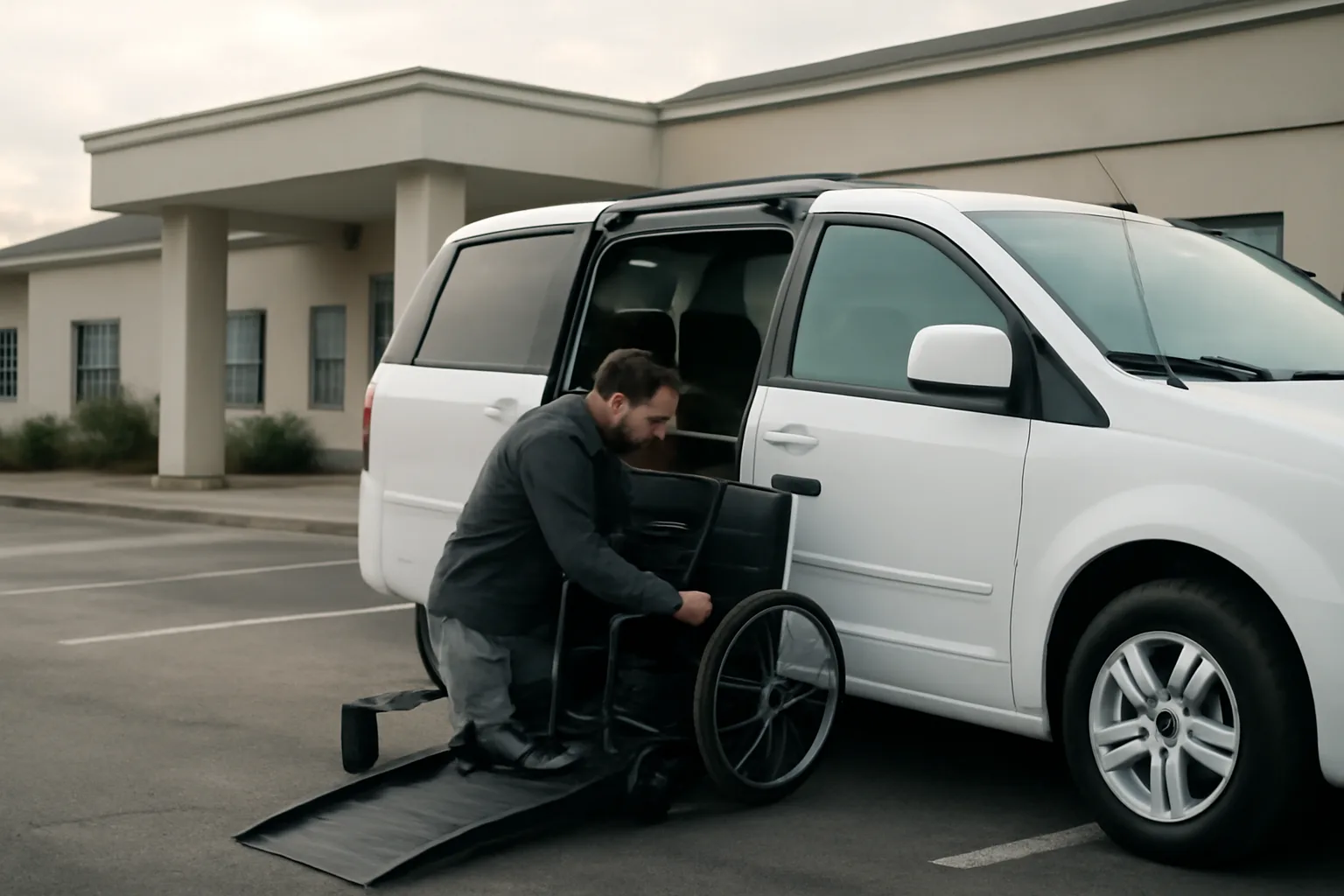
Non-emergency medical transportation (NEMT) is scheduled transport to a covered medical service for someone who isn't having a medical emergency but can't get there on their own, whether that's because of a wheelchair, a walker, dialysis-related fatigue, or no working vehicle. It covers wheelchair van trips, ambulatory sedan trips, and stretcher van trips. It does not cover 911 emergency ambulance response, which is a separate benefit with its own billing codes and its own provider enrollment path. The federal Medicaid statute distinguishes NEMT as an administrative or optional benefit depending on how a state elects to structure its program, while emergency ambulance transport is billed as a medical service under a different provision. CMS describes NEMT plainly on its own guidance pages as transportation "to and from medical appointments" for people who need it and have no other means [2]. If you're buying a wheelchair van, you're in the NEMT lane, not the ambulance lane. Ambulance companies need EMS licensure through the state health department, ambulance service permits, and NREMT-certified staff. NEMT wheelchair van operators generally do not need EMT-level staff, but they do need driver training on securing wheelchairs, passenger assistance, and often a state-specific NEMT vehicle permit or livery registration. Don't confuse the two credentialing tracks when you're calling state offices, because you'll get sent to the wrong department.
Does Medicaid cover ambulance rides?
Yes, Medicaid covers ambulance transportation when it's medically necessary, but the coverage rules and payment rates are set state by state within federal minimums. CMS confirms that ambulance services are a covered Medicaid benefit and that states set their own rates and prior authorization rules within federal guidelines [2]. Coverage generally requires that the trip be to the nearest appropriate facility and that a lower level of transport (like a wheelchair van) wouldn't have been safe or adequate. That's a different reimbursement and enrollment path than wheelchair van NEMT. Ambulance providers bill Medicaid directly (or through a broker in some states) using ambulance-specific HCPCS codes, and they need state EMS licensure first. If your business plan is strictly wheelchair van and ambulatory rides, you don't need to chase ambulance licensure, and you shouldn't, because it triggers a much heavier regulatory lift (EMT staffing, medical director sign-off in some states, ambulance vehicle standards under state EMS codes).
Does Medicare cover medical transportation?
Original Medicare covers emergency ambulance transportation and, in limited circumstances, non-emergency ambulance transportation when a doctor certifies it's medically necessary and documents that requirement in writing. Medicare.gov states that Medicare Part B covers ground ambulance transportation "when other transportation could endanger your health" and that non-emergency ambulance trips need a written order from your doctor confirming medical necessity [3]. Medicare generally does not cover routine non-emergency wheelchair van or sedan NEMT the way Medicaid does. Some Medicare Advantage plans offer supplemental transportation benefits, and those are administered by the plan, not traditional Medicare. If you want a piece of that market, you'd be credentialing with the Medicare Advantage plan's transportation vendor (which is sometimes the same broker, like Access2Care handling MA plan rides in a given region), not with CMS directly. For a new wheelchair-van operator, Medicaid is almost always the bigger and more accessible payer. Medicare Advantage supplemental transportation is worth asking about once you're established, but it's not usually where a first contract comes from.
How do you start a medical transportation business?
Starting a medical transportation business, specifically a wheelchair van NEMT operation, generally follows the same skeleton in every state, even though the paperwork and agency names differ. First, form your business entity (LLC is standard) and get an EIN from the IRS. Second, get commercial auto insurance sized for a wheelchair-accessible vehicle; NEMT insurance minimums are usually well above personal auto minimums and some states set a specific combined single limit for livery or NEMT vehicles. Third, get your vehicle inspected and permitted as a for-hire or NEMT vehicle through your state DMV or department of transportation. Fourth, enroll as a Medicaid transportation provider with your state Medicaid agency (this is separate from broker credentialing and usually has to happen first, since brokers typically require an active state Medicaid provider number before they'll even open your application). Fifth, apply for broker network credentialing with whichever broker (Access2Care, Modivcare, MTM, SafeRide) manages NEMT dispatch in your state or region. Each of those five steps has its own document list: articles of organization, EIN letter, certificate of insurance, vehicle inspection report, driver background check results (often a state-specific criminal history and sex offender registry check), driver's license history, drug test results, and CPR/first aid certification. States vary on which of these are mandatory. For a full map of what individual states require for provider enrollment, see medical transportation and NEMT provider guides broken out by state.
How do I get credentialed with Access2Care specifically?
Access2Care runs its own transportation provider network application, separate from your state Medicaid enrollment. The exact process differs by the state or health plan contract Access2Care is operating under in your area, but the general shape is consistent across brokers in this industry. You'll typically need: an active state Medicaid provider enrollment (or in some markets, enrollment with the relevant managed care organization), a copy of your NEMT vehicle permit or livery registration, proof of commercial auto insurance meeting the broker's stated minimum (this number varies widely by state and broker contract, so get it in writing rather than assuming a figure), vehicle inspection documentation showing your wheelchair lift or ramp meets ADA tie-down standards, driver background checks and MVR pulls for every driver you intend to run under the contract, and often a facility or dispatch capability questionnaire showing you can actually field calls and dispatch during the hours the broker requires. Access2Care, like other brokers, periodically opens and closes its network to new providers depending on rider demand and existing provider capacity in a given county. That means credentialing isn't just paperwork, it's also timing. Call the broker's provider relations line for your state directly and ask whether the network is open before you spend money getting vehicles inspected. Because broker credentialing steps and document lists change over contract cycles, confirm the current requirements with Access2Care and your state Medicaid transportation unit before you submit anything.
How to start a NEMT business with one van
One van is a completely normal way to start, and plenty of NEMT owner-operators run solo for years before adding a second vehicle. The credentialing process doesn't really change based on fleet size, a one-van operation goes through the same state Medicaid enrollment and broker application as a ten-van company. What changes is your operational math: you need backup coverage (who drives if you're sick), and you need honest bandwidth about how many broker networks you can service well with one vehicle. A one-van operator should pick a lane early: focus on one broker relationship or one county's demand rather than trying to credential with every broker in the state at once. Credentialing applications take real hours to assemble (insurance certificates, driver packets, vehicle inspection scheduling), and juggling three broker applications simultaneously with one van and no office staff usually means all three move slowly. Practical order of operations for a one-van start: get the vehicle inspected and permitted first, since brokers and Medicaid enrollment both ask for that documentation. Get your commercial NEMT insurance policy bound next; it's the single line item that other approvals wait on. Then file state Medicaid provider enrollment. Then apply to the broker (or brokers) operating in your county. See NEMT transportation and non emergency medical transportation services for state-by-state enrollment portal links.
What documents does Access2Care (or any broker) usually require?
| State Medicaid provider enrollment confirmation | Brokers generally require you to already be an enrolled Medicaid transportation provider before they'll credential you | |
|---|---|---|
| Certificate of commercial auto insurance | Confirms coverage meets broker/state minimum liability limits for passenger transport | |
| Vehicle inspection / NEMT vehicle permit | Confirms wheelchair lift, ramp, and tie-downs meet safety standards | |
| Driver background check (criminal history, sex offender registry) | Required before a driver can transport Medicaid members | |
| Motor vehicle record (MVR) pull | Screens for disqualifying driving violations | |
| Drug and alcohol testing results | Many states and brokers require pre-employment and random testing programs | |
| CPR/First Aid certification | Common driver qualification requirement | |
| W-9 and business entity documents | Needed for payment setup and 1099 reporting | Confirm the current, exact list with Access2Care's provider relations team for your state and with your state Medicaid transportation unit, since some states add extra requirements like defensive driving courses or passenger assistance training modules. |
Below is the document list that shows up across most NEMT broker credentialing applications, based on the standard components state Medicaid transportation programs and brokers describe in their provider manuals. Treat this as a checklist to prepare, not a guarantee of what Access2Care specifically will ask for in your state. | Document | Why brokers ask for it |
How do you start a non-emergency medical transportation business (state-by-state differences)?
The steps are the same nationally, but the agency names and specific thresholds differ enough that you can't run a single national checklist. Some states enroll NEMT providers directly through the Medicaid agency's own portal. Others require enrollment through a managed care organization first. A growing number of states use a single statewide broker (Access2Care in some, Modivcare or MTM in others) and route all new-provider applications through that broker rather than the state agency directly. Insurance minimums differ by state too. Some states specify a combined single limit for NEMT vehicles in state administrative code; others defer entirely to whatever the broker contract requires. Vehicle inspection standards likewise vary: some states require annual state DOT inspections specific to wheelchair-accessible vehicles, others fold it into a general livery inspection. Because of this variation, the only reliable move is to start with your own state Medicaid transportation unit's website and NEMT provider manual, then cross-check with whichever broker operates in your state. CMS's Medicaid Non-Emergency Medical Transportation guidance page is a reasonable starting index for understanding the federal baseline before you drill into your state's specific program [2]. For state-specific walkthroughs, see non emergency medical transportation and the NEMT hub.
What insurance and vehicle standards does Access2Care expect?
Wheelchair-accessible vehicles used for NEMT need to meet accessibility standards that track back to the Americans with Disabilities Act, and brokers typically require proof the vehicle's lift, ramp, and securement system are functioning and inspected. The Department of Transportation's ADA regulations for transportation vehicles, at 49 CFR Part 38, set the technical specifications for lifts, ramps, and securement systems that accessible vehicles must meet [4]. Commercial auto liability minimums for NEMT vehicles are typically well above the state's basic financial responsibility minimum for a personal vehicle, because you're carrying a vulnerable passenger population. The exact combined single limit a broker requires (commonly cited ranges in industry practice run from $500,000 to $1,000,000 combined single limit, though this varies significantly by state and broker contract) should be confirmed directly with Access2Care's provider relations office and your insurance agent, not assumed from another state's number. Don't buy a wheelchair van and then discover the insurance quote blows your budget. Get an NEMT-specific commercial auto quote before you commit to a vehicle purchase, because premiums for wheelchair vans running Medicaid trips are priced differently than a personal minivan policy.
Building the credentialing packet without wasting money
The single most common mistake new owner-operators make is spending money in the wrong order: buying the van first, then discovering the insurance minimum is higher than expected, then discovering the broker network is closed in their county, then discovering state Medicaid enrollment takes six to ten weeks to process. Sequence matters more than speed here. A workable order: confirm your state's Medicaid NEMT enrollment path and broker (if any) before buying a vehicle. Get an insurance quote for the specific van model you're considering. Confirm the broker's network status for your county. Only then close on the vehicle purchase. This is the exact gap the $199 RideCredential State + Broker NEMT Launch Kit is built to close: a state-by-state and broker-by-broker checklist of what Medicaid enrollment and broker credentialing (Access2Care, Modivcare, MTM, SafeRide) actually require, so you're not guessing which office to call first or discovering a document requirement after you've already bought the van. It doesn't replace confirming specifics with your state Medicaid agency and broker, and it doesn't promise approval; it's a document-prep tool, not a guarantee.
What happens after you're credentialed?
Once you're enrolled with the state and credentialed with the broker, Access2Care (or whichever broker you're working with) starts routing trip assignments to you through its dispatch system, usually a mobile app or a driver portal. You'll typically get paid on a per-trip rate set by the broker contract, on a payment cycle the broker defines (weekly or biweekly is common in this industry, though terms vary by contract). Credentialing isn't a one-time event either. Brokers and state Medicaid programs require periodic re-verification: insurance certificates lapse and need renewal, vehicle inspections are usually annual, and driver background checks often need refreshing on a set schedule (commonly annual, though this varies). Build a simple renewal calendar the day you get approved so you don't get suspended from the network for a lapsed document six months in. For broader background on how NEMT fits into the Medicaid transportation system and how emergency versus non-emergency transport differ operationally, see NEMT and emergency medical transport.
Frequently asked questions
What is NEMT?
NEMT (non-emergency medical transportation) is scheduled transport to and from covered medical appointments for people who aren't having an emergency but can't get there on their own, often due to a wheelchair, walker, or lack of a vehicle. Medicaid covers it as a benefit ensuring beneficiaries can reach services, per 42 CFR 431.53 [1].
Does Medicaid cover ambulance rides?
Yes. Medicaid covers medically necessary ambulance transportation, with states setting their own rates and prior authorization rules within federal guidelines, according to CMS [2]. This is separate from routine wheelchair van NEMT and requires EMS licensure, not standard NEMT vehicle permitting.
Does Medicare cover medical transportation?
Medicare Part B covers emergency ambulance transport and limited non-emergency ambulance transport with a doctor's written order confirming medical necessity, per Medicare.gov [3]. Original Medicare generally doesn't cover routine wheelchair van or sedan NEMT; some Medicare Advantage plans offer supplemental transportation benefits instead.
How do I start a NEMT business with just one van?
Get your vehicle inspected and permitted, bind NEMT-specific commercial auto insurance, enroll as a state Medicaid transportation provider, then apply to whichever broker (Access2Care, Modivcare, MTM, SafeRide) operates in your county. One-van operators go through the same credentialing steps as larger fleets, just with less admin bandwidth to run multiple broker applications at once.
Is Access2Care the same thing as Medicaid?
No. Access2Care is a transportation broker that states and health plans hire to schedule and dispatch NEMT rides. Medicaid is the government insurance program that actually pays for the trip under federal rules set out in 42 CFR 431.53 [1]. You typically need Medicaid provider enrollment before you can credential with the broker.
How long does Access2Care credentialing take?
There's no single published timeline, since it depends on the state, whether the broker's network is currently open, and how complete your documents are. Insurance certificates, vehicle inspections, and background checks each have their own processing time. Call the broker's provider relations line for your state to get a current estimate before assuming a timeframe.
What insurance do I need to drive for Access2Care?
Commercial auto liability insurance sized for passenger transport, typically well above personal auto minimums. Exact combined single limits vary by state and broker contract; confirm the current minimum directly with Access2Care provider relations and your insurance agent rather than assuming a figure from another state.
How do you start a medical transportation business from scratch?
Form an LLC and get an EIN, secure NEMT-rated commercial auto insurance, get your wheelchair van inspected and permitted through your state DMV or DOT, enroll as a Medicaid transportation provider with your state agency, then apply for broker network credentialing (Access2Care, Modivcare, MTM, or SafeRide, depending on your state).
Do I need an EMT license to drive a wheelchair van for Medicaid?
No. Wheelchair van NEMT drivers generally don't need EMT certification; that's required for ambulance-level transport, which is a separate licensing track through state EMS agencies. NEMT drivers typically need a clean driving record, background check clearance, and often CPR/First Aid certification, but not paramedic or EMT credentials.
Can I work with more than one broker at the same time?
Often yes, since brokers operate in different counties or serve different managed care plans within a state, and nothing generally stops a credentialed provider from holding multiple broker contracts. New one-van operators usually do better focusing on one broker relationship first, since juggling multiple credentialing applications with limited staff tends to slow all of them down.
What's the difference between state Medicaid enrollment and broker credentialing?
State Medicaid enrollment makes you an approved Medicaid transportation provider under the state's rules; broker credentialing is a separate application with a company like Access2Care that dispatches trips to enrolled providers. Most brokers require active state Medicaid enrollment before they'll even open your credentialing file.
Where can I check if Access2Care operates in my state?
Check your state Medicaid agency's transportation unit page and CMS's Medicaid NEMT guidance page first [2], then contact Access2Care's provider relations department directly, since broker contracts change and a broker operating in a state one year may not hold the contract the next.
Does starting a NEMT business guarantee broker approval?
No. Completing state Medicaid enrollment and submitting a broker application doesn't guarantee network acceptance; brokers periodically close networks in certain counties based on existing provider capacity and rider demand. Confirm network status with the broker before investing in vehicle inspections or finalizing a purchase.
Sources
- Code of Federal Regulations, 42 CFR 431.53: States must ensure necessary transportation for Medicaid beneficiaries to and from providers
- CMS, Medicaid Non-Emergency Medical Transportation: NEMT and ambulance transportation are covered Medicaid benefits with state-set rates and rules
- Medicare.gov, Ambulance Services coverage: Medicare Part B covers emergency and, with a doctor's written order, non-emergency ambulance transportation
- 42 U.S.C. 1396a(a)(4), Medicaid state plan requirements: Federal Medicaid statute requires state plans to provide for methods of administration, including transportation, necessary for proper and efficient operation
- Code of Federal Regulations, 49 CFR Part 38: DOT regulations specify accessibility standards for lifts, ramps, and securement systems in transportation vehicles
- Code of Federal Regulations, 42 CFR 440.170: Federal regulation defines transportation as a Medicaid service states may cover, including expenses for transportation and other related travel expenses